
Industry 5.0, the factory of the future puts man back at the centre
An Italia project shows how AI can improve working conditions and productivity. But only if combined with human values and training

What if instead of imagining the future we tried to build it? What if, instead of giving in to the market and the new powers, we put the individual and his hopes back at the centre? What if we redesigned industry, products and digital services around man and his well-being?
In the face of such complex challenges, we Europeans have an advantage: we live on the only continent where these questions can still be thought about, formulated, discussed. And become concrete experiments.
By making the workers of a Japanese multinational company wear special sensors and rethinking production processes on the basis of the data collected - after analysing them with an AI algorithm that took two years of research and development - a group of researchers from the University of Trento led by Professor Francesco Pilati managed to reduce the fatigue experienced by workers by 30% and at the same time increase company productivity by 15%.
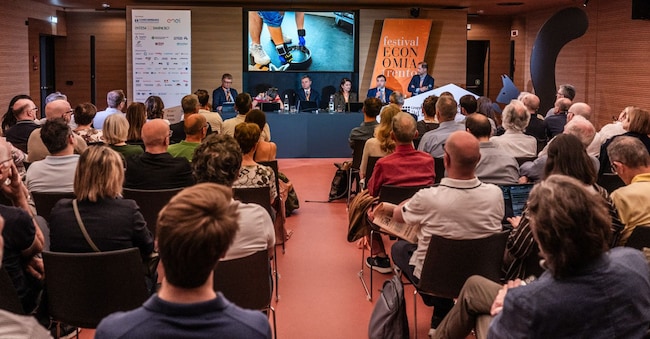
This piece of the realised future was the focus of the meeting 'The factory of the future: new technologies and human well-being' at the Trento Festival of Economics. An opportunity to try to trace a possible 'European way' to artificial intelligence. "We are moving," explained Alessandro Pegoretti, director of the department of industrial engineering at UniTrento, "to the paradigm of Industry 5.0 which, after the push for digitalisation implemented with Industry 4.0, tries to put the person, the human being and the sustainability of production processes and products back at the centre.
Marco Gay, executive chairman of ZEST, the first Italian group with a European dimension dedicated to the growth of the innovation ecosystem, recalled the data that snapshot the adoption of AI in Italia. In 2025, 16.4% of companies with 10 or more employees used at least one artificial intelligence technology, a percentage that rises to 53.1% among large companies. The world of start-ups is particularly dynamic: '30% of those in our portfolio,' Gay explains, 'have launched AI projects, which have raised capital of 25 million euro.


