
Defence industry, Crosetto: 'It's expensive, it's slow. First they saw the money, then they gave the camel. Now we need a cultural change'
Conference in Rome on defence and security in an unstable world. Focus on emerging domains, between space and underwater

Key points
- Crosetto: 'The Italian defence industry is expensive, and slow'
- Minister: 'Mentality must change'
- Valensise: 'There is a need to talk about defence in realistic terms'
- Annunziata: "The war between Russia and Ukraine a laboratory of how new technologies intertwine with the traditional"
- Cascio: 'Strengthening the European defence pillar within the NATO framework'
- Mannino: "The US won't let us down"
- Benigni: "We are at the heart of hybrid warfare, the difference between civil and military is blurred"
- Catalano: "Today those on board the combat vehicle do not see the drone coming"
- Cossiga: "Industry will change faster than administration"
- Salamone: "Space economy in strong growth, Italy in third place for contributions to Esa"
- Folgiero: "Fincantieri works to put Safe in the EU to good use"
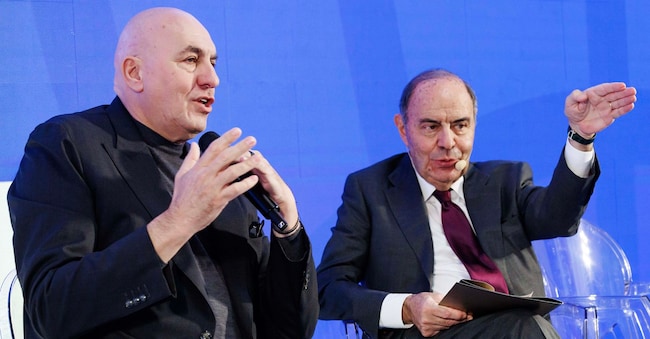
In a context where security threats take shape with extreme speed, with the consequence that responses and reactions need to be deployed very quickly, the defence industry is called upon to provide adequate tools in the shortest possible time. "Italian defence has one of the highest levels of technology in the world. But it has all the shortcomings of all defence industries in the world," stressed Defence Minister Guido Crosetto, speaking on Thursday 29 January in Rome, at Palazzo Sciarra Colonna, at the first edition of the Forum Difesa, the initiative promoted by Bruno Vespa and Comin & Partners in collaboration with the Istituto Affari Internazionali (IAI).
Crosetto: 'Italy's defence industry is expensive, and slow'
"It is expensive, it is slow,' explained Crosetto. 'It is used to building, to working for an Italy, for the Armed Forces that could plan for a very long time, that were not in a hurry to receive means, and even if they received them a year later in the end it changed little, while now we are faced with the need to have the parts in time, to have parts that cost less and less, that are always more technologically advanced'. The consequence of the minister's reasoning is that 'now there will be a need to change pace' and, Crosetto stressed, 'it is accelerating. The CEO of Fincantieri, Folgiero has built changes to double production within a year, it has already increased by 40%, the same is being done by Mbda and Leonardo. All companies are doing it, I repeat with the difficulties they have'.
The minister: 'The mentality must change'
In short, Crosetto sent a clear message. Defence companies 'must change their mentality. They used to see the money, and then give the camel. Whereas private companies normally first make the camel, and then try to sell it, and take the money. Now a cultural change is needed. When scenarios change, there is no one faster than the Italians to adapt to the new scenarios. The Germans are much better than us when it comes to standardising production'.
Valensise: 'There is a need to talk about defence in realistic terms'
The meeting provided an opportunity for a discussion between institutions, companies and experts on the subject of the relaunch of defence, starting with industry and technology at the service of new geopolitical challenges. "We are tempted by a nostalgic approach to a world in which we lived for eighty years, but today this world no longer exists: we must equip ourselves to deal with a world that is, at least in part, new," began Iai president Michele Valensise. "There is a need to talk about defence in realistic terms: not just weapons and tanks, but space, satellites, energy networks. This is a fundamental step that has to do with the security of our continent. Today,' added Valensise, 'the threats are no longer hypothetical, the stuff of library researchers, but are real'. At this point, 'the imperative is to bring all aspects together: the European and the Atlantic Alliance. The European pillar must be strengthened in synergy with the US'. Alessandro Marrone, head of the Defence, Security and Space programme at the Istituto Affari Internazionali, pointed out that 'trusting the US, and therefore NATO, less does not automatically mean moving towards a European defence policy'.
Annunziata: "The war between Russia and Ukraine a laboratory of how new technologies intertwine with the traditional ones"
Gianfranco Annunziata, Chief of General Counsel to the Chief of Defence Staff, highlighted the problem of integration between emerging and traditional technologies. "The war between Russia and Ukraine," he said, "is for us a laboratory of how new technologies are intertwined with traditional ones. The Ukrainians are integrating a traditional capability with new technologies: this is the case with drones. At present they are the best at it. Naval drones have hit the Russian fleet heavily in the Black Sea', On the land front, the pattern is that of 'small units moving supported by drones. The front line becomes wider, more porous. Drones make it possible to deploy fewer men, which is crucial for the Ukrainians'.


