
Defence industry, Pontecorvo (Leonardo): 'It is a time when it is difficult for everyone to choose what to do'
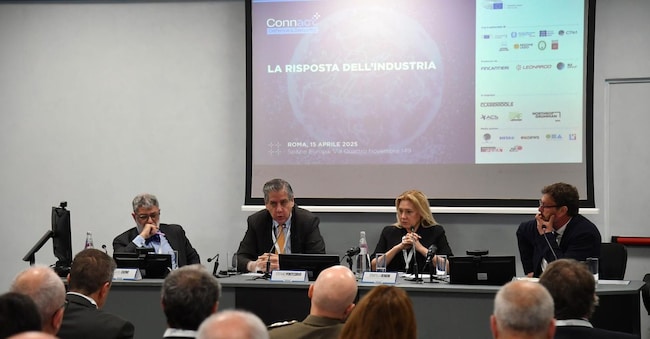
The company's chairman spoke at the Connact Defence & Security 2025 conference, entitled 'Common European Defence: Financing and Industrial Integration': 'There is a need for clear rules, funding is there because the demand is there... We have about a thousand products in our portfolio. Too many. We are concerning the relationship with our suppliers. We could double production tomorrow, but there is a lack of manpower Defence'.

6' min read
Key points
- Pontecorvo (Leonardo): we need certain standards and contracts, change paradigm Defence
- "It is a time when it is difficult for all of us to choose what to do, however; no one has a crystal ball.
- "We have about a thousand products in our portfolio. Too many. We are affecting the relationship with our suppliers' .
- "Supply chain is a largely underestimated problem"
- "We could double production tomorrow, but there is a lack of defence manpower"
- Cucino (Fincantieri): with EU plan quality leap, now Defence regulatory framework
6' min read
The game that the European Union is being called upon to play in terms of defence investment must be played in a way that is complementary to the efforts and 'capability targets' defined by NATO, as, moreover, reiterated between the lines in the new White Paper. Beyond funding, which promises to be substantial, the industry is asking for long time horizons, long-term planning and, of course, certainty of resources. This was the message launched at the Connact Defence & Security 2025 conference, entitled 'Common European Defence: Financing and Industrial Integration', held at Spazio Europa in Rome. Above all, less bureaucracy is needed. 'We needed six months to obtain four authorisations,' recalled Stefano Pontecorvo, president of Leonardo, in his speech. 'Do they ruin our lives? No, they delay us. They are bureaucratic sticks that the industry of now does not need'.
Pontecorvo (Leonardo): we need a clear regulatory framework and contracts, change paradigm Defence
The starting question, the red thread that accompanied the debate. was 'what does the defence industry need? Pontecorvo had his say: 'it needs clear rules, funding is there because the demand is there.... What I realised about the new financial instruments is that a large part is debt. And I realise that for a country like ours, any country, making the distinction between social spending and security spending is not always an easy arbitrage. We have heard what Minister Giorgetti said, on the other hand it is agreeable.... I believe,' Pontecorvo continued, 'that the defence industry must help to make a paradigm shift, that is, defence yes, but we are talking about security of which defence is a part'.
"When you are in a crisis situation, you have to be able to compact the home front as well, and the home front compacts if your critical infrastructure, your global data and so on are defended. And so Leonardo is equipping itself from this point of view, and it is equipping itself trivially by strengthening our cyber capacity. Few people know this,' the company chairman emphasised, 'Leonardo is also an excellence in cyber, we do, we provide cyber security to the European Union, to parts of NATO, to the ESA, i.e. international bodies that can choose anywhere and have crazy pressure to choose anywhere, they choose Leonardo, so we do our own... But we are also moving into the security domain, and the security domain is defended not only with tanks and everything else, but with the use of enabling technology that allows us to safeguard our infrastructure as well. Perhaps it is a strange speech to hear from the president of Leonardo, of Leonardo, but we see beyond the challenge of pure defence,' the Leonardo president added.
"It is a time, however, when it is difficult for all of us to choose what to do, nobody has a crystal ball.
In his speech, Pontecorvo emphasised that 'we need a certain regulatory framework and contracts, at a time when it is, however, difficult for all of us to choose what to do, because an aircraft that has to come on line in 2035, ten years from now, will it be a pilot or an unmanned aircraft? A ship that has to come on line, because how long does it take you? Eight years to build? No, more or less. Five years from now. What is it? A traditional design must invest in safety and must invest in research and development. At Leonardo, out of over 17 billion in turnover since last year, we have invested a clean 2.5 billion in research and development. But nobody has a crystal ball. Surely all this must be cyber secure, first, and second multi-domain. What does that mean? That everyone talks to everyone. The wagon through satellite connections talks to the helicopter, the helicopter talks to its ship and ours. This is a quantum balance for defence, and part of that is also the concept of being able to secure, in the sense of securing, all our infrastructures'.
"We have about a thousand products in our portfolio. Too many. We are concerning the relationship with our suppliers."
"I fear that the demand" for the defence sector "will be there for a long time," Pontecorvo confided. What will this demand be? That remains to be seen. There is an evolution within us and also in our supply chain, which is an interesting thing. We as Leonardo, and I think a bit all of us, are looking at the relationship with our suppliers, especially the larger ones, because we have about a thousand products in our portfolio. There are too many of them. Some of them are even, I don't say obsolete, because Leonardo doesn't sell obsolete things, but they have lower margins and could be done better by leaner companies'. 'What we are doing with our supply chain,' he explained, 'is to identify those who could do the entire product and subcontract, freeing up resources for us, space, financing, etc., helping our small and medium-sized companies, our human resources. We,' Pontecorvo said, 'have 4,000 in Italy and 12,000 in the world, helping them to grow as well.


