Intesa Sanpaolo – Prometeia Report

Industry set to grow slowly in 2026

Record revenue (+4.1 per cent), driven by rising share prices, but only +0.8 per cent in real terms. De Felice: “The economy is holding up well and is less vulnerable than in the past.”

3' min read

Translated by AI
Versione italiana

3' min read

Translated by AI
Versione italiana

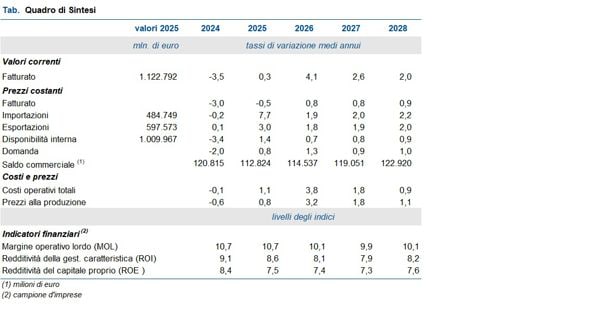
An additional 46 billion. At first glance, the figure for Italian manufacturing revenue in 2026 appears positive: a 4.1 per cent increase, representing the best performance since 2022 and an all-time high, just shy of 1,170 billion.

And yet, when moving from current figures to real figures – that is, after adjusting for inflation – the enthusiasm is tempered, as the average growth in turnover is limited to just 0.8 per cent, although this does represent the first positive sign after three years of decline.

Loading...

The latest edition of the analytical report by Intesa Sanpaolo and Prometeia on the industrial sectors presents a generally mixed picture, reflecting an external environment in which the main challenges – ranging from constraints on international trade to energy prices and their inflationary and financial repercussions – remain largely unresolved.

The figure in current values – an increase that brings the total revenue to just under 1,170 billion – represents a new all-time high, but behind this growth lies a significant inflationary component.

And whilst, with the exception of food and drink and household appliances, all the individual sectors monitored show positive figures in 2026 at current values, the picture changes when viewed at constant values. This is because the consumer goods and fashion sectors, chemical intermediates, furniture and household appliances are all in the red, alongside a wide range of sectors hovering around zero growth.
As the report explains, it is partly substitutable consumer goods that are suffering in particular, penalised by rising inflationary pressures which are eroding households’ purchasing power. Whilst investment is generally underpinning industrial demand (+3.4 per cent in the second quarter) and remains buoyed by the tail end of the National Recovery and Resilience Plan (PNRR), the resilience of household spending will be put to the test by rising prices. This weakness is evident in the limited growth of 0.4 per cent in retail sales over the first eight months of the year.

In any case, when viewed within the European context, the resilience of Italian industry has been confirmed and has even exceeded the expectations set out following the outbreak of the crisis in the Middle East. Industrial production figures show modest growth in the first eight months of the year (+0.4 per cent), a better result than that achieved by Germany and France.

“Generally speaking,” explains Gregorio De Felice, chief economist at Intesa Sanpaolo, “our economy is less vulnerable than in the past, and the growth forecast for this year, 0.8 per cent, is by no means a trivial achievement given the current context; it is, for example, higher than the average for the last 15 and even 20 years.”

Significant support is coming from exports, which have risen by two percentage points at constant prices, with overseas sales suggesting a gradual recovery in the trade balance to 123 billion euros, more than half of which is attributable to the broad mechanical engineering sector – the second-largest sector in absolute terms (177 billion in 2028), second only to the food sector.

“Export capacity,” adds De Felice, “which accounts for nearly 54 per cent of output, with SMEs taking the lion’s share. Overseas sales have grown by 216 billion over the past ten years and, during this period, have recorded growth rates well above those of Germany and France, with the quality of our products – reflected in higher unit prices – making all the difference.”

Loading...

Overall, the outlook remains uncertain, with growth prospects for the 2027–28 period below one percentage point, whilst sectors linked to investment, electrification and digital transformation are set to perform better than others. The electrical engineering, electronics and mechanical engineering sectors are therefore faring well, as are pharmaceuticals and the automotive sector, with the latter rebounding after several difficult years. By contrast, the outlook remains weak for the fashion, furniture and household appliances sectors, for which only modest increases are forecast. Pressure on household budgets – the analysts note – will also affect the food sector, for which zero growth is forecast this year and only a few tenths of a percentage point going forward. This provides a good summary of the difficulties the country is facing, with the issue of insufficient wage growth representing one of the main challenges.

As regards profit margins, the industry will remain under pressure, but its financial structure – which is more robust than in the past – allows us to view this phase with relative optimism, thanks to equity standing at just under 46 per cent of liabilities (up from 41.9 per cent in 2019) and liquidity remaining at high levels, at 9 per cent of assets. Financial reserves and own funds should therefore ensure that investment programmes can continue.


Il trend della manifattura

Rapporto Intesa Sanpaolo - Prometeia

Copyright reserved ©
Loading...

Brand connect

Loading...

Newsletter

Notizie e approfondimenti sugli avvenimenti politici, economici e finanziari.

Iscriviti