
Inhabiting the uninhabitable: architecture for social emergencies
There is a need for smart projects that respond to the emergencies of war and climate change. And some virtuous examples already exist.

According to UNHCR figures, there are more than 43 million refugees in the world today. If we add the internally displaced persons remaining in their countries, the numbers rise to over 120 million. On these already terrible statistics, the waves of new ongoing wars and climate change will crash. According to the World Bank, global warming could cause 200 million refugees by mid-century, and the status today does not even have legal recognition. These are human beings who do not know what to do, do not know where to go and above all do not know where and how to live as they try to survive the political or ecological emergency that has forced them to move. This is a huge challenge for cooperation, but it is also a huge challenge for design and architecture: to make the uninhabitable habitable.
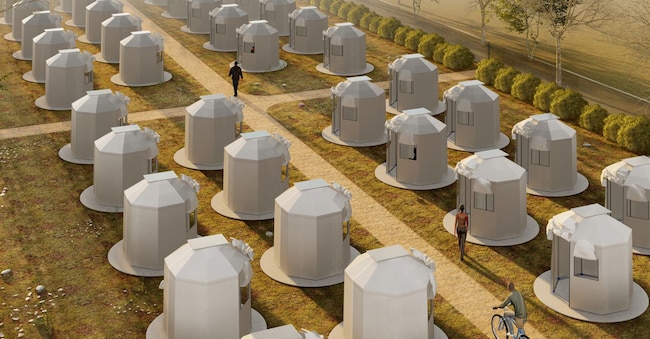
In recent years, this challenge has been taken up by innovators, foundations, architecture firms large and small, renowned or emerging, and start-ups in the global South. One of these is the Nigerian AllSpace, created by a girl named Blossom Eromosele. Her project was awarded by the Swarovski Foundation's Creatives for Our Future programme: these shelters are quick and easy to assemble in just a few hours, powered by photovoltaic panels and built from recycled and waste materials, with a design based on traditional Nigerian architecture. Costing $120 each, the first trials have already been carried out in West Africa. 'They look like typical Nigerian hexagonal rural houses,' explained Eromosele. "It is a way for people to feel at home, to recognise the place that is protecting them. The structures are modular and are also made to create community spaces where people can come together." One of the principles of AllSpace is the search for ventilation to lower the internal temperature, learnt from African vernacular architecture and essential for extreme climatic contexts. For example, in 2025 a frightening heat wave hit the temporary camps of Sudanese fleeing the civil war to Egypt, claiming nearly a hundred lives because the tents became unbearably hot.
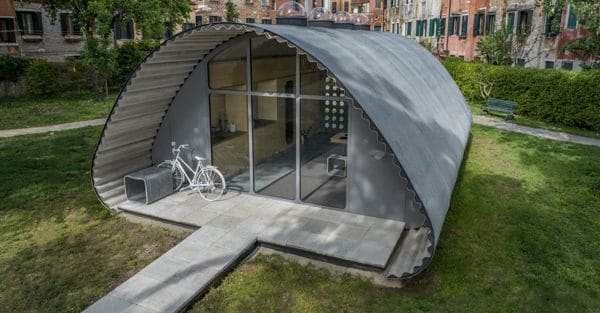
The Norman Foster Foundation has also tried to respond to this challenge, and the prototype, conceived together with the Holcim Group (a leader in sustainable construction), was presented at the Biennale Architettura 2025 and at the last 24th International Exhibition in Milan entitled Inequalities. They are called Essential Homes, they are structures that resemble igloos and do not need foundations or excavation, they have a roof made of roll-up concrete slabs, using 95 per cent less material than standard structures of this type. The panels and foam that insulate the Essential Homes allow for thermal comfort - an aspect that comes back because it is essential in these contexts -, acoustic, and energy efficiency. It was Norman Foster himself who explained the philosophy of the project, at a retrospective at the Centre Pompidou in Paris on the 50 years of his production, read through the lens of ecology: "All the ingredients of a new architecture already exist, it is their combination that creates something new and useful". In short, to do better and do it with little, with what is already there, vital characteristics to quickly meet the needs of refugees. The Essential Homes were conceived from an ecological perspective to meet the needs of victims of environmental catastrophes.
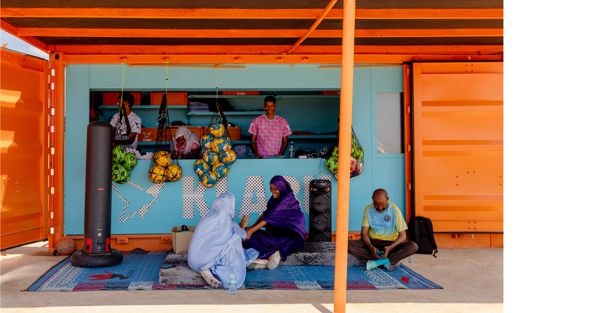
This is the same philosophy of a very young Dutch social enterprise, MVRDV, which has created Klabu. The name comes from the Swahili word for club; they are clubhouses built out of old, disused containers and designed to create sports gathering spaces in refugee camps, where there is not only a need to survive the present, but also to dream of the future. The Klabu produced by MVRDV are at the same time arenas, gyms, bars where people can listen to music and watch games together. The first were installed in the Azraq refugee camp in Jordan for Syrian refugees, then in those in Mauritania for those fleeing the Malian civil war and in Brazil, where exiles from the Venezuelan crisis found refuge. One of Klabu's objectives is to encourage the practice of sport as a means of emancipation from pain and vulnerability. Their founder Alexander Webb, inaugurating a Klabu in Kenya, explained the spirit as follows: 'Refugee camps are the biggest pool of talent and potential in the world, we want them to be able to train, improve and even win, because sport can be the road to healing'. His role model is Sifan Hassan, the middle distance runner who is one of the greatest talents in contemporary athletics (three Olympic gold medals), who grew up in a refugee camp before arriving as a teenager in Holland.
PROTECT ALLSPACE, @blossomeromosele and @all__space. MVRDV, mvrdv.com. NORMAN FOSTER FOUNDATION, normanfosterfoundation.org.

