
Innovation and research: Carinthia looks to the skies
The University of Klagenfurt’s new laboratory, with over 1,000 square metres of open-air testing facilities, is conducting research into drone navigation in real-world conditions.

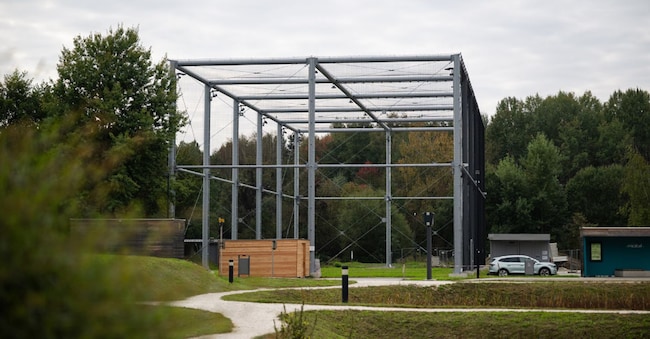
Wind, light that changes from minute to minute, draughts: there are many variables that pose a challenge to a drone when it leaves the laboratory, even though its ‘training’ has taught it to anticipate most of them. This challenge has given rise to the University of Klagenfurt, in Carinthia, within the Lakeside Science & Technology Park, the Outdoor Drone Space Austria (ODSA). This is a technological arena unrivalled in Europe, where researchers bring experimentation into the real world.
Here, drones – whether remotely piloted or autonomous – fly in a controlled environment that closely resembles the real world. The Qualisys optical tracking system tracks their position and movements with great precision: thanks to this project infrastructure, researchers can compare the actual trajectory with that estimated by the on-board systems, identify where the algorithm goes wrong and make the necessary adjustments.
The arena complements the Drone Hall, the indoor laboratory opened in 2019: 150 square metres, 10 metres high, with 37 high-precision cameras. The programme carried out within the laboratory consists of several stages, ranging from digital simulation to indoor testing and finally to outdoor flight. Yannick Morel, a researcher at the university, explains that one of the main objectives of the research is to develop drones capable of navigating and making decisions autonomously, even without relying on GPS. The aircraft must navigate unfamiliar environments, recognise obstacles, plan their route and adapt their decisions to what is happening around them, without an operator to guide them. This has very significant implications for industry, including the ability to inspect infrastructure and facilities in hard-to-reach areas or, in civil protection, to autonomously explore inaccessible terrain in search of missing persons. Their use is also of great importance in land management, for studying swarms of drones that exchange information even without communication infrastructure, for example to automate forest inventory.
A practical example comes from the world of agriculture. Avemoy, a start-up founded in Klagenfurt as a university spin-off in September 2024, has developed HortiScan: an autonomous drone, artificial intelligence modules and a cloud platform to navigate the rows of tomato greenhouses without GPS, 24 hours a day. Images and data are used for harvest planning, pruning control, cluster counting and anomaly detection.
Competitions also confirm the high effectiveness of the training and testing process. In August 2026, the HERMES team from Klagenfurt won “Fully Autonomous Flight 2.0”, the European competition organised by the German agency for disruptive innovation, SPRIND, which featured satellite-free and pilotless missions involving targets to identify, people to locate and a moving subject to track. Klagenfurt was the only team to deploy two autonomous drones communicating with one another, capable of coordinating their actions and avoiding collisions.
The Klagenfurt laboratory is one of the hubs of a wider ecosystem spanning the Carinthian region. In the same Lakeside Park – described as Carinthia’s centre for digital innovation – is based JOANNEUM RESEARCH ROBOTICS, the institute dedicated to robotics and flexible manufacturing: it works on collaborative and mobile robots, sensor technology and the cyber security of networked systems. Spanning 1,200 square metres of laboratory space, the ROBOTICS Evaluation Lab assesses the safety of physical contact between humans and robots, the Dependable Sensor Test Lab validates safety sensors, and the ROBOTICS Solution Centre provides robotic systems to develop and test applications in collaboration with businesses. The park is also home to Lakeside Labs, AIT and the 5G Labs. In Villach, the Technology Park – home to over 40 companies, more than 1,100 students from the Fachhochschule Kärnten and around 850 employees – houses laboratories, cleanrooms and test centres dedicated to microelectronics, mechatronics and sensor technology. Here, Silicon Austria Labs operates what the park’s CEO, Bernhard Lamprecht, describes as Austria’s largest research cleanroom, where even medium-sized enterprises can produce prototypes and small batches; Next door is Infineon, a key player in the local industry, focusing on new materials for chip production and on reducing energy consumption. In St. Paul, along the Koralm railway line, the Lavanttal Technology Park is designed for sustainable technologies, with facilities for pilot production and testing units. Various hubs and different specialisations, all with the mission of uniting research, education and business through shared, measurable objectives.

