
Innovation and tradition drive culture in the Mezzogiorno
In Palermo, the first stage of the States General organised by Sole 24 Ore: the Sicilian capital is the epicentre of a change affecting the whole island. Federico Silvestri: "Starting from here is a good signal".

4' min read
4' min read
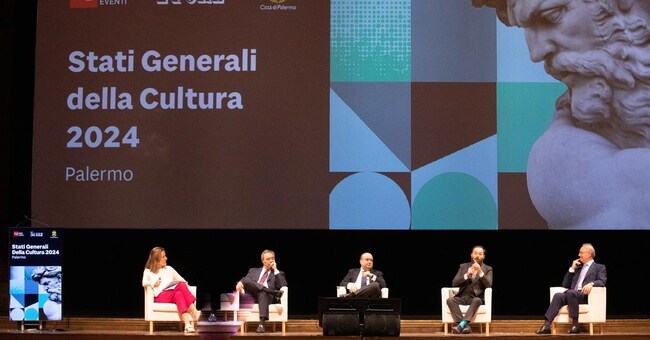
There are places that today, more than others, are metaphors and paradigms of the contemporary renaissance. And one of these places is Palermo, the Sicilian capital protagonist of a change that was not born today but is now beginning to become plastic, evident, perceptible. This was made very clear, yesterday, in a Massimo Theatre packed to the rafters with young people and insiders attending the first stage of the States General of Culture organised by Il Sole 24 Ore. Because the temple of opera, as they say, is then the most obvious representation of what is happening in the city and is at the same time the driving force behind new approaches, new visions that bring together the glorious past of the theatre designed by the Basile family (first the father Giovan Battista Filippo and then the son Ernesto) with the future of an increasingly polycentric city. Culture, understood as a multidisciplinary sector (theatre, music, figurative arts and so on) seen from here is a high-impact phenomenon, one of the key factors in the transformation of the entire Mezzogiorno: 'The North creates value, the South has value. This is why we are starting out from Palermo,' said Federico Silvestri, general manager of Media and Business Gruppo 24 Ore and managing director of 24 Ore Eventi. 'For us it is a source of great pride to bring this initiative to this area. Starting from here is a good signal, to understand what the state of the art is, what the opportunities are for culture, which is a great component for the GDP of this country. Today we are at the advent of artificial intelligence,' he continues, 'which must be seen as a great opportunity, also in the cultural sphere, and also as a potential creator of new jobs'.
The Teatro Massimo epicentre of a movement that involves the entire city, Palermo epicentre of cultural movements and dynamics that now extend throughout the region: there is the history of an island that lacks nothing, there is innovation and new models that start from the bottom and look to the future. Culture that stimulates change, even in the governance of territories, but culture that is also a diplomatic medium for new relationships. "We are proud and we thank Il Sole 24 Ore for choosing Palermo as the first stage of the 2024 General States of Culture. This is an acknowledgement for the city that becomes a place of national cultural debate, indicating a path that is among the privileged ones for its economy and its preparation for the future, namely that of culture understood globally as an element of tradition, training and innovation - says the mayor of Palermo Roberto Lagalla". And Palermo's deputy mayor and culture councillor Giampiero Cannella adds: 'We have brought culture to peripheral places. We have had a great consensus from young people. We will do it tomorrow, for example, at the Sperone, and then also at the Albergheria. It's an investment, from a social point of view. From an economic point of view, it is a profit that produces culture and growth'. But the perspective can also be another: culture as a factor of attractiveness that drags with it the induced revenue from tourism: 'The British - Francesco Bongarrà, director of the Italian Cultural Institute London - are in love with what we are, they admire our being, our art, our food, our way of producing beautiful things that set trends. I am focusing on design, I am doing meetings with costume designers, with Italian designers who come there and tell why they are excellence, why in a theatre like this you can produce things that only make sense to see here. You have to come here to see it'. Indeed. But 'We must have a systemic vision,' explains Alessandro De Pedys, director general for public and cultural diplomacy at the Ministry of Foreign Affairs and International Cooperation, 'with substantial investments. In Italy, the cultural sector has a turnover of 100 billion a year, and if we add to this the allied industries linked to the organisation of events, we go up to 240 billion, which is more than 10 % of GDP. Culture is a fundamental component of the 'brand' Italy, but strategies are needed, as one cannot live off of it. Diplomacy deals with this. There are 88 cultural institutes in the world that organise over 2,000 events a year. It is a capillary activity'.
However, an important road ahead remains that of innovation that produces new paths, new initiatives and new impacts yet to be measured. There is not only artificial intelligence, there is also social, urban, organisational innovation in territories yet to be discovered. "I think that a theatre of this new century is to restore, as in ancient Greece, the sense of a theatre in empathy, a theatre-city with the city - says Marco betta, composer and superintendent until a few months ago of the Teatro Massimo (he is waiting for renewal) -. The theatre belongs to everyone, the real innovation lies in making it usable, in bringing the culture that reveals life and brings peace to everyone because music is the place of listening. Innovation today is also about this beyond the necessary technological innovations that are right and that look at the climate and the ecosystem. We invented two projects, instant opera short opera, to bring great culture and opera everywhere, from classrooms to squares, because music and art are a breath of freedom'.


