
Innovation, Italy at the crossroads between excellence and skills shortage
Technology and public-private collaboration drive growth, but talent shortage remains

3' min read
3' min read
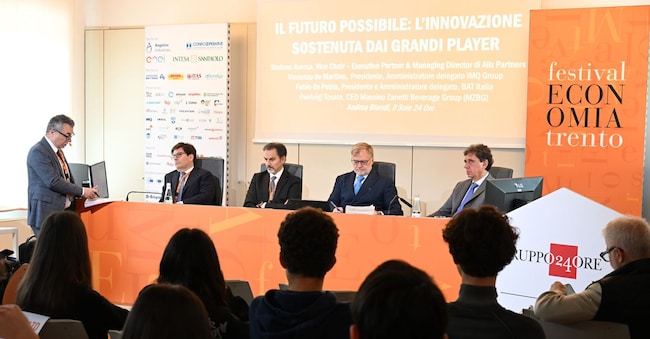
A future evoked not as a distant suggestion, but as a concrete industrial objective, with well-defined numbers, investments and strategies. At the conference 'The Possible Future: Innovation Supported by Big Players', organised as part of the Trento Festival of Economics, the word 'innovation' came out of its comfort zone, becoming the language of business, process engineering, human capital. And taking the form of a digital centre of excellence in Trieste; a blockchain-traceable coffee pod or even a lifesaver protecting our invisible lives inside a wall.
No prophecies. Rather, the conference did the maths. Highlighting those skills that are needed and lacking or even that openness to technology and generative artificial intelligence that is needed but in many cases absent in companies.
Fabio de Petris, managing director of BAT Italia, described the radical transformation of a group that is world-renowned for combusted tobacco and now at the forefront of the race towards reduced-risk products. "Our goal for 2030 is to have 50% of revenue from reduced-risk products. But in Italy we are already at 45%, five years ahead of schedule'. The beating heart of this revolution is in Trieste, where BAT has invested EUR 500 million to open a state-of-the-art plant (which was made possible in just 13 months "thanks to a great public-private partnership") and a centre of excellence for digital transformation "serving other areas, from Canada to the USA. An investment well made,' de Petris emphasises, 'given that the plant's results are the group's best globally.
If BAT bets on a low-risk future, Massimo Zanetti Beverage Group looks to digitalisation to renew one of the Italian symbols par excellence: coffee. "We are learning a lot from Asia. In China,' explained CEO Pierluigi Tosato, 'Luckin Coffee has revolutionised the customer journey: you order via app, the bar prints a QR code, and a machine automatically prepares the coffee. A direct challenge to Starbucks, which we are following closely". But it is not just a question of efficiency. New consumers want to know what they are drinking, where it comes from, and by what methods the coffee was grown. 'Blockchain makes it possible to guarantee traceability and transparency,' adds Tosato, 'and is a concrete response to the demand for authenticity and sustainability. And then there is the Internet of Things: company coffee machines that self-diagnose themselves from Dubai, report faults and calculate consumption in real time.
Vincenzo de Martino, President and CEO of IMQ Group, brings the point of view of the 'controller'. But his is not the role of the 'bureaucrat of progress'. It is rather that of the guarantor: 'Innovation needs trust,' he said, 'and we are there, between those who produce it and those who have to use it. We test electrical sockets and surgical robots, cybersecurity systems and devices for autonomous driving. We give certainty to the market'. A crucial function, especially at a time when technology runs faster than regulation. 'Innovation without reaching the market remains an academic exercise. It is when it is certified, adopted and understood that it becomes progress'.


