
Inside and outside the Show, what not to miss
Daring prototypes, future projects, opportunities to test materials, technologies and construction systems that are difficult to experiment with on a real scale. Installations invade Milan, inside the Fair and among the streets and courtyards of the city. An overview (and some advice) on what would be interesting to visit (in some cases, there is time until 30 April)

The world of architecture and design is intertwined with Salone del Mobile and Design Week with an ever-increasing intensity, breaking out of the usual formats (first and foremost, that of the Milan State University) to give rise to new installations and projects. These are not just direct collaborations for the design of new products. Companies seek in the architect a guarantee of design coherence and cultural positioning; studios find in the relationship with industry an opportunity for applied research - on materials, technologies, environmental systems - that the traditional architecture market alone struggles to offer. This gives rise to virtuous design visions that can blossom into embryos of future projects, increasingly important opportunities for the design world also to test materials, technologies and construction systems that they would not have the chance to experiment with on a real scale. In this article we try to give you some hints (not exhaustive, given the vast number of installations invading Milan) on what might be interesting to visit (in some cases, there is time until 30 April).
Let us start with a premise. Pushing for an acceleration of the architecture-design link is the Salone itself, which has entrusted Rem Koolhaas architecture firm OMA with David Gianotten with the Salone Contract Masterplan: not an installation, not a display, but a multi-year assignment to redesign the very structure of the event in response to the growing complexity of the global contract market. The project, conceived as a long-term research platform rather than a traditional exhibition format, will debut in its full form in 2027: in 2026 some initiatives (among them, the lectio magistralis by Koolhaas) will be the premise. "Since the 19th century, Universal Expositions have functioned as experimental laboratories," said Koolhaas. "Today, Salone Contract represents a contemporary declination of this function: a space to observe how industry and design culture adapt to an increasingly complex geopolitical and market context. It is proof that the architect's role in the fair is no longer confined to the exhibition space: it has become structural.
Inside the Salone del Mobile
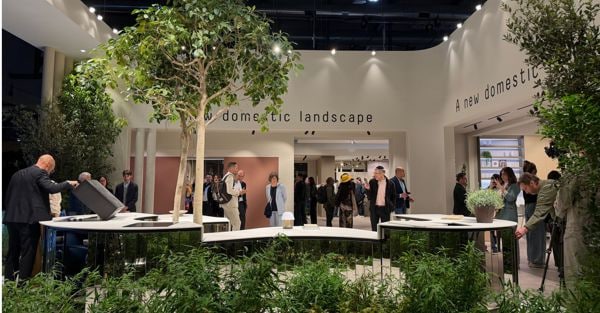
The collaboration between architects (more or less well-known even outside the industry) and companies is a leit-motif of the entire edition. The symbol of a product that is also, in truth, an installation is OLTRE, the outdoor kitchen that CRA - Carlo Ratti Associati designed for Veneta Cucine. The project stems from a collaboration initiated at the Venice Architecture Biennial 2025 - curated by Ratti himself on the theme of natural, artificial and collective intelligence - and translates that reflection into an object destined for the market. "With food ingredients, nature enters the home through the kitchen," says Ratti. "With Oltre it is the kitchen that enters nature. The shape follows the contours of the land and surrounding vegetation, adaptable to both open and indoor environments. Also in Rho, the Beko pavilion at Eurocucina was designed by MCA - Mario Cucinella Architects. The challenge: to keep together four distinct brands - Whirlpool, Hotpoint, Beko and Bauknecht - each with its own positioning, within a unified spatial system. The solution is a suspended, undulating textile veil that diffuses a soft light. "A white cloud that holds these very different brands together", as the architect himself called it. The materials are selected according to the logic of reuse and recycling, with a post-event restitution plan already agreed upon: the fabric will be recovered and re-introduced into the production cycle, donated to the company la Fortezza teatrale of Armando Punzo, career lion, who works in the Volterra prison. Also: In the Nardi stand Raffaello Galiotto - designer who signs all the outdoor production of the Vicenza-based company - has built Fuori le mura (Outside the walls): a concept inspired by the walled cities of the Mediterranean that overturns the traditional exhibition logic. The products are discovered from above, looking out from the walls of a Mediterranean city reproduced at the fair, with a central raised part accessible by stairs. The viewpoint changes, and with it the way of reading outdoor furniture. The stand of Acua, the new taps and fittings brand founded by Alberto Cristina, debuts in a space set up by Naomi Hasuike, who has already received the ADI Booth Design Award at Cersaie 2025 for the same exhibition project: a rare case of a stand awarded for sustainability and entirely re-assembled in a different exhibition context. Wood and cork as the prevailing materials, for an immersive and authentically ecofrinedly experience.
At the fuorisalone
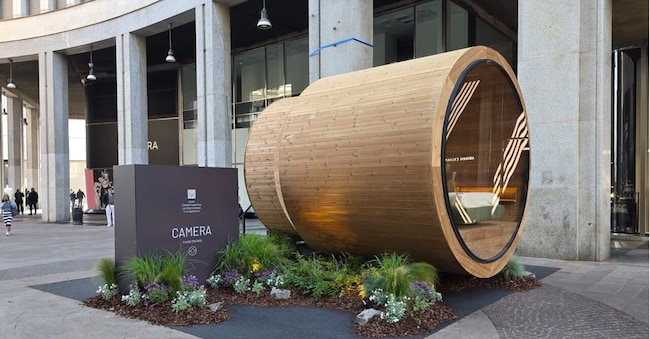
The pinnacle of experimentation is reached in the installations of Design Week. The first stop, in an itinerary we have imagined for those interested in architecture and design, is CAMERA - Inside the Lens, the micro-architecture by Progetto CMR, a studio founded by Massimo Roj, realised for MoDesign with Finsa as main partner and iGuzzini, Schüco, AGC and others among the technical partners. Open until Sunday between Corso Vittorio Emanuele II and Piazza San Babila, it is a compact wooden volume inspired by the geometry of a photographic lens: concentric diaphragms, calibrated proportions, a geometry that directs the gaze towards a precise point. The experience is deliberately analogue (no screen, no digital mediation) and offers visitors a space of suspension that frames a unique view of the Duomo, inviting them to rediscover the quality of looking directly at the city. A project initially conceived for outdoor hospitality and glamping, but which also reveals itself as an urban device capable of generating relationships and spatial awareness. In the courtyard of the historic headquarters of the Corriere della Sera, again MCA signs Città delle Idee, commissioned by Corriere della Sera with Living and Abitare for the 150th anniversary of the newspaper. This is the third chapter in Cucinella's ongoing research into this space, after Città Miniera in 2024 and Città Paradiso, and the consistency of the project is itself a design fact: each edition explores the theme of the sustainable city with a different construction system. This time, almost 700 dry-assembled and 3D-printed modules with a cement mortar developed by Heidelberg Materials gradually thin out to define an agora in the centre. After Design Week, the modules will be dismantled and reused.
Brand connect


Newsletter RealEstate+
La newsletter premium dedicata al mondo del mercato immobiliare con inchieste esclusive, notizie, analisi ed approfondimenti
Abbonati