In the new Egyptian Museum in Giza

Inside the Grand Egyptian Museum in Cairo (finally)

A journey between innovative architecture and pharaonic treasures, the Gem establishes itself as Cairo's new cultural icon, a couple of kilometres from the pyramids of Giza

by Gabriele Meoni

3' min read

Translated by AI
Versione italiana

3' min read

Translated by AI
Versione italiana

Building the Pyramid of Cheops 4,500 years ago took the same amount of time. Amidst rising costs, Arab Spring, Covid and economic difficulties, the Grand Egyptian Museum (Gem) was only finally inaugurated on 1 November - after twenty years, a decade behind schedule - and now finally offers itself to the public in all its grandeur. So much so that it has already become a 'classic' for those who go to Cairo.

The Gem is a couple of kilometres from the pyramids of Giza, which tower in the background and dialogue with the museum.

Loading...

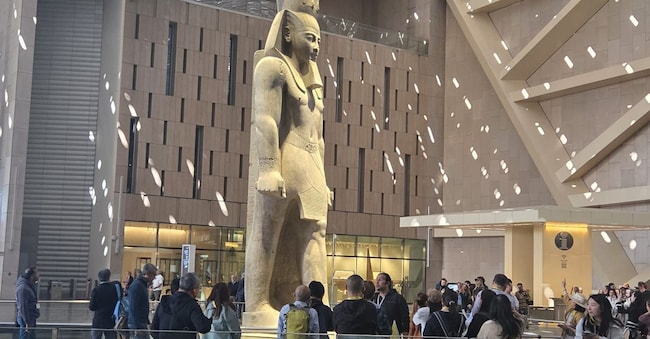
The building, designed by Irish studio Heneghan Peng Architects, is sand-coloured and has a monumental pyramid-shaped entrance. The whole complex, outside and inside, is a constant reminder of those miracles of human ingenuity. We enter through the large triangular door. An enormous 10,000-square-metre hall with a pierced roof is open on two sides, light pierces through every crevice with singular perspective effects, a gentle breeze makes the climate pleasant, and water flows placidly in a pool flush with the floor: the calling card is one of great charm.

Just a few metres from the entrance stands the colossus of Ramses II, a 12-metre high, 83-tonne heavy red granite statue moved here in 2006.

Once past the turnstiles, here is another breathtaking setting: a monumental staircase criss-crossed with statues, tombstones and other sculptures leads up to the actual entrance to the galleries. At the top, a large glass window overlooks the pyramids: the architects wanted to win hands down.
Il Grand Egyptian Museum del Cairo è già un classico

Photogallery11 foto

The collections are arranged in 12 galleries divided by theme (society, royal power, beliefs) and by period (prehistoric, ancient, middle and new kingdom). Natural light penetrates from outside and allows the thousands of exhibits to be seen at their best.

The collection of Tutankhamun is the exact opposite but just as spectacular: the7,500 square metre area is bathed in darkness, with artificial light illuminating the masterpieces dedicated to the child pharaoh, from the golden mask to the thrones to the sarcophagi and jewellery. Despite the crowds at the Mona Lisa at the Louvre, viewing is pure pleasure.

The Gem is an 'easy' museum: moving from one room to another, retracing one's steps, everything is intuitive and well signposted. The only drawback is the lack of an in-depth description of each period. The individual works are well presented with signs in English but the framing of the historical context is too sketchy.

Although it has only been open for a few months, the Gem has already firmly entered the list of sites to visit in Cairo. It is therefore already very crowded even during periods considered low season. In the era of global overtourism, the high season now lasts 365 days a year.

Those who decide to stay in the city for a few days are spoilt for choice.

For museum enthusiasts, there is the NMec with its famous mummy room, transported here in 2021 in a solemn ceremony, or the old Egyptian Museum in Tahrir Square, which has surrendered its most precious treasures to its younger 'cousins' but retains the retro charm of its early 20th century exhibition venues.

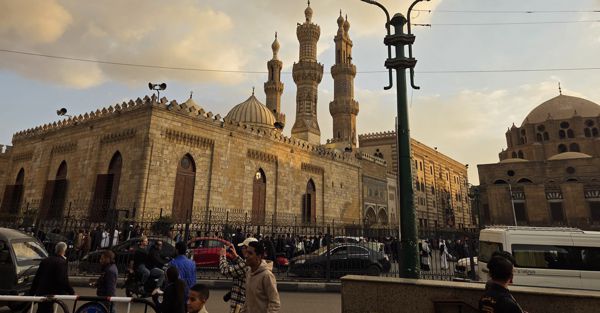
Il complesso con la moschea e l’università di al-Azhar, massima istituzione religiosa dell’Islam sunnita

Not everyone knows that Cairo boasts one of the best-preserved medieval Islamic city centres in the world, along with Fes in Morocco. The al-Muizz street between the gates of Bab al-Futuh and Bab Zuweila is an open-air museum where one cannot count the mosques, madrasas and mausoleums spanning a thousand years of history. Masterpieces of fine art that testify to the cultural richness of the Mamluk and Ottoman periods. Cairo, in short, is not only Pyramids and Gem. It is a vibrant metropolis with a thousand years of history that emerges here and there with its jewels among slums, dumps, traffic jams and not always decent poverty alongside luxury hotels and pleasant expat quarters.

Il grande cortile della moschea di Ibn Tulun, della fine del IX secolo, il più antico del Cairo conservato ancora con lo stile dell’epoca

Copyright reserved ©
Loading...

Brand connect

Loading...

Newsletter

Notizie e approfondimenti sugli avvenimenti politici, economici e finanziari.

Iscriviti