
Backfire for Intel: how Apple tries to extricate itself from TSMC
The Cupertino giant is also considering Samsung for the production of its chips

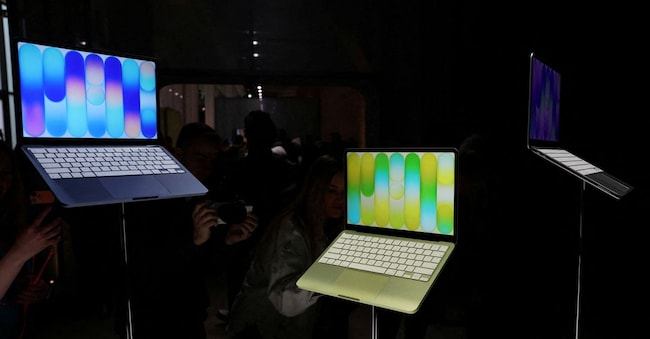
There was a time when the Apple-Intel pairing was synonymous with a very solid business. In 2006, the Cupertino company decided to rely on the Santa Clara-based manufacturer for the chips in its Macs. And so it was for almost 15 years. Then, in 2020, the decision was made to transition to proprietary processors based on ARM architecture, the so-called Apple Silicon, designed in-house and manufactured by TSMC. This marked the end of the dependence on Intel in Macs.
Now, however, something could change again. Because according to authoritative sources, Apple is considering production alternatives for the chips that power its devices, opening a preliminary confrontation with Intel and Samsung Electronics in the United States. News that clearly resonated immediately on Wall Street, with Intel's stock reaching $114 (about a year ago, it was hovering around $20...).
It has to be said that the talks are at an early stage and have not led to any orders, but they indicate an attempt to reduce dependence on the Taiwanese giant TSMC.
For years now, Apple has been developing its system-on-a-chip and relying on TSMC for production with the most advanced nodes, now at 3 nanometres. This integration has guaranteed performance and volumes, but has also exposed the Californian company to geopolitical risks (linked to the geographical concentration of the supply chain) and the available production capacity of a single player. Recent supply-side tensions, fuelled by the growth of data centres for artificial intelligence and stronger-than-expected demand for Macs, have made these limitations more evident.
During the last quarterly report, Apple's pro-tempore CEO Tim Cook indicated that chip availability is holding back growth, pointing out that the supply chain is less flexible than the company's standards. For this reason, the Cupertino giant is now exploring alternative options. With Intel, the contacts concern the utilisation of the foundry division's production capacities, a pillar of the relaunch plan led by CEO Lip-Bu Tan. For Intel, obtaining Apple as a customer would signal industrial credibility and could facilitate the acquisition of other contracts. And indeed, as mentioned above, the stock reacted strongly to the rumours, reaching double-digit intraday gains and accumulating a rise of more than 180% since the beginning of the year.


