
Intellectuals and students against school drift
At Pordenonelegge, Giuseppe Nibali's choral volume laid bare the controversial world of Italian education
by Matteo Bianchi
 Aggiungi Il Sole 24 Ore
ai preferiti su Google
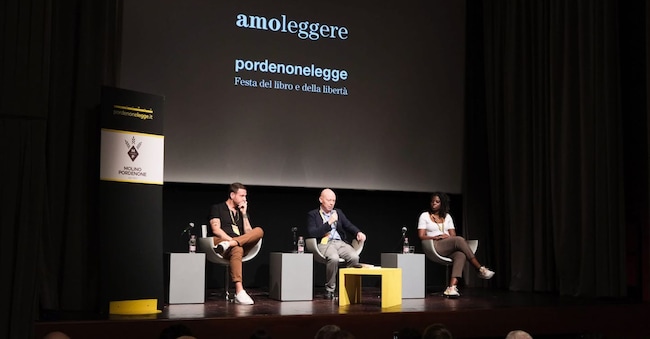
Books return to the squares, passionate squares around the authors who conceived them. The most authentic figures of Pordenonelegge are the six hundred and sixty-seven intellectuals engaged in four hundred meetings to interpret the present, sharing themes, investigations, hopes, needs and views on the world. Great satisfaction for the twenty-sixth edition was also expressed by artistic director Gian Mario Villalta: "The festival is the result of an ongoing commitment over the course of the year, of relationships that intensify, of constant attention to topics that we propose and consolidate as leading traces in the local and national cultural fabric".
Back to the boys
.During the five days, hundreds of protagonists of that 'festival within a festival' the Junior and Young poster, tailor-made for young readers, their families, teachers and educators, passed the microphone to each other, without the fear of lucidly confronting the contradictions of the educational context. Specifically, Espérance Hakuzwimana and Giuseppe Nibali confronted each other by challenging their experiences and their publications, respectively "Tra i banchi di scuola. Voci per un'educazione accogliente' (Einaudi, 2024, pp. 136, euro 13) and 'Una cosa che non parla. Intellectuals and students against school' (San Paolo, 2025, pp. 208, euro 18). The two protagonists criticised the drift of a school system that was at times passatist and claustrophobic, planted in the 1980s in too many Italian provinces, in order to spur it to respond more effectively to the existential needs of those who attend classrooms every day. Attempts to racialise classrooms in the face of the imposing multicultural turn that European society has gone through, slow down the poietic desire of young people, their determination to realise themselves as individuals and to intervene in the community, struggling within the 'cultural nothingness' branded by Galli della Loggia.
Against a retrograde school
.It questions the devices of power, bureaucratic inertia and the rhetoric of 'skills training' in the choral volume edited by Nibali, who has collected a series of dialogues between intellectuals and secondary school students, recorded and transcribed in 2024, and introduced by a weighty note that serves as a theoretical framework as much as a practical manifesto. The writer and teacher finds in the figure of Paul Klee's 'Der Held mit dem Flügel' - 'the one-winged hero' - a metaphor for today's students: 'clumsy and regal at the same time, within a defeat that seems foretold'. In fact, their aspiration to 'fly' is hindered by worn-out democratic instruments, such as religious instances trivialised, political circles turned into 'stipendiaries', and strikes scheduled as serial vent valves.
The knot of bureaucratisation
Among the voices involved by Nibali is that of Alessandro Barbero, who identifies crystal-clear one of the structural evils: "The school is attacked by the prevailing culture of planning, of ridiculous acronyms, of Kafkaesque bureaucracy and institutionalised waste of time, of useless meetings and forms to be filled in, perhaps with the proclaimed aim of certifying merit and quality". This sentence proves to be a key to reading the entire book, as it caustically captures the paradox of a body that, in an attempt to guarantee the desired 'meritocracy', ends up suffocating the very substance of teaching under the formal apparatus. And tons of wasted paper.

