
International Book Fair: the 38th edition kicks off
The wars of adults saved by the spontaneity of children: this is the hope that will run through more than two thousand seven hundred events
by Matteo Bianchi
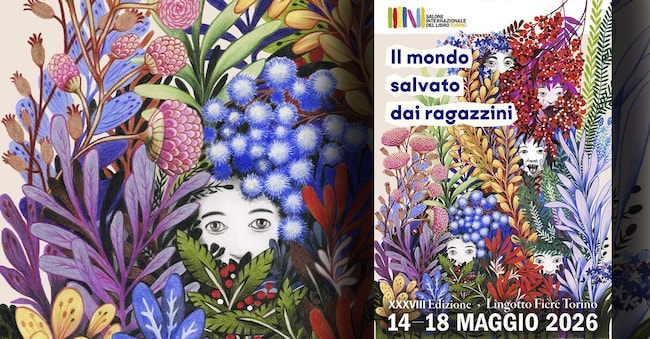
Faced with a society no longer capable of arguing a protest, which has transformed indignation into media consumption and rebels into fashion icons, the Turin Book Fair chooses Elsa Morante's 'The World Saved by Little Boys' as the emblem of Spring 2026. Back at the Lingotto from Thursday 14 to Monday 18 May, with over five hundred stands, one thousand two hundred and fifty publishers, and two thousand seven hundred events, again under the direction of Annalena Benini, to welcome the community of readers of all ages who will meet Italian and international authors and discuss the present.
In the book dated 1968, it is no coincidence that young people represent the only possibility of salvation against the degradation of the adult world, dominated by violence and conformism, as they preserve an immediate perception of reality. Writing in the post-war period and going through the Cold War, Vietnam and nuclear tensions, Morante resists with language and draws up a long catalogue of vital, anarchic and poetic gestures that instil hope: young people rescue animals, listen to jazz, discuss Christ and Buddha, insult the police, steal sunflowers, fall in love, dress up, cry and laugh at the same time.
The world's extreme adolescence
'Il mondo salvato dai ragazzini (The World Saved by Little Boys) is a fundamental book by Elsa Morante,' Benini comments, 'which contains many, and which crosses different forms of art and speech. It is a manifesto and a poem, a celebration and an invective, a novel and a magic key. It opens all doors. So many definitions, because it eludes all definitions: it cannot be classified, it is a moving title and is, first and foremost, a message of hope. It is the world that the Book Fair aims for, hopes for, tries to build every day with inventiveness and dedication'.
The thirty-eighth edition begins on Thursday 14, at 2 p.m., in the Sala Oro, with the opening lecture 'Everything was extreme. And it still is. A Reflection on Adolescence' by uninhibited and rigorous Zadie Smith, twice selected by 'Granta' as one of the twenty best pens in English literature.
The trajectories of translation
The twenty-sixth edition of AutoreInvisibile, a cycle dedicated to translation and curated by Ilide Carmignani, will host fifty-six speakers in twenty-one meetings. Emmanuel Carrère will dialogue on writing and translation with Ena Marchi and Dacia Maraini with Paolo Di Paolo. The section "The writer and his double" will again welcome Zadie Smith with Martina Testa, Peter Cameron and Kiran Desai with Giuseppina Oneto and Ece Temelkuran with Giulia Boringhieri. Instead, Valerio Magrelli and Paolo Nori will discuss their new transpositions of Molière's "Misanthrope" (Mondadori) and Čechov's "Life is Horrible and Wonderful" (Neri Pozza). "Translation has always been a paradigm of welcome," adds Carmignani, "because it does not assimilate the foreigner by erasing all his foreign characteristics, nor does it slavishly surrender to the other to the point of losing its own identity. Translation is an encounter that preserves and enriches both, offering in these times of migrations and new cohabitations a model of value that is not only linguistic and literary, but ethical, social and political; an example of how we can overcome borders and blur the separations between us and them, between inside and outside, between those who are included and those who are excluded'.

