University

International students in the US: visas and legal status revoked, lawsuit against the Trump administration

According to an analysis conducted by the Associated Press, at least 1,024 students from 160 colleges, universities and university systems have been affected since the end of March.

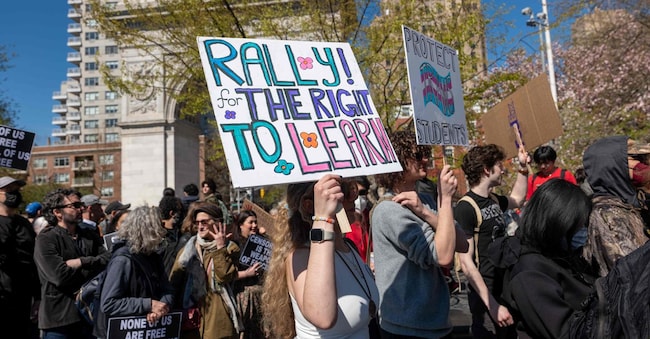
People rally and march in support of universities and education on April 17, 2025 in New York City.  Spencer Platt/Getty Images/AFP

4' min read

4' min read

In recent weeks, more than a thousand international students have had their visas or legal status revoked, and many have filed lawsuits against the Trump administration, claiming that the government denied due process by suddenly revoking their permission to stay in the US.

Private and public universities involved

.

The actions taken by the federal government expose hundreds of students to the risk of detention and deportation. These are students from both private universities such as Harvard and Stanford, as well as large public institutions such as the University of Maryland and Ohio State University, and some small liberal arts colleges.

Loading...

According to an analysis conducted by the Associated Press, at least 1,024 students from 160 colleges, universities and university systems have been affected by the measure since the end of March. In the lawsuits against the Department of Homeland Security, the students argued that the government had no justification to cancel their visas or revoke their status.

Visas can be cancelled for various reasons, but universities claim that some students are targeted for minor infractions such as traffic violations, including some dating back a long time. In some cases, students say it is unclear why they are being targeted.

"The timing and uniformity of these resolutions leave little doubt that DHS has adopted a national policy, written or unwritten, of mass revocation of (legal) student status," Michigan's Aclu lawyers wrote in a lawsuit on behalf of students at Wayne State University and University of Michigan.

In New Hampshire, a federal judge last week issued a restraining order in the case of Xiaotian Liu, a Chinese computer science student at Dartmouth College, whose status was revoked by the government. Other lawyers have filed similar appeals in federal courts in Georgia and California.

The Associated Press asked Homeland Security officials for comment on the matter, but they did not respond.

The Mahmoud Khalil case

.

In some cases, including the detention of Columbia University activist Mahmoud Khalil, the administration of President Donald Trump has argued that it should be allowed to expel foreign nationals for their involvement in pro-Palestinian activism. However, in the vast majority of visa revocations, universities say there is no indication that the students concerned had any role in the protests. "What we're seeing happening with international students is actually part of the much tighter scrutiny that the Trump administration is exerting on immigrants of all different categories," said Michelle Mittelstadt, director of public affairs at the Migration Policy Institute.

What does the F-1 visa provide for

?

Students from other countries must fulfil a number of requirements to obtain a student visa, usually an F-1. After being admitted to a university in the United States, students must undergo an application and interview process at a US embassy or consulate abroad.

Students with F-1 visas must demonstrate sufficient financial support for their studies in the United States. They must remain in good standing with their academic programme and are generally restricted in their ability to work off-campus during their academic career.

Entry visas are handled by the State Department. Once in the United States, the legal status of international students is overseen by the Student and Exchange Visitor Program of the Department of Homeland Security.

Trump's change of pace

.

In recent weeks, many college officials learned that the legal residency status of some of their international students had been revoked when college staff checked a database maintained by the Department of Homeland Security. In the past, college officials say, legal statuses were typically updated after colleges notified the government that students were no longer studying at the institution.

Historically, students whose visas were revoked were allowed to maintain their legal residency status and complete their studies.

The lack of a valid entry visa only limited their ability to leave the United States and return, which they could apply for again to the State Department. But if a student lost legal residency, he or she risked detention by immigration authorities. Some students have already left the country, abandoning their studies to avoid arrest.

According to many observers, arrests and visa revocations may discourage students abroad from continuing studies in the United States. The lack of clarity about the reasons for revocations can create a sense of fear among students, said Sarah Spreitzer, vice president of government relations at the American Council on Education.

Anxiety and fear among students

.

"The actions taken by ICE and the Department of Homeland Security against some of these students, which are removing them from their homes or from their streets, are not usually taken unless there is a security issue when a student visa is revoked," Spreotzer said. "The threat of such rapid deportation is new." The universities said they demanded answers from the federal government on the causes of the terminations. Others reiterated the importance of travel precautions for students, recommending that they carry passports and other immigration documents.

University leaders spoke of a growing sense of uncertainty and anxiety.

"These are unprecedented times and our normal guiding principles for living in a democratic society are being challenged," University of Massachusetts Boston Chancellor Marcelo Suárez-Orozco wrote in an email. "With the speed and depth of the changes taking place, we must be attentive to how best to prepare, protect and respond." Suárez-Orozco said that legal residency status has been revoked for two students and "five other members of our university community, including recent graduates participating in training programmes".

Copyright reserved ©
Loading...

Brand connect

Loading...

Newsletter

Notizie e approfondimenti sugli avvenimenti politici, economici e finanziari.

Iscriviti