
Internationalisation and solidarity-based logistics to boost markets
From the agri-food centres the project to distribute surpluses to the needy and to support small businesses at foreign trade fairs
3' min read
3' min read
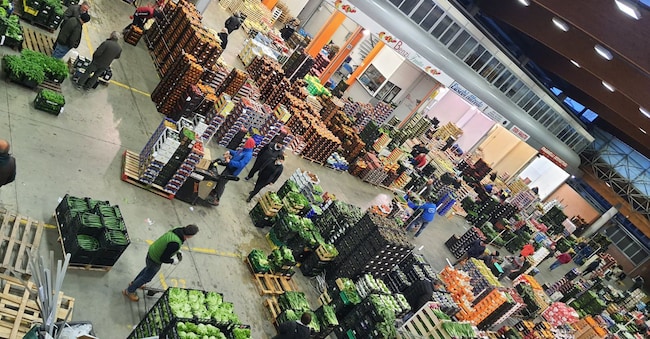
From a marketplace for wholesale fruit and vegetable sales to a strategic hub for last-mile urban logistics, for the enhancement of local produce on domestic and international tables, for the fight against waste and the recovery of food surpluses: this is the future of wholesale markets as outlined in Rimini, where the 40th world conference of the sector's operators (WUWM-World Union of Wholesales Markets) has just taken place, and on which 'Emilia-Romagna Markets Enterprise Network' is working, the network contract set up in 2021 by the three agri-food centres of Bologna (Caab), Parma (Cal), Rimini (Caar) with the fruit and vegetable market of Cesena (For). A small reality, because together the four companies on the Via Emilia total 50 hectares of space, 11 million euro of production value and around thirty employees.
For comparison: the Rungis market on the outskirts of Paris - the largest covered hub for fresh produce in Europe - has 234 hectares of space, more than 1,200 established companies, 13 thousand employees and moves more than 3 million tonnes of goods every year; and Mercamadrid, in the Spanish capital, moves more than 3 million tonnes of products per year on 222 hectares, with 800 established companies and 9 thousand employees. In Italy, the Italmercati network, which brings together the country's 22 most important wholesale facilities (out of 137 active ones), brings together 115 million euros in turnover, 540 hectares of platforms and 250 direct employees.
However, the fruit and vegetable micro-markets in Italy and the international fresh wholesale giants share the same destiny and the same problems, after twenty years of the disintegration of the long supply chain by the large-scale retail trade, which obtains its supplies directly from producers' consortia and today intermediates three quarters of the fruit and vegetables sold in Europe. To the point of calling into question the very existence of market structures. In the search for a new identity, the Emilia-Romagna agri-food centres have become an interesting laboratory of best practices. Starting with the 'solidarity logistics' project, supported by the Region, which started in Parma (where it 'saved' over 2,000 tonnes of surplus fruit and vegetables in three years, distributing them free of charge to 10,000 families in need), has already arrived in Romagna and is ready to land in Bologna. While on the internationalisation front, thanks to a territory that is worth 50 per cent of Italian exports of fresh fruit and vegetables, the Network has begun to support local SMEs and small protection consortia for participation in trade fairs and direct marketing in the Arabian Peninsula.
"These are still marginal activities, which do not disturb the competition, but which indicate an intelligent route to enhance the agri-food markets. They are an important instrument of economic and social democracy, thanks to their redistributive function, and they boast strategic logistical structures which, thanks to the NRP, are benefiting from 270 million euro in funding for modernisation, which has never happened before. This is an opportunity not to be missed to put wholesale markets back at the centre of public policy, exploiting their potential to improve logistics and urban procurement and to bring consumers closer to quality local produce by reducing waste, because health and wellbeing depend on a healthy diet in which fruit and vegetables play the primary role,' emphasises Luca Lanini, professor of logistics and supply chain at the Cattolica University, scientific curator of the Wuwm 2024 in Rimini and founder of CibuSalus, a spin-off of the University of Padua and Sinloc for sustainable food transition.

