Space

Interstellar comet 3I/ATLAS with unique chemistry and anomalous jets observed by Hubble and James Webb

Discovered in 2025, it revealed unusual compositions and never-before-seen behaviour, offering valuable insights into distant planetary systems

by Leopoldo Benacchio

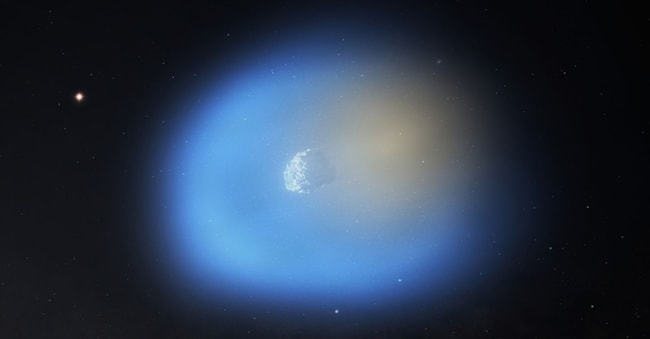
Rappresentazione artistica della cometa 3I/ATLAS Il metanolo nella coma è rappresentato in blu, il cianuro di idrogeno è rappresentato in arancione

3' min read

Translated by AI
Versione italiana

3' min read

Translated by AI
Versione italiana

Right now it is in the vicinity of Jupiter, but it is moving away fast, over 200,000 kilometres per hour, and is leaving our solar system for a journey that may last another billion years.

It is 3I/ATLAS. the third interstellar comet we have ever observed and it comes, of course, from the depths of the universe, from another distant solar system, where it formed billions of years ago. Its age is at least twice that of our solar system, 8-10 billion years, and it brought with it a veritable treasure trove of information about what happens in other planetary systems, as different from us as they are distant.

Loading...

She has left us with a lot of important information, but she is also taking away other secrets about her origins that we have not been able to wrest from her. Still, a heavenly messenger we managed to follow and study quite a bit this time.

3I/ATLAS was discovered on 1 July 2025 and, due to its decidedly hyperbolic orbit, it was immediately realised that it came from beyond our Solar System.

Since its discovery, astronomers have pointed the largest ground and space telescopes on Earth at it. It has been observed by the Hubble Space Telescope, by the James Webb Space Telescope, the two most powerful ones we have ever had, by various probes, even from Mars where various robots are working, and even by the European probe Juice which is on its way to Jupiter. In short, astrophysicists did not miss the opportunity this time to understand as much as possible.

Many of its anomalous features, such as jets of matter in the opposite direction to that of its tail, have even led to the suggestion that it is an alien artefact. The idea comes from Avi Loeb, a Harvard-educated astrophysicist, who has studied the comet in depth, listing 22 'oddities' that led him to formulate the bizarre ufological idea, which the astrophysicist seems to be particularly fond of, unlike the majority of his colleagues.

A study of the interstellar comet conducted recently using the antennas of the Atacama Large Millimeter/submillimeter Array (ALMA), which operates at 5,000 metres in the Chilean Andes, has revealed that its chemical structure is different from that of the vast majority of comets found within our Solar System.

Le antenne del telescopio Alma che osserva l’universo nelle lunghezze d’onda millimetriche e micro

3I/ATLAS in its exterior shows to have a much higher amount of methanol, an alcohol with toxic effects on us humans, than the average comet in the solar system. A few newspapers looking for headlines to grab readers called 3I/ATLAS the 'drunk' comet, with a cosmic fall from grace.

Methanol is present in 'normal' comets, but in ten times smaller quantities, and is one of those organic molecules that could be considered a precursor to life as we know it.

The 'foreign' comet approached the Sun in October 2025 and passed close to the Earth, however at 1.8 million kilometres, in December 2025.

ANSA VERIFIED - 3I/Atlas, l'intruso del Sistema solare, e' davvero una cometa?

3I/ATLAS showed features never observed before, not only the large amount of methanol, suggesting that it formed in a very cold environment, probably in the furthest reaches of our Galaxy, thousands of light years away.

In contrast to 'homegrown' comets, where water dominates, in 3I/ATLAS the main component is CO₂, the simultaneous abundance of methanol and cyanide in the canopy indicates a different chemistry from that of solar comets, a kind of identity card of another star system.

From the many, even simultaneous observations, it could be seen that it emits jets of gas oriented in an unusual way, in unexpected directions, perhaps due to the rotation or irregular structure of the core. In short, it sprays gas from all sides and this is unusual.

3I/ATLAS shows a peculiar dust formation that appears to be pointing towards the Sun, an anti-tail, instead of in the opposite direction. This phenomenon is well known in astronomy, but in this case it has exceptional dimensions, on the order of hundreds of thousands of kilometres. This is why Avi Loeb has always put forward the idea that 3I/ATLAS was moving with a type of engine unknown to us, but the idea has not gathered any supporters, except for himself, perhaps in spasmodic search of popularity.

It was an almost unique opportunity: only three interstellar objects have been directly observed in the history of astronomy, and we have witnessed all three in recent years thanks to the advances in instrumentation that have been developed on Earth and in space. With the new generation of instruments, we will probably see many of them and be able to study them comfortably to understand systems other than our own.

Copyright reserved ©

Brand connect

Loading...

Newsletter

Notizie e approfondimenti sugli avvenimenti politici, economici e finanziari.

Iscriviti