
Intimate memoirs of a finance man
In 'The Reluctant Capitalist. Confessions from the heart of power' Francesco Micheli recounts a composed and articulate community, such as the one in Milan
by Paolo Bricco
3' min read
3' min read
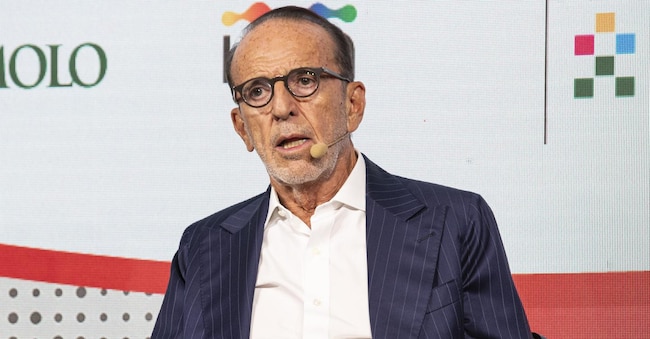
An intimate memoir. Of a person. But also the public account of a city (and, after all, of a country). When Lina Sotis, in the Buzzati room of the Corriere della Sera Foundation, asks in a loud voice 'speak louder, we can't hear you' and Ferruccio de Bortoli turns around and smilingly raises his own tone, it is clear that the book Il capitalista riluttante. Confessioni dal cuore del potere' (Solferino, pp. 240, 17.90 euro) by Francesco Micheli is the story of a composed and articulate community, such as that of Milan. And this sense of choral recomposition, starting from the private affair of a man of finance, is also felt when - not without affectionate irony - the industrialist Marco Tronchetti Provera emphasises the precise number of people quoted in the acknowledgments: 'There are 250'. In this catalogue of gentlemen and gentlewomen - once upon a time, one would have said - one finds the exponents of the Milan of money and political power, of cultural influence and banking, of the Stock Exchange (the one still shouting) and industry, of art and music (La Scala the epicentre of the heart of Milan), of evil and good, of the harshness of actions and the mobility of thought. 'Seventy per cent of the story,' notes Corriere della Sera editor Luciano Fontana, 'concerns non-personalities or events in the economy. A point of view - on the heterogeneity of the text - shared by the journalist Stella Pende: 'The soundtrack of his life, and therefore of the book, is made up of his love for music and his family, rather than his centrality in the history of finance. And, even the financial events in which he was a protagonist are always narrated with a tone of understanding and absolution. Enrico Cuccia is recounted in his public harshness, diluted however by his sympathy in private conversations. Attilio Monti, whom the chronicles of the time called Artiglio Monti, is described in his humanity as the years advance. A character not devoid of unscrupulousness like the builder Salvatore Ligresti is also recounted in his generosity and fairness towards the younger builder Manfredi Catella'.
The theme of the complexity of things was recalled several times in the room yesterday: 'In 1971 Michele Sindona tried to take over Bastogi. I was at Montedison with Eugenio Cefis. I was organising the defence of Bastogi at the top. But, at the lower levels, we worked with Sindona's companies operating together on the Chicago commodities market'. That's capitalism, beautiful.
Micheli himself reflects: 'I took full advantage of the opening of investment funds, with American operators landing in Italy and eager to make. Without that historic step, the takeover of Bi-Invest would not have been possible. Even if, in that case, the technical innovation of the funds coincided with a phase of maturity in the system: on the stock market, in everyone's opinion, sooner or later someone would have taken the company away from the Bonomi family. And I spent the month of August buying shares from a telephone booth at the Bocche di Bonifacio, with my children and their friends who wanted to go to the seaside in the morning, while I was attached to the receiver arguing with the other tourists who wanted to call home'. A contrast, with respect to Enrico Cuccia's Mediobanca, on which de Bortoli calls for analytical balance: 'The adventurous life of Micheli, who after having been a delivery boy and Totip scrutineer as a young man became a leading player in industry and finance, shows how, even in the 1970s and 1980s, there was a pluralism of Italian financial capitalism, fierce but articulate. And, perhaps, it would have been good to highlight the limits of that system, which could be criticised like any form of power, when Enrico Cuccia was alive and at the height of his power'. Tronchetti Provera remarks: 'The industrial capitalism controlled by Cuccia was fragile.
The young messenger originally from Parma, adopted like all true Milanese by Milan, continues - at the age of eighty-seven - to be questioned like the pupil of Aldo Ravelli, the legendary stockbroker, on the past, present and future: 'The Mps operation? I find the architecture of a small bank saved with public money launching an Opa on a larger private bank with the excellent fundamentals of Mediobanca paradoxical. Finance managed not by men but by machines? Today this artificial element plus the chaos triggered in the real economy by Donald Trump's tariffs make the financial markets look like a casino to me'. And, in a friendly and amused mood, Tronchetti Provera intervened: 'I agree with Francesco. Although I think the emphasis should be removed. More than a casino, it's all a mess'.


