Scenarios

Investors who prioritise diversification but lack discipline

The Vanguard Digital Investor Study reveals a growing focus on technological solutions, alongside a demand for behavioural support

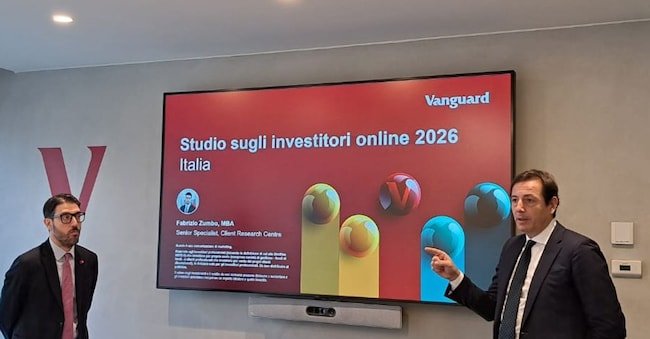
Presentazione dello studio Vanguard

4' min read

Translated by AI
Versione italiana

4' min read

Translated by AI
Versione italiana

The evolution of self-directed investing in Italia is showing a growing openness towards advanced technological solutions, with 58 per cent of digital investors stating that they trust tools based on artificial intelligence and chatbots for financial guidance, whilst 70 per cent would welcome automated notifications and messages offering behavioural support to help them navigate periods of heightened market volatility.

The human element

However, the drive towards automation does not negate the importance of the human element: 52 per cent of respondents to the Vanguard Digital Investor Study, which surveyed a sample of 2,014 Italian DIY investors who use digital platforms (aged between 18 and 78, comprising 59 per cent men and 40 per cent women), highlight that the opportunity to consult a financial adviser even just once or twice a year would significantly increase their satisfaction, demonstrating that the move away from traditional advisory services — driven in 46.8 per cent of cases by costs deemed too high relative to the value received, and in 51.3 per cent by the confidence to make decisions independently — is driving interest towards a hybrid service model.

Loading...

Millennials

Millennials are at the forefront of this transformation, accounting for 60.6 per cent of the total sample of Italian DIY digital investors (alongside 19.1 per cent from Gen Z, 16.7 per cent from Gen X and 3.7 per cent from the Baby Boomers). For this demographic group, the ETF regular savings plan (PAC) stands out as the preferred investment vehicle: as many as 69 per cent of investors say they intend to set one up in the next 12–24 months, a figure that rises to 72.7 per cent among Millennials, responding to the need to overcome the current low frequency of investment, with only 36 per cent currently making regular monthly contributions to products already in their portfolios.

Greater awareness

More generally, the findings of the Vanguard Digital Investor Study paint a picture of strong theoretical self-awareness set against a backdrop of significant practical challenges. Although 63 per cent of respondents believe they have sufficient knowledge of investment products to achieve their goals, only 33.6% have a clearly defined long-term strategic asset allocation, whilst 49% have only a general idea of one and 13.6% do not follow any structured plan.

Whilst a predominantly long-term outlook prevails — with 84 per cent setting a specific target and 66 per cent stating a time horizon of more than 5 years — the main driving factor remains the sheer growth of assets without a set target (34.9 per cent), followed by retirement planning (21.4 per cent), whilst 43 per cent of investors say they are willing to take on greater risks in order to grow their capital.

Although there is almost unanimous agreement on the principle of diversification – considered essential by 79 per cent of the sample – the practical management of portfolios reveals a marked tendency to react to short-term fluctuations: 43 per cent purchase new products at least once a quarter and 65 per cent sell holdings at least once or twice a year. Purchase decisions appear to be driven mainly by recent strong performance (32.1%) or by an attempt to capitalise on market downturns (6.1%), whereas divestments are triggered by lower-than-expected returns (22.9 per cent) and spikes in volatility (17.3 per cent).

Times and tools

This approach is accompanied by significantly reduced analysis and research times, given that 73 per cent of investors spend less than a week researching before deciding to buy or sell (with 35.7 per cent spending between one hour and one day, and 8.4 per cent less than an hour), favouring short online articles and PDF reports (31.4%) accessed via financial news and education websites (46.2%), independent advisory portals (38.9%), informal discussions with friends and family (32.2%) or financial newspapers (28.3%).

Among the range of investment instruments used, ETFs are the most popular, accounting for 49.7 per cent of usage, well ahead of individual shares (35.9 per cent) and actively managed mutual funds (20.6 per cent), and are favoured by 56 per cent of respondents for their cost-efficiency, transparency and simplicity. The trend towards index-based investing is set to strengthen, with 38.3 per cent intending to increase their use of ETFs over the next 12to 24 months, and 48 per cent intending to reallocate capital from active strategies to ETFs or index funds, basing their choices primarily on past performance (21.5 per cent) and management fees (19.7 per cent).

Analysing this scenario, Fabrizio Zumbo, Senior Specialist at Vanguard’s Client Research Centre, explains: “The growth in DIY investing represents a significant development in access to financial markets, but the real challenge is helping investors to translate their knowledge and intentions into behaviour consistent with their long-term goals”. Zumbo points out that the main difficulty lies in maintaining discipline during turbulent periods, adding: “Research shows that investors are increasingly mindful of costs and diversification, but often struggle to stick to a disciplined strategy, particularly during periods of volatility.” This is where behavioural coaching can make a difference, helping investors to recognise emotional reactions and avoid decisions driven by short-term fluctuations. This therefore presents an opportunity for digital platforms to go beyond simply providing access to markets, by integrating financial education, behavioural support tools and, where necessary, human expertise.”

The expectations expressed by savers confirm the urgency of this paradigm shift: whilst 82.7 per cent of users are satisfied with the services offered by their main platform, 69 per cent are calling for simpler and more accessible educational content, 68 per cent want greater access to third-party data and advanced analytical tools, and 63 per cent would like to gain a deeper understanding of the emotional mechanisms that lead to irrational decisions. In this context, Vanguard suggests adopting innovative methodological approaches such as the ‘ACE (Attentiveness, Commitment, Empathy) model’, designed to identify behavioural gaps, structure systems that encourage long-term discipline and adapt the digital experience to investors’ real psychological needs, guiding platforms towards a future capable of combining technological autonomy with behavioural orientation.

Copyright reserved ©

Brand connect

Loading...

Newsletter

Notizie e approfondimenti sugli avvenimenti politici, economici e finanziari.

Iscriviti