Industry

IoT in Italy: growth, applications and challenges of Factory 5.0

AI and IoT integration revolutionises supply chains, mobility and energy with systemic and sustainable impacts, as explained by the Politecnico Observatory

5' min read

Translated by AI
Versione italiana

5' min read

Translated by AI
Versione italiana

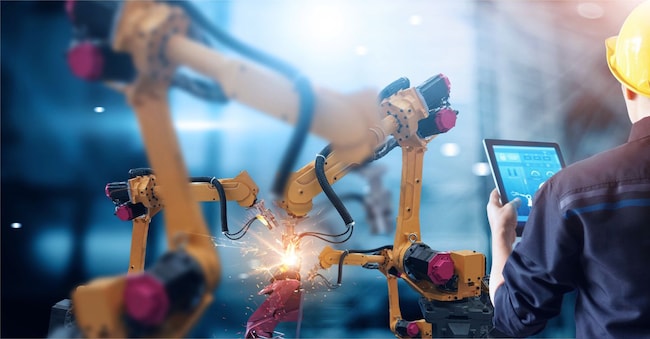
In the factory today, the rhythm is not set by the conveyor belt, but by data: the production cycle is no longer a rigid sequence of steps, but a continuous conversation between machines, sensors and algorithms. Robots slow down or speed up according to the orders coming in from the sales floor, vision systems check every single part that comes off the line, a private 5G network connects machinery, warehouse and quality lab, while artificial intelligence models predict possible breakdowns and fluctuations in demand, product by product. This is where the Internet of Things shows its true face: not a technological gadget, but the invisible web that holds data, people and processes together.

The Internet of Things Observatory of the Milan Polytechnic summarises this phase as follows: the Italian IoT market is 'a consolidated and increasingly pervasive reality', capable of affecting the industrial world as much as services and everyday life. Indeed, even more so on this second front, transforming interactions and behaviour in everyday acts . And it is precisely on the basis of this pervasiveness that we understand why, without IoT, not only would Factory 5.0 remain a mere exercise in style, but also our lives would be completely different and less immediate.

Loading...

Font-Family: sun_text, Georgia, Times, "Times New Roman", serif; font-size: 22px;">Forever

In 2024, the Internet of Things market in Italy reached 9.7 billion euros, a growth of 9% compared to the previous year, with 155 million active connected objects, more than two and a half devices per inhabitant. If we then imagine the divergent trend between the expansion of connected objects and the national demographic decline, we can get an idea of how this percentage has wide margins for increase. It is an ecosystem that is now close to the symbolic threshold of EUR 10 billion in value, moving faster than digital as a whole and increasingly reliant on services: EUR 4.2 billion, 43% of the market, comes precisely from software platforms, data analysis, maintenance and new business models.

Within these numbers, the Smart Factory plays an increasingly prominent role. For the first time in 2024, it exceeded EUR 1.04 billion, a growth of 15% year-on-year. It means that industry is getting serious: eight out of ten large manufacturing companies have launched at least one Industrial IoT project, up from 66% five years ago.

Behind the acronym industrial IoT there are very concrete cases. An assembly line equipped with vibrational and thermal sensors that feed predictive maintenance algorithms; automated guided trolleys and mobile robots that move guided by a private 5G network, in continuous dialogue with the warehouse management system; platforms that cross production data, orders and inventories to suggest supplies in advance, reducing stocks and downtime. It is no coincidence that, among the companies that have already launched 4.0 projects, the most widespread applications relate precisely to predictive maintenance and production optimisation, considered a priority by more than six out of ten companies.

The transition to Factory 5.0, however, is not yet complete. The new 5.0 Transition Plan, which is supposed to push investments also oriented towards sustainability and workers' welfare, is struggling to take off: only one in two large companies and one in three medium-sized ones claim to have launched 5.0 initiatives. The paradox is that the technology exists, the incentives too, but the cultural leap - rethinking the organisation around data, people and cooperating algorithms - is slower than expected.

Everyday normality

But the IoT economy expands far beyond the factory gates. The areas of connected cars and utilities remain the first in terms of turnover, with comparable values of around EUR 1.6 billion, followed by Smart Building (EUR 1.4 billion). Together they make up a third of the market and tell another side of the transformation: connected vehicles that communicate with fleets and insurance systems, smart meters for energy, gas and water that enable dynamic tariffs and new money-saving services, buildings that regulate lighting and air conditioning based on the actual presence of people.

But it is in the combination of these worlds that we see the most interesting trends. Factory 5.0 does not live in isolation: it connects to renewable energy communities, uses smart meters and IoT platforms to modulate consumption according to peaks in production from renewables, and communicates with similarly connected logistics systems that track goods, vehicles and temperatures. In this scenario, the IoT connection with its wealth of data becomes a currency of exchange between different actors.

Now artificial intelligence is a candidate as a value multiplier. The Polytechnic Observatory emphasises that AI is 'at the top of the list of technologies that companies want to integrate with the Internet of Things': more than half of large companies and a third of medium-sized companies with IoT projects have already experimented with AI solutions within these initiatives. It is not just a matter of slightly more sophisticated dashboards: models are starting to appear in Italian factories that predict waste rates based on process parameters, suggest format changes to respond to sudden variations in demand, and automatically adjust line speeds to meet delivery targets.

The same logic applies to sales and supply forecasting. The integration of sensors along the supply chain, IoT tracking systems on pallets, sales data from physical and digital channels enables much more accurate forecasting models. In a 5.0 perspective, this is not just to 'optimise the warehouse', but to make the entire chain more resilient: avoid overproduction, reduce waste, plan shifts and supplies with greater attention to people's well-being and environmental impact.

Skills to be updated

The not secondary issue of skills remains. The Observatory highlights how many administrations and companies point to the lack of skills as the main obstacle to the spread of advanced IoT projects, particularly in the Smart City sphere, where almost half of the municipalities indicate the lack of skills as an obstacle to the start-up and consolidation of initiatives. It is an issue that directly intersects with Factory 5.0: without technicians capable of interpreting data, integrators who know how to make Ot and It communicate, and managers capable of reasoning out scenarios based on forecasting models, the IoT risks remaining a collection of technological islands.

Yet the overall picture is of a mature market that has moved beyond the pioneering phase and is now playing the game of systemic impact. As a commentary on the Politecnico research summarises, Italy is "a country in which almost six out of ten citizens have at least one smart object in their home, eight out of ten large manufacturers have Industrial IoT projects and two key areas, Smart Factory and Smart City, have exceeded the billion euro threshold".

In short, the IoT economy is no longer the backdrop of digital transformation: it is the engine that is redefining the factory, services, and cities. The challenge of the next few years will be to understand whether Italy will be able to use this infrastructure of sensors, 5G connections, robotics and artificial intelligence not only to produce better, but to build a truly competitive and sustainable 5.0 model. (P.Sol.)

Copyright reserved ©
Loading...

Brand connect

Loading...

Newsletter

Notizie e approfondimenti sugli avvenimenti politici, economici e finanziari.

Iscriviti