The war in the Middle East

Iran déjà vu: all of Trump’s bluff attacks (and U-turns)

In five months of conflict, the US president has threatened a ‘final solution’ against Tehran on four occasions. Only to then return to the negotiating table

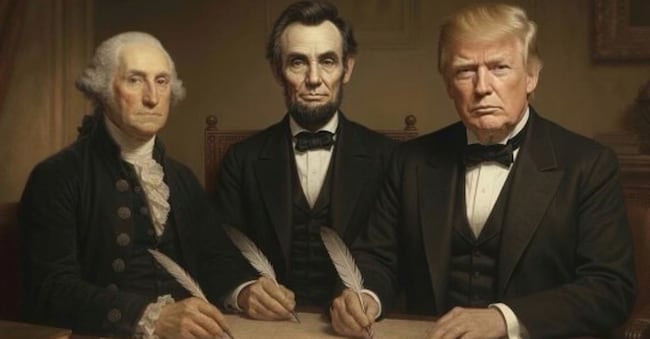
George Washington, Abraham Lincoln e... Donald Trump, nell’ennesimo meme generato dall’intelligenza artificiale condiviso dal presidente Usa sui social

4' min read

Translated by AI
Versione italiana

4' min read

Translated by AI
Versione italiana

He’s already played that card, in five months of war. And not just once. Donald Trump brandishes the threat of imminent escalation, exemplary punishment and the ‘doomsday weapon’ against Iran, only to do a U-turn and return to the negotiating table.

Ultimately, it always works the same way: it starts with a grim warning to Tehran that the US president is on the verge of ordering US forces to ‘destroy’ its power stations or seize key parts of its oil industry if its leaders do not swiftly accept American conditions to end the war. It ends with him backtracking with a last-minute statement, sometimes at the request of this or that Gulf ally, in which he states that he will allow more time for diplomacy.

Loading...

The iron-fisted strategy – which ‘The Donald’ honed over the years as a property developer in New York, in the circle of Roy Cohn, the most unscrupulous lawyer in the Big Apple of the 1970s – aims to shake up negotiations through pressure and chaos. There’s a lot of bluffing involved. Risks included, because ultimately the problem with bluffing is always that someone calls your bluff. A bit like the Iranian theocracy now seems to have learnt to do.

The latest episode began on Friday, when Trump, surrounded by his cabinet, declared with an air of impatience that he was ‘losing confidence’ in the negotiations with Iran and warned that the US military would ‘hit them very hard’.

A few hours later, White House spokeswoman Karoline Leavitt fuelled speculation in Washington – and around the world – with a threatening statement in which she claimed that ‘Iran will continue to pay until it sits down at the negotiating table in a way that President Trump considers meaningful’. In fact, the ‘largest US attack since the Second World War’ was reportedly just around the corner.

But late on Saturday evening, Trump stated on social media that there were signs of progress towards reaching an agreement and that he would, for the time being, suspend plans to launch further large-scale attacks.

The following day, Trump emphasised that calls to give diplomacy more time – made by anonymous Iranian officials and the leaders of the Gulf allies – Qatar, Saudi Arabia and the United Arab Emirates – were decisive in his change of course. “It would have been disastrous for them. And they didn’t want us to do it,” said the White House occupant.

Throughout the conflict, there were several occasions on which Trump demonstrated his propensity for belligerence, only to back down at the last minute, whilst claiming that his threats had spurred progress.

In early April, the United States and Iran agreed to a two-week ceasefire in an announcement made less than two hours before the deadline Trump had set for Tehran to capitulate or face attacks on bridges and power stations. Attacks which, according to him, would have meant ‘the death of an entire civilisation’.

Following days of fierce threats against Iran, Trump announced on 18 May that he would call off a major military strike that had already been planned because ‘serious negotiations’ were under way, crediting his Gulf allies with having persuaded him to show restraint.

Loading...

Then, in June, Trump threatened to strike Iran ‘very hard’ and to seize the Iranian energy base on the island of Kharg in order to ‘take total control of their oil and gas markets’, only to then backtrack on social media, stating that peace negotiations had made progress with high-level Iranian leaders.

What the president failed to mention was that such an undertaking would have required the deployment of US troops on the ground in Iran. A politically risky proposal for a president who based his election campaign on avoiding foreign entanglements and criticised previous administrations for becoming bogged down in endless wars.

With this latest episode – the fourth since the start of the war – Trump has made it clear that the Saudi Crown Prince Mohammed bin Salman played a particularly important role in persuading him not to escalate the conflict. The sheikh is said to have pointed out to the tycoon that an escalation of the fighting could have serious repercussions for the global economy if Tehran were to respond to a new US bombing raid by targeting some of the United States’ allies in the Gulf.

Bear in mind that in November there will be the elections Midterm elections in November, and that, according to an AP poll, around two-thirds of US adults believe that in the war against Iran, which began on 28 February, the game wasn’t worth the proverbial ‘candle’. When it comes to polls, be careful not to ask the President questions that are too explicit: he’ll reply that it’s all ‘fake news’. The real poll figures show me at an all-time high – and how could it be otherwise, given the biggest tax cuts and the best employment figures ever, the largest foreign investment in US history, a completely secure border, a crushing victory in Venezuela, the denuclearisation of Iran, unrivalled respect and success around the world, and much more besides?”, he writes in a post on Truth. Because ‘The Donald’ knows what to do: keep up the bluff, as long as it holds. Or at least seems to hold.

Copyright reserved ©
Loading...

Brand connect

Loading...

Newsletter

Notizie e approfondimenti sugli avvenimenti politici, economici e finanziari.

Iscriviti