Theocracy

Iran after Khamenei: who is in charge now and the names of possible successors

Pezeshkian and two senior officials will lead the transition

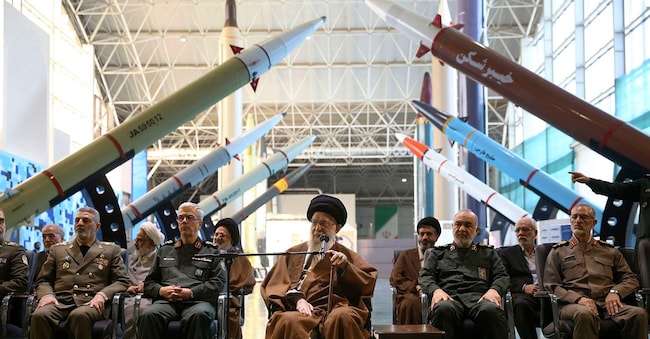
 In questa foto diffusa dal sito web ufficiale dell'ufficio della Guida Suprema iraniana, la Guida Suprema Ayatollah Ali Khamenei, al centro, accompagnato dai comandanti delle forze armate, visita una mostra sui risultati raggiunti dalla Guardia Rivoluzionaria nel settore aerospaziale, in Iran, il 19 novembre 2023. (Ufficio della Guida Suprema iraniana tramite AP, File)

3' min read

Translated by AI
Versione italiana

3' min read

Translated by AI
Versione italiana

The Iranian President Masoud Pezeshkian and two senior officials will lead the transition in Iran after the death of the Supreme Guide, Ayatollah Ali Khamenei. This was confirmed by the head of the Supreme Security Council, Ali Larijani, after reports on state TV, which named the two officials as the head of the judiciary, Gholamhossein Mohseni Ejei, and another official of the country's judicial council.
Ali Larijani, credited by the media as the likely candidate to succeed the late Ali Khamenei in the role of Supreme Guide, told state television that a temporary governing council will be formed to guide the country during the transition period.. "The process of forming the council will begin today, in accordance with Article 111 of the Constitution, which deals with the death or dismissal of the leader. The council will be composed of the president, Masoud Pezeshkian, the head of the judiciary, Gholamhossein Ejei, and one of the Islamic jurists who are members of the Council of Guardians, who will be appointed by the Council of Opportunity, until the presentation of the new leader' by the Assembly of Experts.

Loading...

The Iranian Constitution entrusts the choice of successor to the Assembly of Experts, composed of 88 clerics, which deliberates in a closed vote.

There is no designated heir and the selection reflects a delicate balance of theological authority, political allegiance and support from the centres of power.

According to an analysis by the news site Amwaj.media, the prospect of succession in recent months has triggered a concrete and increasingly visible competition within the Iranian establishment.

Two other names that seem to be emerging more strongly are Hassan Rouhani and Hassan Khomeini. The former, a former president and moderate cleric, is critical of the current conservative line, but many interpret this position as a calculated move to establish himself as a credible alternative. With a long institutional curriculum - from the leadership of the Supreme Council for National Security to the presidency of the Republic - Rouhani has solid ties in the ganglia of power and enjoys recognition in the Shiite seminaries of Qom and Najaf.

Hassan Khomeini, grandson of the founder of the Islamic Republic, combines dynastic legitimacy with high-level religious training. Khomeini is close to the Pasdaran on strategic issues and a supporter of the 'Axis of Resistance', and has been open on civil liberties and diplomacy. He has thus built a transversal profile capable of attracting both conservative and more pragmatic circles.

More unlikely, but often cited, is the hypothesis of Mojtaba Khamenei, son of the Supreme Guide who was allegedly killed today. A hereditary succession would conflict with the Shia tradition and the anti-monarchical principles of the Islamic Revolution, and risk undermining the legitimacy of the already fragile system.

Ebrahim Raisi was until his death considered the preferred candidate of the conservatives and left a vacuum in the hardline front that helped shift attention to figures considered possible 'bridges' between factions.

The Pasdaran also play a crucial role: the military apparatus has reportedly been engaged for some time in a preliminary selection phase to ensure that the future leader enjoys their support.

Among the possible successors mentioned in an analysis by Iranwire is Mohammad Mehdi Mirbagheri, a member of the Assembly of Experts and considered an exponent of the more ideological wing, with an eschatological vision combined with political intransigence: he rejects Western models, calls for 'maximum' control of the clergy over society and has justified extreme positions even on the Middle East conflict.

More secluded but influential is Ahmad Hosseini Khorasani, a member of the Guardian Council by direct appointment of Khamenei, he is a staunch defender of the Pasdaran, whom he calls a pillar of the system. He supports national self-sufficiency and is sceptical about negotiations with the West.

Another name circulating is that of Mohammad Reza Modarresi Yazdi, himself a member of the Assembly of Experts and a figure linked to powerful clerical networks. Close to the Larijani family, he has taken increasingly hard-line positions against the West and religious minorities.

Copyright reserved ©
Loading...

Brand connect

Loading...

Newsletter

Notizie e approfondimenti sugli avvenimenti politici, economici e finanziari.

Iscriviti