
Live
War, latest news. Iran-Oman plan to reopen the Strait of Hormuz: a ‘temporary, jointly managed corridor’
The Pakistani army stated in a press release that the talks focused on measures to prevent a further escalation of the conflict and the reopening of the Strait of Hormuz
For feedback, please contact
english@ilsole24ore.com
 Aggiungi Il Sole 24 Ore
ai preferiti su Google
Summary by bullet points
25 August 2026
Israel expels Dutch representatives from the Board of Peace base in Kiryat Gat
Israeli Foreign Minister Gideon Sa’ar has announced the expulsion of Dutch representatives from the International Support Centre for Gaza (formerly CMCC) in Kiryat Gat, part of the Board of Peace for the Gaza Strip, who will have to leave Israel ‘within a week’. “I took this decision today following a series of anti-Israeli initiatives by the Dutch government. The latest was the passing of a law banning trade in Israeli products from Judea and Samaria, East Jerusalem and the Golan Heights, which will come into force next month,” Sa’ar wrote on X.
25 August 2026
Gaza: Israeli drone strikes Jabalia refugee camp, three dead
An Israeli drone strike on the Jabalia refugee camp has killed three people and injured several others. Sources at al-Shifa Hospital reported this to Al Jazeera. The attack struck a house situated behind a school in the northern part of the Jabalia refugee camp in Gaza.
25 August 2026
Bessent: “The Iranian leadership is admitting that the pressure is working”
“The Iranian leadership is admitting what the world can now see: the pressure is working”. This was stated by the US Treasury Secretary, Scott Bessent. Iran’s President Masoud Pezeshkian, in a post on ‘X’, emphasised that “he has acknowledged Iran’s economic difficulties, stating: ‘At some point, the war will have to end’.” Mohammad Bagher Ghalibaf, Speaker of the Iranian Parliament, was even more direct: ‘No matter how much military power we may have, if the population is hungry and we have no financial circulation, economic growth or domestic production, we will not be able to hold out’,” Bessent emphasises. “Under Donald Trump’s presidency, the Treasury Department will continue to cut off every source of economic support that keeps this regime afloat, until Tehran is completely isolated,” concludes the US Treasury Secretary.
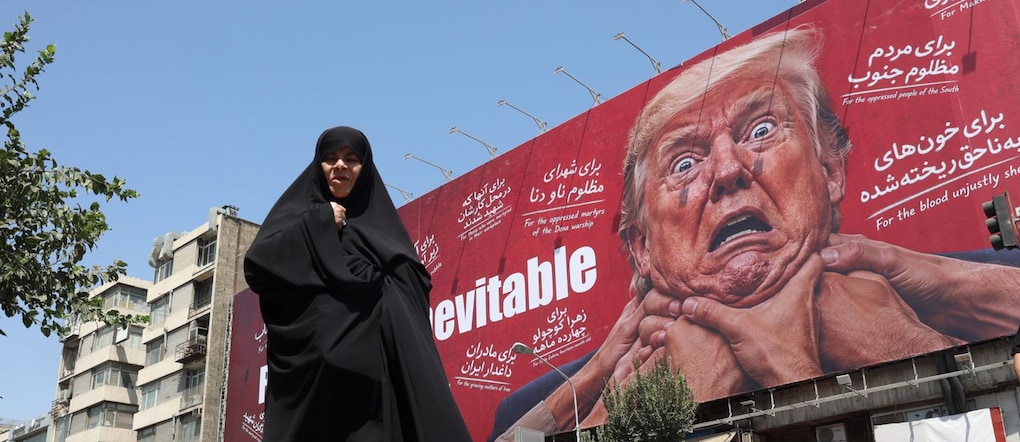
Una donna cammina accanto a un cartellone pubblicitario contro Trump a Teheran, in Iran, il 19 agosto 2026. Il presidente del Parlamento iraniano Mohammad Bagher Ghalibaf ha affermato che lo Stretto di Hormuz rimarrà chiuso fino a quando gli Stati Uniti non revocheranno il blocco e non porranno fine alle sanzioni. EPA/ABEDIN TAHERKENAREH EPA
Ask the editorial team
Have questions or feedback about this article? Contact our editorial team.
25 August 2026
Iran-Oman plan to reopen the Strait of Hormuz: a ‘temporary, jointly managed corridor’
A temporary, jointly managed maritime corridor and a joint mine-clearance operation. This is the plan discussed by Iran and Oman to enable “the resumption of safe navigation” in the Strait of Hormuz, according to a joint statement issued by the Foreign Ministry in Muscat following talks in Tehran between the two countries’ foreign ministers, Badr Albusaidi and Abbas Araghchi. The plan, the statement reads, envisages “a multi-stage process”. The first phase involves the establishment of a temporary maritime corridor through the Strait and a joint project to clear the waters of mines. The aim is to create the conditions for the safe reopening of the maritime route, “whilst preserving the sovereignty and rights of the coastal states”.
According to Iran and Oman, “technical negotiations” will continue to define “a permanent maritime corridor” and establish future arrangements for the management of the Strait. Among the issues to be addressed are information sharing, the coordination of maritime traffic and the provision of navigation and safety services. Oman and Iran are also calling for the involvement of other regional countries bordering the waters of the Gulf and reiterate the need to respect international law and the sovereign rights of coastal states.
25 August 2026
Gaza Ministry of Health: risk of ‘total collapse’ due to oxygen shortage
Israel “continues to step up its attacks on Gaza and to violate the ceasefire agreement, which exists in theory but is absent from the lives of people on the ground”. This was stated by Dr Munir al Bursh, Director-General of the Gaza Ministry of Health. Speaking on the Arab satellite channel Al Jazeera, Dr al Bursh said that the Gaza Strip is experiencing a “total collapse of essential goods and services”, adding that “only twelve oxygen stations out of approximately 34 remain operational” and warning that “any further breakdown could cut off the supply of oxygen to patients”. “If this oxygen supply is cut off, these people will die,” he said. “We do not want to reach the point where a doctor is forced to choose between two patients, deciding who will receive oxygen and who will be left without it.”
25 August 2026
Tehran: ‘We have full control over the Strait of Hormuz’
Iranian Vice-President Mohammad Reza Aref has stated that Tehran’s control over the Strait of Hormuz “is the exercise of our legal and sovereign right over our national wealth”. “The Strait of Hormuz belongs to Iran,” said Reza Aref, according to reports by the Iranian news agency ISNA. “We are fully prepared to face the enemy,” he added.
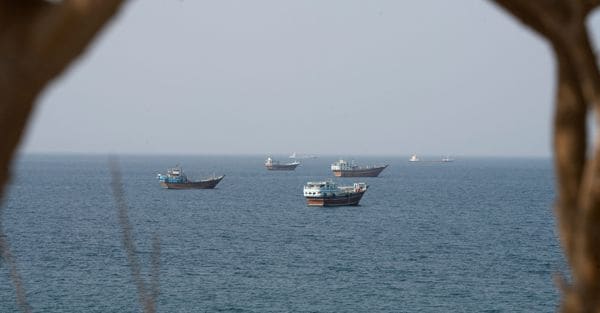
FOTO D'ARCHIVIO: Imbarcazioni nei pressi dello Stretto di Ormuz, viste da Musandam, Oman, il 17 agosto 2026. REUTERS/Stringer/Foto d'archivio
25 August 2026
Iran, US: no negotiations or talks are currently taking place or planned
A White House official, speaking on condition of anonymity, told Al Jazeera that no talks or negotiations with Iran are currently taking place or are planned. ““As President Trump has stated, there are currently no talks or negotiations with Iran taking place, nor are any planned,” the source said. “The naval blockade remains firmly and effectively in place, the Strait of Hormuz is open, and the sea mines have been removed or destroyed,” the
25 August 2026
Hormuz: meeting in Tehran between the foreign ministers of Iran and Oman
The foreign ministers of Iran and Oman – the two countries that control the Strait of Hormuz – met for talks in Tehran. This was reported by the Foreign Ministry in Tehran, without providing details on the content of the meeting between the Omani minister, Badr al-Busaidi, and his Iranian counterpart, Abbas Araghchi. In early August, Tehran announced that it had agreed with Oman on a new route for ships passing through the Strait, but the official signing of the agreement remains pending. Before the war, around a fifth of the world’s hydrocarbons passed through the Strait of Hormuz. Iran closed the Strait following the Israeli-US attacks in late February, whilst Washington responded by imposing a blockade on Iranian ports.
25 August 2026
IDF Chief of Staff: the hunt for those responsible for the events of 7 October continues
“The hunt for the terrorists behind the 7 October attack continues: all those who took part in the massacre will be forced to live on the run until they are eliminated.” This was stated by the IDF Chief of Staff, Lieutenant General Eyal Zamir, during an operational visit to the Gaza Strip, according to a post by Tsahal on Telegram. During the visit, Zamir met with commanders on the ground, who briefed him on the operational situation and the troops’ activities. The Chief of Staff expressed his appreciation for the soldiers deployed in the Gaza Strip in defence of Israeli civilians.
Zamir stated that the IDF is prepared and on high alert on all fronts, and that Israel will not allow its enemies to rebuild their capabilities along its borders, “with particular focus on Gaza and Lebanon”. “We will continue to act proactively and systematically to weaken them. We will not allow terrorist infrastructure to take root. We will seize every opportunity to eliminate threats whilst they are still in their infancy”, he said, adding that the Israeli army is applying the lessons learnt and has adjusted its approach: “The IDF will not return to the situation of 6 October”.
25 August 2026
Iran: Trump, ‘No more mines in the Strait of Hormuz – zero tolerance’
“I have just been informed by the US Navy that all mines have been removed and/or blown up in the international waters of the Strait of Hormuz.” So said Donald Trump in a new post on Truth dedicated to Iran, in which he states that Tehran has been informed that “any ship or vessel that lays new mines will be immediately and systematically destroyed”. “Through the Space Force, we are monitoring every centimetre of the Strait, just as we do with Pickaxe Mountain and the other three nuclear sites that have already been destroyed,” he concludes, emphasising what he calls a “zero-tolerance policy on the laying of mines”, a “policy” which the tycoon claims is “fully in force”.
25 August 2026
CNN: ‘Iran and Canada: a test for Trump’s philosophy’
Donald Trump’s presidency is based on the idea that the president and the United States are so powerful that both allies and enemies must bow to their will. But the tycoon’s philosophy is now facing its most serious test with the war in Iran and the trade dispute with Canada. Tehran has, in fact, challenged American power in a war that began six months ago and which Trump has not yet managed to bring to an end, notes CNN. Canadian Prime Minister Mark Carney, on the other hand, has publicly stated that the United States has ‘changed’ under Trump, who is using ‘economic integration as a weapon’. The Trump administration “is sending the US economy to war in the hope that Canada will yield to a deal and the Iranian regime will fall. But the path is uncertain on both fronts because the president often backtracks when the economic consequences of his attempts to assert himself become clear”, CNN points out. Any effort to ensure US dominance in the standoffs with Canada and Iran could trigger retaliation capable of driving up prices for Americans, as well as destabilising the markets. If the president’s threats “are a prelude to further U-turns” – as ‘Taco’ Trump is dubbed – the risk the president faces is that of “jeopardising his own power and that of the country as difficult mid-term elections loom for the Republicans”.
25 August 2026
Ben Gvir: ‘UNRWA is in our hands’
“This morning, a large contingent of Israeli police cleared the UNRWA compound in Kafr Aqab. UNRWA is an organisation whose staff have been involved in terrorist activities and which has repeatedly provided cover for Hamas. Sovereignty is not proclaimed, it is won. Jerusalem is the capital of the State of Israel and will remain so. Anyone who establishes terrorist hideouts there will be expelled.” This was stated in a note by the Minister of National Security Itamar Ben-Gvir. Ben-Gvir also posted an image on X of the UNRWA training centre, located between the village of Kafr Aqab and the Calandia checkpoint north of Jerusalem – in an area that Israel recognises as an Israeli municipality – in which the Israeli flag can be seen flying, adding the caption “UNRWA is in our hands” (paraphrasing the iconic phrase in Israeli narrative, ‘The Temple Mount is in our hands’, uttered by then-General Mordechai Gur after Israel’s conquest of the area in the 1967 Six-Day War).
אונר״א בידינו🇮🇱 pic.twitter.com/2smQ0he8Fn
— איתמר בן גביר (@itamarbengvir) August 25, 2026
25 August 2026
Trump’s approval rating stands at 33 per cent, with the war in Iran weighing on his support
Donald Trump’s approval rating remains at an all-time low as support amongst Americans for a war with Iran wanes. According to a Reuters-Ipsos poll, only 31 per cent of Americans support a conflict with Tehran, down from 37 per cent in March and 34 per cent in recent weeks. This is weighing on Trump’s popularity; for the second consecutive poll, he has the backing of just 33 per cent of Americans.
25 August 2026
Israeli raid on mosques in Gaza: ‘They contained weapons’
Israeli raids on Hamas weapons caches located inside mosques and near certain healthcare facilities. This is according to a statement issued by the Israel Defence Forces (IDF) on Telegram. Yesterday, the IDF emphasised that the Israeli army and the Shin Bet “struck and dismantled five Hamas weapons depots and a Hamas launch site as part of several attacks carried out in various areas of the Gaza Strip. In these facilities, Hamas was storing rockets, weapons, explosive devices, grenades, ammunition and other military equipment, with the aim of carrying out terrorist attacks against IDF troops in the Gaza Strip’. These storage facilities, Tsahal claims, ‘had been set up inside mosques and alongside humanitarian infrastructure in the Gaza Strip. According to the IDF, this is yet another example of Hamas’s systematic exploitation of the civilian population and infrastructure, including mosques and humanitarian facilities, in violation of international law.”
25 August 2026
Nyt: US set to send diplomats back to its embassies in the Middle East
The US State Department is preparing to return US diplomats to embassies in the Middle East that had been evacuated before and during the conflict with Iran, which began with the operations launched on 28 February by the US and Israel against the Islamic Republic – to which Tehran has not failed to ‘respond’. This is reported by the New York Times, based on an internal State Department document and information obtained from three US officials, emphasising that the decision suggests the Trump Administration does not anticipate a return to large-scale hostilities. According to the document seen by the newspaper, the return of diplomatic service officials and the scaling back of emergency measures adopted at US missions in the Middle East could begin as early as this week; among the embassies where higher staffing levels are expected to be restored are those in Israel, Lebanon, Saudi Arabia, Qatar, Jordan, Oman, Iraq and Kuwait.
25 August 2026
Trump: ‘Iran is killing protesters; there is a massive humanitarian crisis’
“Iran, now on the brink of collapse, is failing to pay large sections of its armed forces and is killing protesters – even when they are not protesting – on an unprecedented scale. This is a humanitarian crisis of enormous proportions that must be stopped, now.” Donald Trump made this statement on his social media platform, Truth.
25 August 2026
Qatar: ‘US sanctions against Iran are unilateral. We support mediation’
“The US sanctions against Iran are unilateral, and we support mediation efforts aimed at resolving the crisis.” This was stated by the spokesperson for the Qatari Ministry of Foreign Affairs, Majid Al-Ansari, as quoted by Al Jazeera. “The situation in the Strait of Hormuz should return to how it was before the crisis, and we emphasise the need for freedom of navigation.” The spokesperson went on to add that “if Israel wishes to become an integral part of the region, it must fulfil its obligations”. Meanwhile, Doha rejects “Iran’s attempt to involve countries in the region whenever it is attacked by a third party”.
25 August 2026
IDF: Hamas weapons caches in mosques in Gaza hit
The Israeli Air Force has stated that yesterday, five Hamas weapons depots located inside mosques and near humanitarian aid centres, as well as a rocket launch site, were bombed in the Gaza Strip. According to the Israeli Defence Forces, the weapons depots were being used to store rockets, weapons, explosives and other military equipment used by Hamas to launch attacks against troops.
“These depots have been set up inside mosques and next to humanitarian facilities in the Gaza Strip,” the army says.
25 August 2026
Gaza: new details emerge about the IDF raid on Nasser Hospital a year ago
One year on from the bombing of Nasser Hospital, which claimed the lives of 22 people, including five journalists, in the south of the Gaza Strip, an Israeli soldier has told several international media outlets how the Israeli army uses so-called “retroactive incrimination” to link the victims of an attack to Hamas.
Immediately after the attack, the Israeli authorities said that the target was a camera, suspected of belonging to Hamas, situated on the roof of the hospital. Among the journalists killed were the Reuters cameraman, Hussam al-Masri, and the video journalist Mariam Dagga, who worked for the Associated Press and other news organisations. Despite repeated requests from the Associated Press, the army has not provided any details regarding the investigation into the circumstances of the attack, nor has it given a timeframe for its completion.
In the face of international outrage over the double attack on the hospital, which was captured on an external camera, the AP reports that the Israeli army subsequently claimed that six of those killed were linked to Hamas, without, however, providing any evidence. An Israeli soldier who spoke to the media on condition of anonymity stated that the army had found no evidence linking the camera – which belonged to a Reuters cameraman – to Hamas, and that none of the six had been the intended target of the attack. The AP notes that it had already emerged immediately after the attack that one of the six people was not on the list of victims and that two others were medical or emergency personnel.
The soldier was put in touch with the Associated Press and other media outlets by Breaking the Silence, the group founded over 20 years ago by Israeli veterans which collects testimonies from soldiers and denounces Israel’s actions in the Palestinian Territories. The soldier stated that, following attacks that kill civilians without a clear military objective, army officers retroactively seek links between the victims and militants. Breaking the Silence has referred to a “process of retroactive incrimination” in which Palestinians killed are automatically deemed to be militants, even if they were unarmed.
Retroactive criminalisation is used as “an almost automatic justification for every bullet, grenade or missile fired, and as a means of avoiding proper investigations”, explained Nadav Weiman, the group’s executive director.
25 August 2026
Iran, Beijing: US sanctions are illegal; we will safeguard our legitimate interests
“China has repeatedly made clear its firm opposition to illegal unilateral sanctions, which have no basis in international law and have not been authorised by the United Nations Security Council.” This was stated by Chinese Foreign Ministry spokesperson Lin Jian during a press briefing, in response to the warning issued yesterday by US Treasury Secretary Scott Bessent, in which he urged countries to sever all financial ties with Iran or face exclusion from the US dollar system. “Economic warfare and maximum pressure tactics do not help resolve problems and will only further fuel conflicts, trigger knock-on effects, disrupt the global economic and financial order, and harm the rights and interests of other countries,” added Lin, “The top priority is to ease tensions and return to the path of dialogue and negotiation as soon as possible. China will take the necessary measures to resolutely safeguard its legitimate rights and interests.” This was reported by the Global Times.
25 August 2026
Plane en route to Tehran declares an emergency whilst flying over Turkey
An Airbus A310 aircraft operated by Taban Airlines, en route from Istanbul to Tehran, declared an emergency whilst flying over Turkey. This is according to Flightradar24. The aircraft transmitted the emergency code 7700 whilst descending near Ankara, indicating a possible deviation from its planned route. The nature of the emergency has not been clarified.
25 August 2026
Gaza, UNICEF: ‘12.2 per cent of children under five are suffering from chronic malnutrition’
12.2 per cent of children in Gaza are found to be suffering from chronic malnutrition. This is the finding of a new population-based nutritional survey, carried out in accessible areas of the Strip, which reveals a complex nutritional picture: relatively low levels of acute malnutrition amongst children, worrying rates of chronic malnutrition (stunted growth), maternal malnutrition, very poor dietary quality, inadequate feeding practices for infants and young children, and a significant impact of childhood illnesses. “Acute malnutrition amongst children under five was found to be low,” explains UNICEF. Chronic malnutrition, or stunting (an indicator of impaired linear growth that reflects nutritional and health conditions accumulated over time), affected 12.2 per cent of children under five. Overweight affected 4.0 per cent. The co-occurrence of stunting, wasting and overweight within the same population indicates poor dietary quality rather than simply a matter of food quantity: 73.0 per cent of children aged between 6 and 23 months had consumed unhealthy foods the previous day, and only 22.4 per cent had a minimally acceptable diet. Around 37.1 per cent of children under the age of five had suffered from diarrhoea in the two weeks prior to the survey. Maternal malnutrition was also documented amongst girls and women aged between 15 and 49 years.” The survey was conducted between 31 May and 15 June this year, following a substantial increase in humanitarian aid after the ceasefire in October 2025. In the months leading up to the ceasefire, including August 2025, when the Integrated Food Security Phase Classification (IPC) confirmed a state of famine in Gaza, severe access restrictions and supply disruptions meant that general supplementary feeding – one of the main means of preventing acute malnutrition – had been largely suspended across Gaza. Some programmes aimed at identifying and treating malnutrition continued to operate, but the supplies and access needed to prevent children from becoming malnourished in the first place were not reaching them. Following the ceasefire, the resumption of aid and commercial traffic meant that, whilst hospital admissions for the treatment of acute malnutrition had peaked at nearly 17,000 children in August 2025, by March 2026 they had fallen to fewer than 3,000. “The nutritional situation of children,” says Edouard Beigbeder, UNICEF’s Regional Director for the Middle East and North Africa, “improves when aid and commercial supplies reach them and deteriorates just as quickly when they do not. The improvements we are seeing are fragile and depend on sustained humanitarian access, adequate funding and functioning commercial markets. Without these, progress could be undone within a matter of months, and it will once again be children who pay the highest price. “Acute malnutrition can improve within a matter of weeks. The wider damage, however, cannot,” concludes Beigbeder. “Children need safe drinking water, healthcare and a varied, nutritious diet – not just enough calories to survive.”
25 August 2026
US offers a $10 million bounty on the head of the Pasdaran and its top leaders
The United States has offered a $10 million reward for the military leaders of the Pasdaran: “These individuals are in charge of units that have targeted US personnel with attacks and US critical infrastructure with cyber operations. Help us counter these threats. Submit a tip-off today,” reads the State Department’s announcement on X, addressed to “anyone who can provide information”, featuring photos of the head of the Pasdaran, Ahmed Vahidi, commander Ali Abdollahi, the head of aerospace and drone forces, Said Aghajani, the head of cyber warfare, Hamidreza Lashgarian, and the head of intelligence, Majid Khademi.
25 August 2026
Piracy on the rise in the Gulf of Aden
The Secretary-General of the International Maritime Organisation (IMO), Arsenio Dominguez, has called for the “immediate and unconditional” release of the more than 90 seafarers being held hostage following the recent acts of piracy in the Gulf of Aden.
“Navigational difficulties are on the rise due to the recent increase in incidents of piracy in the Gulf of Aden. With the latest hijacking, a sixth ship is now in the hands of pirates and armed robbers in waters that are becoming far too dangerous for seafarers,” said Dominguez, adding in a statement that “over 90 innocent seafarers are currently being held captive, their lives under constant uncertainty and threat, often with limited access to adequate food, drinking water, medical care and other essential services”.
“I call for the immediate and unconditional release of all those being held captive,” said the IMO Secretary-General, emphasising that “no seafarer should be subjected to violence, intimidation or exploitation simply for doing their job and helping to move goods around the world”.
25 August 2026
‘Economic D-Day’ against Iran: Bessent also threatens China over sanctions
 From New York Luca Veronese

‘Economic D-Day’ – the sanctions war that the United States intends to unleash to ‘isolate Iran through unprecedented measures’ – has rapidly become – as was evident yesterday in statements by the US administration – a threat to countries that do business with the Tehran regime, buy Iranian oil and ultimately prop up the ayatollahs’ economy. First and foremost is China, which has been the main buyer of Iranian oil for years. But also India and Turkey. And then there are Russia, the United Arab Emirates and Pakistan.
Scott Bessent, during a press conference in Washington, announced ‘the immediate launch of Operation Economic Outcast’, a new series of secondary sanctions, forming part of a broad ‘economic offensive to marginalise Iran and sever Tehran’s financial ties across the globe’: “Our aim,” the Treasury Secretary reiterated, “is to sever every economic lifeline supporting this tyrannical regime, until Tehran is left completely isolated.”
25 August 2026
Pakistan: ‘Significant progress in the talks in Tehran’
The Pakistani Minister of the Interior, Mohsin Navqi, reported “significant progress” in the talks he held in Tehran alongside the Chief of the Army, Field Marshal Asim Munir.
“Field Marshal Asim Munir and I had a very positive and productive meeting with the Iranian President – he wrote on X – our discussion focused on the conflict between Iran and the United States, tensions in the Middle East and future prospects, as well as the steps required by both sides to reinstate the Islamabad Memorandum of Understanding, which would lead to a comprehensive resolution of the conflict.”
For its part, the Pakistani army stated in a press release that the talks focused on measures to prevent a further escalation of the conflict and the reopening of the Strait of Hormuz.
“The Iranian President spoke frankly about his government’s position and concerns, and we had a very constructive discussion on the issues at hand,” added the Home Secretary. “Significant progress was made and the meeting concluded on an extremely positive note. We remain confident that this momentum will help pave the way for further progress and lasting peace in the region.”
25 August 2026
A ship has been attacked off the coast of Oman
The UK Maritime Operations Agency (UKMTO) has reported that a vessel was “hit by an unidentified projectile” approximately 9 nautical miles north-east of Ash Shishah, in Oman. The impact damaged the vessel’s engine room, whilst the crew were unharmed.
25 August 2026
Latest news on the war. Bessent: ‘Anyone who facilitates money laundering for Iran will be excluded from the dollar system’
