In Geneva

Iran, Foreign Minister Araghchi: 'Talks with US on nuclear power in Vienna on Monday'. Wsj: "Distant on key issues"

According to FT, Iran is reportedly trying to offer financial incentives to President Donald Trump in an attempt to reach an agreement on its nuclear programme
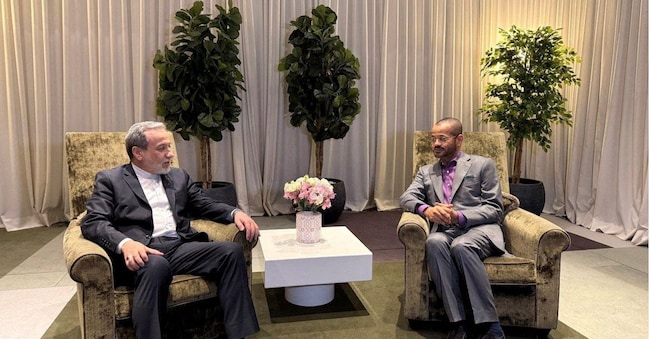
Il ministro degli Esteri iraniano Abbas Araqchi discute con l’omologo dell’Oman Sayyid Badr Albusaidi, mediatore dei colloqui indiretti a Ginevra

3' min read

Translated by AI
Versione italiana

3' min read

Translated by AI
Versione italiana

Diplomatic breakthrough, further negotiations, or rupture and war.
The international community remains suspended around these three possible outcomes of the sensitive US-Iran negotiations, now in their third round in Geneva. The Omani representative, after shuttling between emissaries from Washington and Tehran, spoke of "an unprecedented openness to new ideas" on the nuclear dossier and declared the session concluded with "significant progress" that will lead to new technical consultations next week in Vienna.

But the positions between Iran and the United States are still far apart on some key issues for a possible agreement. This is reported by the Wall Street Journal citing sources, according to which Tehran has rejected the idea of transferring uranium stockpiles abroad, has opposed an end to enrichment and the dismantling of its nuclear facilities, as well as permanent restrictions on its programme.

Loading...

The nuclear technical talks between Iran and the United States will begin on Monday next week at the headquarters of the International Atomic Energy Agency (IAEA) in Vienna. This was confirmed by Iranian Foreign Minister Abbas Araghchi on state television. "We have decided that the technical teams will begin technical negotiations at the International Atomic Energy Agency in Vienna on Monday, with the help of experts from that organisation," Araghchi said after a third round of talks between the two sides in Geneva.

The ayatollahs' regime also spoke of 'serious talks', which were attended by IAA Director Rafael Grossi.

'Disappointment', on the other hand, emerged at one point in the day from Steve Witkoff and Jared Kushner, showing that the road remains uphill. Complicating matters is the Iranians' insistence on keeping their ballistic missile arsenal out of the negotiations, while for the White House 'this is a problem'.

And in the meantime the US military apparatus in the region is being strengthened, with the aircraft carrier Gerald Ford heading towards Israel. The new demands presented to Iranian Minister Abbas Araghchi by Trump's envoys, according to sources in Geneva quoted by the Wsj, are to dismantle its three main nuclear sites and hand over all enriched uranium.

Washington would, however, be open to Tehran maintaining a symbolic enrichment threshold of less than 5 per cent below the purity level to produce atomic weapons.

On the other hand, the Iranians, who claim to want to keep their production alive for civil purposes, would be against moving their stocks abroad. Then there is the issue of sanctions, which strangle the Islamic Republic's economy. Tehran is calling for the lifting of all restrictions, but the Trump administration has not yet spoken out.

In the break between rounds of talks, in which the two delegations consulted each other's capitals, Iranian Foreign Ministry spokesman Esmail Baghai spoke of 'very important and concrete proposals made by both sides' and dismissed 'contradictory statements by foreign media and some US officials that continue to fuel doubts'.

A reading to somehow exorcise Trump's bellicose intentions

What worried the regime were the words of the tycoon, who in his State of the Union address accused Iran of possessing "missiles that can threaten Europe" and American military bases, and of working to develop more powerful ones capable of "reaching the United States soon". And this is precisely the point that threatens to derail the talks, even assuming an agreement on the nuclear issue is found.

This was confirmed by Marco Rubio: 'The president wants diplomatic solutions, but in the end we will have to discuss other issues besides the nuclear programme', explained the secretary of state, adding: 'Iran refuses to talk to us about ballistic missiles or anyone else, and that is a big problem'.

At this stage, the Trump administration is keeping its finger on the trigger: the aircraft carrier Ford, believed to be the world's largest, has left the NATO naval base in Souda, on the Greek island of Crete, heading towards Israel. It will join the Lincoln and its escort. On the timing and manner of a possible attack, however, uncertainty remains.

One of the options on Trump's table is a targeted blitz to pressure Tehran into making concessions on the nuclear issue. If, on the other hand, the White House's aim was to encourage regime change, a broader and more prolonged military campaign would be required. Among other things, no precise ideas filter out of Washington as to what might happen following the fall of the ayatollahs: who, for example, would take over the leadership of a country in which there is no single, consolidated opposition. Not counting the ambitions of Reza Pahlavi, son of the last Shah;

Copyright reserved ©
Loading...

Brand connect

Loading...

Newsletter

Notizie e approfondimenti sugli avvenimenti politici, economici e finanziari.

Iscriviti