Football and geopolitics

Iran v New Zealand ends in a draw (2–2), with boos during the national anthem and a round of applause for the players at the final whistle

The Melli team had to move their training camp to Mexico because of the war. That night, their debut against New Zealand was marred by protests from exiles of the 1979 Khomeini revolution
by Marco Bellinazzo

 (AP Photo/Andre Penner) APS

4' min read

Translated by AI
Versione italiana

4' min read

Translated by AI
Versione italiana

The long wait, marked by tensions that went far beyond football, dissipates at the kick-off whistle. It should always be like this. But for Iran, having reached the 2026 World Cup after weeks of conflict with the United States and Israel and with a peace agreement signed just before the match, there is nothing ordinary about it.

Protests by Iranian exiles

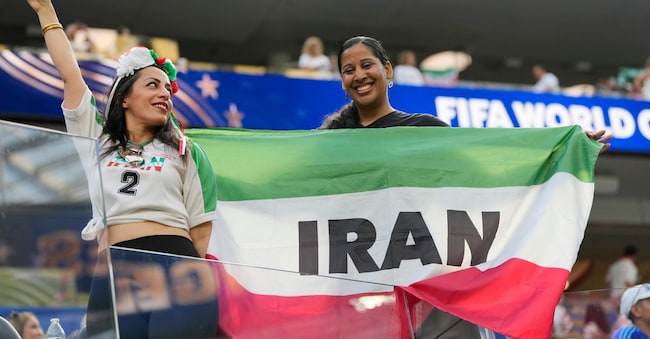
At SoFi Stadium in Los Angeles, an ultra-modern venue, the match against New Zealand kicked off in a tense atmosphere. In the stands, the Iranian community in exile – one of the largest in the world – made their dissent heard, as announced the day before, by displaying the flags used by movements opposing the regime alongside the historic tricolour featuring the Lion and the Sun (Shir-o-khorshid) at the centre – and by booing the national anthem, which was instead sung by the players. This scene stood in stark contrast to the team’s desire to focus exclusively on the pitch.

Loading...

Fast-paced match with the result still in the balance

Once the deadlock was broken, the match immediately took on a dynamic pace. New Zealand took the lead as early as the 12th minute, with Just skilfully finishing off a swift counter-attack that began with a win back in midfield: a through ball, a run behind the Iranian defence and a crisp finish at the near post.

Iran were shaken by the goal in the minutes that followed, showing some uncertainty in their build-up play. In the 19th minute, another chance for the Oceanians: a shot from the edge of the box by Singh was deflected for a corner by an alert save from the Iranian goalkeeper.

The Asian side’s response came as the match progressed, thanks to greater activity down the flanks. The equaliser came in the 33rd minute: a corner was taken from the right, and Razaeian made a perfect run to head the ball past the New Zealand defence and make it 1–1.

The second half got off to an even faster start. New Zealand resumed their direct attacking play and, in the 56th minute, struck again through Just, who scored his second goal of the match: he controlled the ball on the edge of the box and fired in a precise right-footed shot following a swift move in the final third that put the Iranian defence under pressure.

Iran, however, proved they were capable of staying in the game. In the 68th minute, a persistent move down the left, followed by a low cross into the box, set the stage for the equaliser. After a short clearance by the defence, it was Mohebi who found the winning touch from a few metres out to make it 2–2. The second equaliser was celebrated with jumping, chants and a huge roar that united the Iranian community. It is worth noting that the FIFA broadcast team, which shows the match on television and on the large screens above the pitch, never showed the Iranian flags at the centre of the controversy: neither the official ones bearing the Islamist symbol of the ayatollahs nor those of the opponents of the Islamic Republic featuring a lion in the centre.

In the closing stages, however, both teams had chances to win: in the 81st minute, an Iranian curling shot went just wide, whilst in the 88th minute, a New Zealand counter-attack saw Just come close to a hat-trick, with his shot saved at the last moment.

From the initial boos to the final applause, the match also signalled a partial reconciliation between the team and the crowd. At the end of the match, as they made their lap of honour, the Iranian players were greeted with sincere appreciation for the effort they had put in.

Rankings and outlook

The draw, combined with the simultaneous 2–2 draw between Belgium and Egypt, leaves Group G wide open. No team has pulled clear, and every remaining match will be decisive.

For Iran, the key will be to find stability and consistency. For New Zealand, it will be about turning good performances into wins. Meanwhile, in Los Angeles, football did what it does best: bringing everything, at least for ninety minutes, back within the confines of the game. With the simultaneous draw between Belgium and Egypt, Group G remains wide open. No clear picture has yet emerged: consistency and solidity will be needed to come out on top.

Iran returns to Mexico

Immediately after the match, the Iranian delegation was escorted to Mexico. Iran had planned to hold its training camp in Arizona, but was forced to move across the border because of the war. Having overcome the problems of visa refusals (although the federation president, Mehdi Taj, and other officials, considered close to the Pasdaran, were not granted permission to enter the US), from the moment of their arrival, the players of Team Melli (“national team” in Anglo-Persian) have been subject to strict security measures and are escorted by armed soldiers between their hotel and the Caliente stadium, where they are training at Club Tijuana’s facilities.

For the matches, the team will make quick trips to the United States on the eve of each game, returning immediately after the match to Mexico. Iran will return to Los Angeles for the match against Belgium on 21 June. The final group stage match will be against Egypt on 26 June in Seattle.

FIFA President Gianni Infantino never wanted Iran’s participation in the World Cup to be called into question and, above all, wanted the schedule for the matches to be played on American soil to be respected, whilst acknowledging the need to relocate the training camp for security reasons. “I am delighted that Iran are at the World Cup and proud of the work done by the FIFA team to make this possible. “We had to deal with exceptional circumstances over which we had no control,” said Infantino. “When I went to visit the Iranian national team in Antalya in March, someone told me they wouldn’t be able to come. I replied that they had qualified, and they would be coming. And that’s exactly what happened.”

Copyright reserved ©
Loading...

Brand connect

Loading...

Newsletter

Notizie e approfondimenti sugli avvenimenti politici, economici e finanziari.

Iscriviti

Tutto mercato WEB