
27 August 2026
War: latest news. Lebanon: Israel says no to Italian forces in ‘pilot zones’. NYT: war possible following Riyadh’s response to Houthi attacks
In a letter to the United Nations, the Islamic Republic accused the United States of using sanctions to harm civilians by restricting access to essential goods
For feedback, please contact
english@ilsole24ore.com
 Aggiungi Il Sole 24 Ore
ai preferiti su Google
Summary by points
27 August 2026
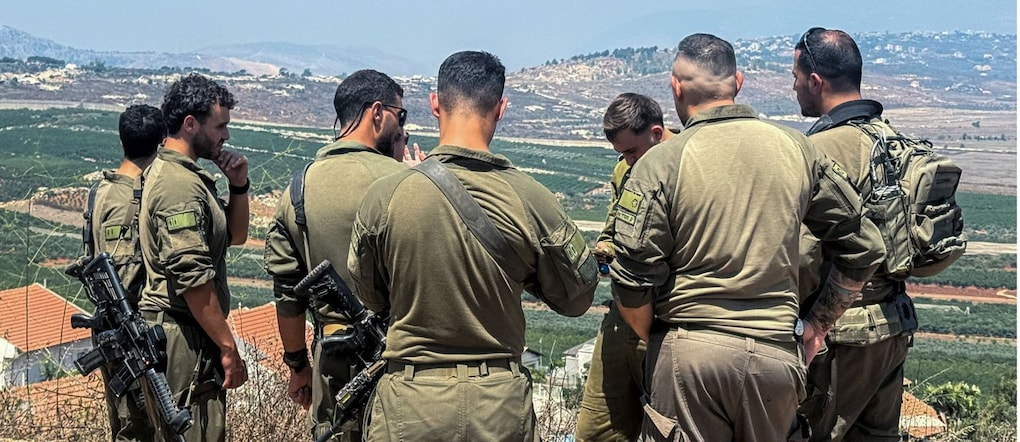
Lebanon: media reports that Israel has rejected the deployment of Italian forces in ‘pilot zones’
Israel opposes the deployment of an Italian military force in southern Lebanon, which would be tasked with inspecting the ‘pilot zones’ from which the Israel Defence Forces would withdraw, leaving control to the Lebanese army. This is reported by Ynet. According to the report, discussions amongst Israel’s defence leadership have concluded that “this is in fact an attempt by the Lebanese to circumvent the disarmament of Hezbollah, and concerns have been raised that the deployment of an Italian military force or one from elsewhere would lead to a restriction on the IDF’s freedom of action”.
27 August 2026
Gaza: at least three dead in Israeli attacks
The latest death toll from the attacks carried out today by Israeli forces in the Gaza Strip stands at three dead and several injured. According to reports from the Wafa news agency, an Israeli drone struck a tent housing displaced people in the al-Mawasi area of Khan Younis, in the south of the enclave, killing one person and injuring several others. In a separate incident, a drone struck an electric bicycle west of Gaza City, killing one Palestinian and injuring several others, one of whom is in a serious condition. Earlier in the morning, another Palestinian was killed in an attack on the al-Shati refugee camp, west of Gaza City.
27 August 2026
Yemen, NYT: Riyadh’s response to Houthi attacks could lead to a new war
A new front in the war could soon open up – one between Saudi Arabia and the Houthis. This is because weeks of attacks carried out by Yemeni militiamen against Saudi targets have brought Riyadh and the Iran-backed militia to the brink of a new conflict. This is the view of a number of analysts quoted by the New York Times, who suggest that Saudi Arabia may be seeking to weaken the group in order to force it to negotiate a settlement to the Yemeni civil war that is more favourable to Riyadh and its allies. Furthermore, the analysts say, there are signs of a broader military build-up on both sides.
Meanwhile, the channels of communication between Riyadh and the Houthis – which had remained open for years – have now broken down. “At the moment, I don’t see a political way out,” Mohammed al-Basha, a Washington-based political analyst specialising in Yemen, told The New York Times. “War is imminent,” he added. Earlier this week, the Houthis claimed responsibility for a missile attack on a Saudi oil tanker and two attacks on Saudi-backed forces in Yemen. A Saudi official, speaking on condition of anonymity to the New York Times, said that Riyadh prefers peace, but is prepared for war with the Houthis and will defend itself by any means necessary.
According to Yemeni analysts, the Houthis are acting to support Iran and to consolidate their own power, with the aim of securing access to Yemen’s oil resources. “Today, Yemen faces a greater risk of a return to large-scale conflict than at any other time since the UN-brokered truce in 2022,” warned the UN Special Envoy for Yemen, Hans Grundberg, during a briefing to the UN Security Council on 13 August. Earlier this month, Saudi Arabia’s ambassador to the United States, Princess Reema bint Bandar, voiced the kingdom’s concerns in Washington. Together with the Yemeni ambassador, Jamila Rajaa, she met with members of Congress to highlight the threat posed by the Houthis. According to a US official and a Yemeni official with knowledge of the meetings, the ambassadors discussed the need to counter the militias and encouraged the United States to support this effort.
Meanwhile, Ahmed Nagi, a senior analyst on Yemen at the International Crisis Group, told the New York Times that Saudi Arabia has improved military coordination between the anti-Houthi factions and is supplying these forces with advanced weapons, something that “had never happened before”. Riyadh has many reasons to avoid war, but the Houthis “are not ready to negotiate” and are pressing for political concessions in Yemen, Nagi said.
Soldati israeliani guardano verso il Libano da un punto panoramico al confine tra Israele e Libano, il 21 agosto 2026. Foto scattata con un cellulare. REUTERS/Avi Ohayon REUTERS
Ask the editorial team
Have questions or feedback about this article? Contact our editorial team.
27 August 2026
Senior Tehran official visits the Kharg oil hub
The Deputy Speaker of the Iranian Parliament, Ali Nikzad, has inspected the state of the oil infrastructure on Kharg Island following months of US attacks. This was reported by Al-Jazeera, citing the Iranian news agency Tasnim. At its peak, Kharg Island, off Iran’s southern coast, accounted for 90 per cent of the country’s total oil exports, with a capacity of around 1.5 million barrels a day, or approximately 950 million barrels a year.
27 August 2026
NATO, AP: Critical shortage of Patriot systems in Europe
The US armed forces are facing a shortage of advanced missile interceptors in Europe that is “beyond the critical threshold”, largely due to US President Donald Trump’s war against Iran, according to a US defence official in Europe and a NATO official who spoke to the Associated Press, expressing concern over the vulnerability of European countries to a potential Russian attack. The US defence official told the AP that the most worrying shortage concerns Patriot interceptor missiles, which are capable of shooting down high-speed Russian ballistic missiles. The NATO official confirmed the low stocks of Patriots among US and NATO forces in Europe.
27 August 2026
IDF kills Hamas commander who held three Israelis hostage
Ismail Mohammed Ibrahim Barim, a Hamas commander who had held three Israelis hostage in Gaza during the war, was killed yesterday in an attack in the south of the Strip. This was announced by the IDF. The man, it is explained, had taken part in the abduction of Edan Alexander, Matan Zangauker and Avera Mengistu in southern Gaza. All three were subsequently released by Hamas.
27 August 2026
Iran: Al-Thani meets Ghalibaf – resuming the diplomatic process
The Prime Minister and Foreign Minister of Qatar, Mohammed bin Abdulrahman Al-Thani, met the Speaker of the Iranian Parliament and chief negotiator, Mohammad Bagher Ghalibaf, during his visit to Tehran.
During the meeting, the Foreign Ministry in Doha said in a statement that Al-Thani had emphasised “the need to resume the diplomatic process, stressing that dialogue is the best way to address differences and prevent further escalation in the region”.
The meeting with Ghalibaf took place following the one held with the Iranian Foreign Minister, Abbas Araghchi, during which the two sides discussed the “creation of a temporary shipping corridor through the Strait of Hormuz and an agreement to implement a joint project to clear the strait of mines”.
27 August 2026
Iran: The aircraft carrier Roosevelt is to be deployed in the Middle East for over seven months
The US aircraft carrier USS Theodore Roosevelt and its crew of around 5,000 are set to set sail in the coming weeks for a deployment to the Middle East lasting at least seven months. “They know they will be there for more than seven months. Their commanding officer is telling them to plan for eight months,” said John Perryman, a senior chief petty officer in the US Navy, as reported by USNI News. The decision comes as the Navy is dealing with the fallout from the recent deployment of the USS Abraham Lincoln to the region, during which the ship spent more than 250 days at sea without calling at a port. This lengthy deployment has raised concerns about the mental health of the sailors, including reports of at least one person falling overboard, as well as reports of shortages of supplies on board the 100,000-tonne warship. According to USNI News, the Roosevelt is expected to replace the George Washington. The aircraft carrier USS George H.W. Bush is also currently engaged in operations in the Middle East.
27 August 2026
Pizzaballa: The West Bank is a no-man’s-land; the two-state solution is the only way forward


‘We must avoid reducing peace to a slogan and adopting naïve approaches to complex situations.’ Cardinal Pierbattista Pizzaballa, Latin Patriarch of Jerusalem, opened the session at the Rimini Meeting entitled ‘Gazing at the Sky of Jerusalem’ with these words. Politics, the cardinal explained, is also made up of balances of power and positions of strength, but the problem arises when “it is reduced solely to partisan interests; we have seen this in the Middle East, but not only there. At present, the emerging narrative is one of force and power – not just military power – and the consequences are clear.”
In the West Bank – as the Cardinal had explained in an interview given prior to the event – ‘tensions are constantly rising, particularly between the settlers and the Palestinian population’. The Occupied Territories have become “a no-man’s-land, a lawless place, where everything that happens goes completely unchecked in terms of security and the rule of law”. But there is no alternative to the two-state solution, because “it is the only way to recognise the right of Israelis and Palestinians to have a home in their own land”. This can only be achieved through diplomatic efforts, which must see the West engage in mediation to stem the current drift, bring the conflict to an end and set in motion “paths that are not only political, but also cultural, social and religious, and which are inclusive and respectful of the histories and narratives of both sides, Israelis and Palestinians”. This is a task that will take time. In short, the path to achieving this outcome does not lie in confrontation. When asked for his view on the Flotilla initiative – which aimed to break Israel’s naval blockade and deliver humanitarian aid to Gaza – Cardinal Pizzaballa responded by calling for initiatives that make a positive contribution and do not fuel confrontation or polarisation between the parties.
27 August 2026
White House: there are currently no negotiations with Iran
There are currently no negotiations taking place with Iran. This was stated by White House spokesperson Karoline Leavitt in an interview with Fox, emphasising that the US sanctions remain in force and that the United States aims to isolate Tehran economically. In the same interview, Leavitt also said that all options against Iran remain on the table.
27 August 2026
Iran: media reports suggest Ratcliffe asked Moscow to scale back its support for Tehran
As well as warning Russian officials not to escalate the conflict with America’s NATO allies, particularly Estonia, Latvia and Lithuania, in response to the stalemate in the Russian invasion of Ukraine, CIA Director John Ratcliffe used his surprise visit to Moscow on Tuesday to press Russia to reduce its military and economic support for Iran. This is according to Politico, citing several sources.
27 August 2026
Qatar: Discussions held with Iran on efforts to de-escalate tensions and the conditions for dialogue
During today’s meeting in Tehran between the foreign ministers of Iran and Qatar, “the latest developments in the regional situation were discussed, along with ongoing efforts to de-escalate tensions and create the right conditions for dialogue, thereby contributing to the strengthening of regional security and stability”, stated the Qatari Ministry of Foreign Affairs in a press release quoted by Al Jazeera.
27 August 2026
Media: CIA chief also asked Moscow to scale back its support for Iran
The head of the CIA John Ratcliffe is reported to have used his brief trip to Moscow to put pressure on Russia to reduce its military and economic support for Iran. This is reported by Politico, citing sources who claim that during his visit, Ratcliffe warned Russia against attacking NATO allies.
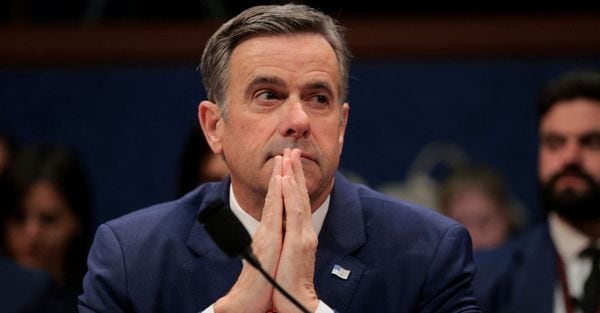
Il direttore della Central Intelligence Agency (CIA) John Ratcliffe partecipa a un'audizione della Commissione per l'intelligence della Camera dei Rappresentanti degli Stati Uniti sulle minacce globali, a Capitol Hill, Washington, D.C., Stati Uniti, il 19 marzo 2026. REUTERS/Kylie Cooper/Foto d'archivio
27 August 2026
Media: Consideration is being given to expelling GB from the Gaza centre
Israel is considering the possibility of expelling British representatives from the US-led international coordination centre for Gaza, located in the southern city of Kiryat Gat. This was reported to the Times of Israel by a source familiar with the matter, confirming an earlier report in the Financial Times and adding that “other measures” against London are also under consideration. The decision is being considered against the backdrop of the row between Israel and the UK over London’s alleged plans to impose a total ban on trade in goods from West Bank settlements and to adopt other punitive measures in response to theexpansion of the controversial Israeli E1 settlement plan, which would hinder territorial contiguity between the main Palestinian population centres. Sources state that, during a recent telephone call between Foreign Minister Gideon Sa’ar and his British counterpart, “Sa’ar made it clear that Israel cannot allow punitive measures to be taken against it without reacting”.
27 August 2026
Rabbi Ascherman: “In 31 years, I have never seen such collusion between the IDF and settlers in the West Bank”

Arik Ascherman was born in the United States in 1959, but has been living in the West Bank for over 30 years: as a rabbi and director of the NGO Torah of Justice, he has consistently denounced the settlers’ excesses and the illegality of the occupation, but the recent escalation of violence against Palestinians has left even him (almost) speechless. ‘I am witnessing a paradoxical situation. On the one hand, in my 31 years in the West Bank, I have never heard so many critical voices raised from within Israel regarding settler violence: not a day goes by without the Israeli mainstream media devoting articles and reports to it. The paradox is that this shift in public condemnation of the violence has not led to any practical change. Indeed, if anything, the situation has worsened,’ explains Rabbi Ascherman.
Apart from the media coverage, have you also noticed any institutional action?
27 August 2026
Israel orders troop reinforcements for the West Bank
The Chief of Staff of the Israeli Army, General Eyal Zamir, has stated that he has ordered a significant reinforcement of troops in the West Bank in light of recent tensions in the area. Zamir explained that, partly due to the upcoming Jewish festive period, he had ordered a division of the regular army to be placed on high alert, ready to reinforce troops in the West Bank should it be necessary. “In addition to this, it is necessary to make arrangements for the immediate deployment of units and battalions to reinforce the area,” he added. Normally, the West Bank is garrisoned by two divisions.
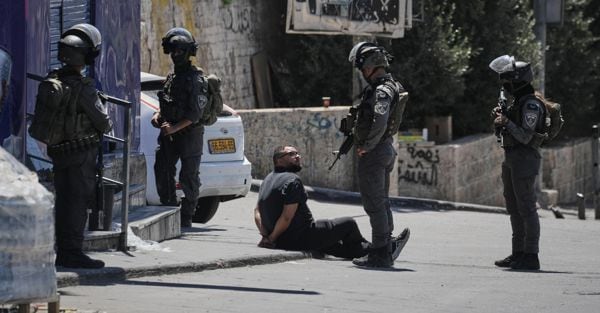
Un uomo palestinese ammanettato viene arrestato dagli agenti della polizia di frontiera israeliana durante un’operazione dell’esercito nel campo profughi di Qalandiya, in Cisgiordania, martedì 25 agosto 2026. (AP Photo/Mahmoud Illean)
27 August 2026
Egypt-Russia talks on the Iran-Oman agreement regarding the Strait of Hormuz
The Egyptian Foreign Minister Badr Abdelatty and his Russian counterpart Sergey Lavrov held a telephone conversation on various crisis situations and bilateral issues, “first and foremost the developments in the Middle East, including the joint proposal by Iran and Oman to establish a temporary maritime corridor in the Strait of Hormuz”, according to a statement from the ministry. Abdelatty outlined “Egypt’s intensive contacts with various regional and international parties to ease tensions and create a favourable climate for the resumption of the implementation of the Memorandum of Understanding between the United States and Iran, as well as for the conclusion of lasting agreements that address the various issues and strengthen regional security and stability”. During the talks, the Palestinian issue was also discussed, with emphasis placed on “the need for Israel to commit to complying with the provisions of the first and second phases of the plan and to cease all measures that undermine the prospects for peace, including settlement expansion and land confiscation”. On the Russia-Ukraine crisis, Egypt reiterated its hope for a political solution. On this occasion, an update was provided on the progress of work by the Russian company Rosatom on the construction of the Dabaa nuclear power station on the north coast, where the reactor pressure vessel for the plant’s second unit has been installed. A call was also made for the completion of the procedures necessary for the commissioning of the Russian industrial zone within the Suez Canal Economic Zone.
27 August 2026
Pezeshkian to Islamic countries: a mutual security pact is needed
The Iranian President, Masoud Pezeshkian, has called for greater unity and cooperation amongst Islamic countries, proposing three initiatives: “a pact on mutual security and non-aggression”, “a permanent mechanism for mediation and conflict prevention” and a network for economic cooperation in sectors such as artificial intelligence, medicine, energy, agriculture and new technologies. Speaking at the 40th International Conference on Islamic Unity, Pezeshkian emphasised that the security of countries in the region should not be built at the expense of their neighbours. “No Islamic country should become a platform for aggression against another Islamic country, and no Islamic country should seek its own security through the insecurity of its neighbour,” he stated, according to the IRNA news agency. The Iranian president also defended Tehran’s position in the conflict with Israel and the United States, arguing that “we did not start the war, but we have stood firm in the face of this aggression”. Among the proposals put forward by Pezeshkian, IRNA continues, is the creation of a permanent mechanism, through the Organisation of Islamic Cooperation, capable of intervening before disputes escalate into conflicts.
27 August 2026
The war in the Middle East in pictures
Guerra in Medio Oriente - 27 agosto 2026
Photogallery13 foto
27 August 2026
US: The aircraft carrier Theodore Roosevelt is heading for the Middle East for more than seven months
The US aircraft carrier USS Theodore Roosevelt is preparing for a deployment to the Middle East set to last over seven months, as the US war against Iran continues. This is reported by the US Naval Institute.
The head of naval operations, Admiral Daryl Caudle, and the Master Chief Petty Officer of the Navy, John Perryman, explained to journalists that the Theodore Roosevelt, its escort vessels and the Carrier Air Wing 11 on board are set to relieve the USS George Washington. The George Washington, normally based in Japan, entered the US Fifth Fleet’s area of responsibility in the Middle East last week. This new deployment confirms the growing shift of US naval resources towards the Middle East theatre, which also has implications for the US military presence in the Indo-Pacific.
27 August 2026
Iran: Vice-President says that, due to the US blockade, we are unable to import enough oil
“Oil production is insufficient and, due to the US naval blockade, we cannot import it”. Mohammad Jafar Ghaempanah, vice-president for executive affairs, acknowledged Tehran’s difficulties in managing fuel supplies, as reported by the official IRNA news agency. The comments by this representative of the moderate faction confirm the problems that have emerged in recent days, with long queues of Iranian motorists waiting at petrol stations. On Monday, the Iranian president’s chief of staff, Mohsen Haji-Mirzaei, had stated that oil import quotas would be reviewed, without providing further details. Ghaempanah criticised the distribution of heavily subsidised fuel in Iran, stating that the current system disproportionately benefits those who own multiple vehicles. “The distribution of petrol in the country is unfair. Those who own more vehicles benefit from the subsidies, unlike those who do not own a single one,” he said. Iran, one of the world’s leading oil producers with some of the cheapest fuel prices globally, has heavily subsidised fuel for years, making any change to prices highly ‘sensitive’ from a political standpoint. On the diplomatic front, Ghaempanah returned to the agreement signed at the time by President Masoud Pezeshkian and US President Donald Trump, brokered by Pakistani Prime Minister Shehbaz Sharif, describing it as a “source of pride for Iran” and calling for “an assessment of the commitments we have made and those made by the United States”. Emphasising that war is not an end in itself, but a means of guaranteeing the rights of the Iranian people, Ghaempanah stated: “We want an independent, free and prosperous country, capable of standing on its own two feet. We want a strong Iran.” However, the vice-president went on to add that Tehran should avoid war when its objectives can be achieved by other means. “Talking about an agreement is not a sign of weakness, but of strength,” concluded Ghaempanah, adding that military power and diplomacy complement one another.
27 August 2026
Pezeshkian: Iran is not in a position of weakness; it knows how to defend itself
Iran “is not in a position of weakness” and knows how to defend itself. This was stated by Iranian President Masoud Pezeshkian whilst addressing the 40th International Conference on Islamic Unity, currently taking place in Tehran.
In his speech, which was broadcast on television, Pezeshkian called on Muslim countries to unite despite their differences. The president also condemned what he described as the Israeli-American aggression against his country.
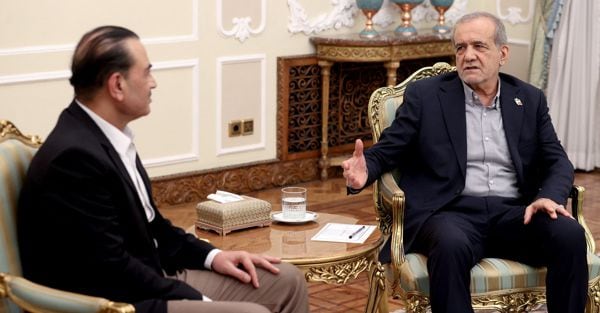
Il presidente iraniano Masoud Pezeshkian incontra il capo delle Forze di difesa del Pakistan, il feldmaresciallo Asim Munir, a Teheran, in Iran, il 24 agosto 2026. Sito web della presidenza iraniana/WANA (West Asia News Agency)/Foto fornita tramite REUTERS
27 August 2026
Qatari Prime Minister arrives in Tehran for talks with Iran on de-escalation
The Prime Minister of Qatar has landed in Tehran for talks with Iranian officials on de-escalation, following visits by the head of the Pakistani armed forces and the Omani Foreign Minister. This has been reported by various international media outlets, including Al Jazeera.
27 August 2026
Iran: no military vessels in the Strait of Hormuz in the event of an agreement with Oman
Iran will not allow military vessels to transit the Strait of Hormuz under the agreement it is negotiating with Oman for the management of maritime traffic in the strategic waterway. This was stated by the Iranian Deputy Foreign Minister, Kazem Gharibabadi. Diplomats from the two countries met to discuss the management of commercial traffic in the Strait, which remains largely closed almost six months after the start of the war with Iran. Gharibabadi explained on state television, as reported by the Associated Press news agency, that commercial vessels heading for the Persian Gulf would pass through Iranian waters, whilst the outbound route would pass partly through Iranian waters and partly through those of Oman. The deputy minister clarified that these would be temporary routes and that Iran and Oman would need to discuss a permanent plan for maritime traffic within 30–60 days. However, the agreement currently being finalised is facing opposition from the US administration. President Donald Trump has threatened to bomb Oman should the sultanate “get in the way”, whilst Washington is contesting certain aspects of the agreement under discussion.
27 August 2026
Iran: Oil tanker hit by an unidentified projectile in the Strait of Hormuz
An “unidentified projectile” struck an oil tanker in the Strait of Hormuz, causing a fire which was subsequently extinguished. This was reported by a British maritime agency. “Local authorities have reported that an oil tanker was struck by an unidentified projectile, causing a fire on board, which was subsequently brought under control,” said the United Kingdom Maritime Trade Operations (UKMTO).
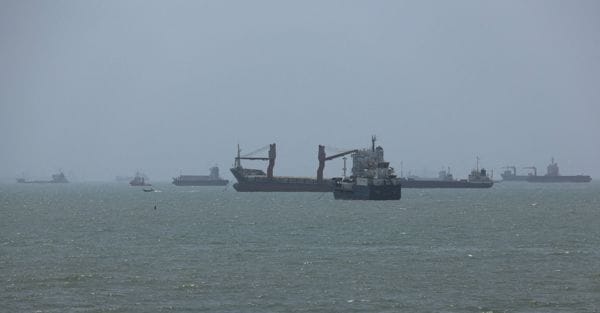
Navi nello Stretto di Ormuz sono visibili nei pressi della spiaggia di Bandar Abbas, in Iran, il 26 agosto 2026. Majid Asgaripour/WANA (West Asia News Agency) via REUTERS
27 August 2026
WP: US ammunition shortage worries Asian allies
Concerns are mounting amongst the United States’ Asian allies and Pentagon officials responsible for the Indo-Pacific region over the massive consumption of ammunition in the Middle East. The fear is that a protracted war in Iran could compromise US operational readiness in the event of a confrontation with China. This is reported by the Washington Post, citing several sources. Taiwan is expecting significant delays in deliveries of Patriot PAC-3 systems, whilst Japan has been warned of possible delays to various deliveries.
27 August 2026
Iran: US sanctions are an act of economic terrorism
Iran has condemned the latest threat of US sanctions in a letter to the United Nations, describing it as a “act of state and economic terrorism”. Foreign Minister Abbas Araghchi stated in the letter, published on Telegram and by Iranian state media, that the United States is seeking to put an end to Iran’s legitimate economic relations with other countries “after failing to achieve its objectives through war”. The letter was addressed to UN Secretary-General António Guterres, the UN Security Council and UN member states. Washington announced yesterday its intention to impose new sanctions aimed at economically isolating Iran, including measures targeting Tehran’s trading partners. US Treasury Secretary Scott Bessent stated on Monday that anyone conducting business with Iran would face the consequences of US force, with the aim of cutting Tehran off from all sources of income. When asked whether the measures would also apply to China, the main buyer of Iranian oil, Bessent replied that no one should “test” Washington’s resolve. Araghchi stated that the sanctions were designed to harm civilians by restricting access to food, medicines, medical equipment, energy and other essential goods. He called on the United Nations Security Council and its member states to condemn and reject the “unilateral coercive measures and secondary sanctions” , urging countries not to implement them and calling on Washington to stop pressuring third countries to alter their trade relations with Iran. China has already criticised the threatened sanctions, stating that an economic war would not lead to a solution, but would instead exacerbate conflicts and disrupt the global financial order.
27 August 2026
Hegseth does not rule out the possibility of launching attacks against Iran and in the Strait of Hormuz
The head of the Pentagon Pete Hegseth refuses to rule out the use of force against Iran. “We do not rule out the use of kinetic strikes anywhere in the Strait of Hormuz or in the vicinity,” he said, emphasising that Tehran will not be able to withstand the economic pressure it is under.
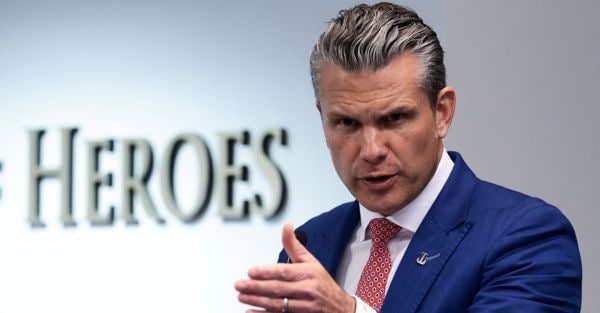
Il segretario alla Difesa degli Stati Uniti Pete Hegseth interviene durante una cerimonia in onore dei marines che hanno prestato servizio all’Abbey Gate dell’aeroporto internazionale Hamid Karzai di Kabul durante l’attentato suicida del 26 agosto 2021, in cui hanno perso la vita 13 militari statunitensi e circa 170 civili afghani durante l’evacuazione delle forze armate statunitensi dall’Afghanistan, tenutasi al Pentagono a Washington, D.C., Stati Uniti, il 26 agosto 2026. REUTERS/Evelyn Hockstein IMMAGINI DEL GIORNO DI TPX
