
-U22305373282sgW-1440x624@IlSole24Ore-Web.jpg?r=1020x442)
Live
Latest war news. Tehran reaches agreement with Oman on shipping route through the Strait of Hormuz
Iran’s Deputy Foreign Minister, Kazem Gharibabadi, has stated that a potential transit route through the Strait could be viable for a period of between two and four months
For feedback, please contact
english@ilsole24ore.com
 Aggiungi Il Sole 24 Ore
ai preferiti su Google
Summary by points
5 August 2026
Pezeshkian: It is very difficult to speak to Khamenei, but his presence is a great source of strength
Iranian President Masoud Pezeshkian has stated that it is currently “very difficult” to communicate with Supreme Leader Mojtaba Khamenei, “but his presence is a great source of strength for us”. This was reported by the Iranian news agency Fars. Since taking office in March, following the killing of his father, Ali Khamenei, in an Israeli-American raid, he has never appeared in public.
5 August 2026
Lebanon: Netanyahu calls security meeting over Hezbollah ceasefire violations
Israeli Prime Minister Benjamin Netanyahu is due to hold a telephone conversation this evening with Defence Minister Israel Katz, Chief of the General Staff Eyal Zamir and other senior officials. The discussion is likely to focus on the response to be given to Lebanon following the ceasefire violations committed by Hezbollah. This is according to Ynet.
5 August 2026
Houthis strike second Saudi oil tanker in the Gulf of Aden
The Iran-backed Houthi rebels in Yemen have claimed to have attacked another Saudi oil tanker – the second in a single day – as they continue their declared naval blockade against Riyadh. In a statement, Houthi military spokesman Yahya Saree said that the rebels had targeted the Saudi oil tanker Daisy in the Gulf of Aden with a ballistic missile.
Mercoledì 5 agosto 2026, dal villaggio di Zawtar al-Gharbieh, nel Libano, si vede un carro armato israeliano di stanza tra le abitazioni del villaggio di Zawtar al-Sharqiyah, occupato dalle forze israeliane. (AP Photo/Mohammed Zaatari) APN
Ask the editorial team
Have questions or feedback about this article? Contact our editorial team.
5 August 2026
Israel rejects Arab statement on Jerusalem
Israel has rejected the statement adopted by the foreign ministers of the Arab Ministerial Committee, which met in Jordan, on the situation at the Temple Mount, describing it as based on “false allegations, historical distortions and a complete ignorance of the facts”.
“It is particularly cynical to accuse Israel of violating freedom of worship whilst at the same time declaring that the entire Temple Mount is a place of worship reserved exclusively for Muslims, ignoring the Jewish people’s historical connection to Jerusalem and its holiest sites,” the Israeli Foreign Ministry stated on X.
According to the ministry, under Israeli sovereignty, Jerusalem “has never been so open and accessible to worshippers of all faiths”. Israel, the statement continues, remains committed to preserving freedom of worship and the status quo on the Esplanade, as well as to ensuring public order and the safety of visitors.
Jordan had convened an emergency meeting of foreign ministers from Arab and Islamic countries, warning of the risk of a change to the rules governing access to and prayer at the Al-Aqsa compound. Amman has historically exercised a custodial role over the Islamic and Christian holy sites in Jerusalem.
Tensions had escalated on 23 July, when the Israeli Minister of National Security, Itamar Ben-Gvir, along with a number of MPs and groups of settlers, entered the compound under police protection. Arab and Islamic ministers had also condemned the display of Israeli flags and other actions deemed to be a violation of the historical and legal status quo.
The Arab statement reiterates that “the 144-dunum (14.4-hectare, ed.) area of the Al-Aqsa Mosque/Al-Haram al-Sharif is exclusively a place of worship for Muslims”.
5 August 2026
Tehran: the route agreed with Oman could remain in place for 2–4 months
Iran’s Deputy Foreign Minister Kazem Gharibabadi has stated that a potential transit route through the Strait of Hormuz – currently the subject of an agreement being finalised between Iran and Oman – could be viable for a period of between two and four months. According to Gharibabadi, the agreement is nearing completion, with agreements in principle having been reached on almost all issues, including maps of entry and exit routes for maritime traffic and related matters. This was reported by the IRNA news agency. Gharibabadi added that the proposed agreement constitutes a new model, rather than a continuation of the system used over the last 60 years, taking into account current conditions, the security situation surrounding Iran and future agreements governing the Strait of Hormuz. Under the proposed agreement, a northern Iranian route, located near the island of Larak, and a southern route in Oman’s internal waters would be closed on a temporary basis.
5 August 2026
From transit through the Strait to mine clearance: the key points of the Iran-Oman agreement
The agreement on the Strait of Hormuz reached between Iran and Oman – on which the Trump administration must now take a decision – aims, according to media reports, to restore a truce between Washington and Tehran in order to restart negotiations on a final agreement regarding navigation in the Strait and the nuclear issue. The main points of the document, in summary, are as follows:
1) A new ceasefire and new negotiations. Along the lines of the Islamabad Memorandum, a 60-day ceasefire is envisaged, which may be extended, with a halt to attacks by both sides and the resumption of the June negotiations to attempt to reach an agreement not only on trade routes through the Strait but also on the nuclear issue.
2) Traffic in the Strait. During these two months, inbound traffic (heading towards the Persian Gulf) will pass exclusively along a northern lane situated within Iranian territorial waters, effectively placing these vessels under Tehran’s direct surveillance and control. Outbound traffic (towards the Arabian Sea) will follow a southern lane within Omani territorial waters, managed by the authorities in Muscat in close coordination with Iran.
3) Mine clearance. A 30-day plan is envisaged to clear and remove mines from the central channel of the Strait. Once cleared, this will become a permanent central corridor for traffic in both directions. Iran is therefore reportedly considering allowing European countries to carry out mine-clearing operations in the Strait of Hormuz.
4) Transit costs. No fixed tolls will apply for the first 60 days. However, a ‘service charge’ will be introduced to cover the costs of cargo security, staffing and the protection of the marine environment. Once the 60 days have elapsed, Iran plans to officially introduce mandatory tolls and transit charges for all merchant ships and oil tankers, but this will be one of the key issues to be resolved in the negotiations.
5 August 2026
Red Sea: explosion near an oil tanker off the coast of Yemen
The UK Maritime Operations Authority (UKMTO) has stated that it received a report of an incident 95 nautical miles south-east of Aden, in Yemen, where the captain of an oil tanker reported hearing a loud explosion near the vessel. The UKMTO added that all crew members have been accounted for and are safe, and that no environmental impact has been reported. It went on to state that the authorities are investigating and advised ships to navigate with caution and to report any suspicious activity.
5 August 2026
Media: “Progress in talks with Israel; Beirut calls for a renewal of the truce”
In the ongoing talks between Lebanon and Israel in Rome, Beirut “has called for the renewal and strengthening of the truce for 8 weeks or 60 days”. This is according to Lebanese sources speaking to Al Arabiya, who added that there is “progress across all tracks of negotiations with Israel”. “Significant progress” is also being made “on the border issue”, according to the same sources.
5 August 2026
Iran: “We are moving towards a joint statement with Oman, provided no third parties interfere”
Iran and Oman are working on a “joint statement” regarding the agreement reached on a new route through the Strait of Hormuz, provided “that third parties do not interfere with the process”. This was clarified by the Iranian Foreign Ministry spokesperson, Esmail Baghaei, as quoted by the official IRNA news agency, in an apparent reference to the United States.
5 August 2026
Lebanon: Israeli air strike on Tebnine leaves one dead and 11 injured
The death toll from the Israeli air strike on a building in the town of Tebnine, in southern Lebanon, has risen to at least one dead and 11 injured. This was reported by the official Lebanese news agency NNA. “One person has died and 11 others have been injured in an enemy air strike on the roof of a place of worship in the cemetery in the town of Tebnine,” the agency reported. Earlier, the Israeli Defence Forces had ordered residents of Al Mansouri, situated about 19 kilometres from Tebnine, to evacuate the area urgently in anticipation of an attack.
5 August 2026
Tehran reaches agreement with Oman on shipping route through the Strait of Hormuz
The spokesperson for the Iranian Ministry of Foreign Affairs, Esmaeil Baghaei, has announced that Iran and Oman have reached an agreement on the geographical features of a maritime route through the Strait of Hormuz. Baghaei added that Iran and Oman are in the final stages of preparing a joint announcement on the agreement, provided that “certain third parties” do not interfere in the process. This was reported by Al Jazeera.
5 August 2026
Iran: US lifts sanctions on companies linked to the Pasdaran
The United States has lifted anti-terrorism sanctions on two aircraft and three airlines with links to Iran’s Islamic Revolutionary Guard Corps, according to details published today on the US Treasury Department’s website, Reuters reports.
5 August 2026
Media reports: one dead and 11 injured in an IDF attack in southern Lebanon
One dead and 11 injured. According to the Lebanese news agency NNA, this is the toll so far from the IDF’s attack on the town of Tebnine in southern Lebanon. The Israeli raid is reported to have struck a prayer hall in the town’s cemetery. The IDF had previously announced strikes against Hezbollah in response to a breach of the ceasefire by the pro-Iranian Lebanese group.
5 August 2026
Media: Tehran set to monitor traffic entering the Strait of Hormuz
An agreement between Iran and Oman on the management of the Strait of Hormuz would give Tehran control over traffic entering the Persian Gulf. This is according to Reuters, which, citing an Iranian source and two regional officials, describes it as a major concession in Iran’s favour. The news agency’s sources emphasise that many details still need to be agreed, including the definition of ‘control’ over the waterway and Tehran’s role regarding traffic leaving it. These reports contradict the claims made by the US President, who yesterday stated that the reopening of the Strait was imminent.
According to Reuters, the high-level Iranian source played down the idea that a deal would be finalised quickly, pointing out that Iranian Foreign Minister Abbas Araghchi is on holiday: “Talks are continuing, but it is too early to say that a deal with Oman has been finalised”. Another Iranian source said: “The devil is in the detail. A single tweet from Trump could bring the whole thing crashing down.”
5 August 2026
Sources in Tehran: “Reopening of the Strait of Hormuz not automatic following a possible agreement with Oman”
Any potential agreement between Iran and Oman regarding transit through the Strait of Hormuz “will not automatically” lead to the reopening of this strategic waterway. This was stated by a source speaking to the Iranian broadcaster Press TV, following reports carried by the satellite channel Al Jazeera.
5 August 2026
The IDF has launched a new attack in southern Lebanon
The Israeli army has stated that it launched attacks in southern Lebanon “in response to a blatant breach of the ceasefire by the terrorist organisation Hezbollah”. Shortly before, the IDF spokesperson had issued an urgent evacuation order for the village of al-Mansouri, in southern Lebanon. “Following Hezbollah’s breach of the ceasefire agreement, the IDF is compelled to respond forcefully,” the statement read. “The IDF does not intend to harm you; for your own safety, you must evacuate your homes immediately and move northwards from the village for at least 1,000 metres, into an open area. Anyone in the vicinity of Hezbollah fighters, their facilities or their combat vehicles is putting their own life at risk.”
5 August 2026
Iran: media reports suggest Araghchi will be in Pakistan on Friday for talks with mediators
Iranian Foreign Minister Abbas Araqchi is expected to visit Pakistan on Friday. This has been reported by the media in Tehran, which state that he is due to hold talks with the Chief of the Pakistani Army, Asim Munir, Prime Minister Shehbaz Sharif and Foreign Minister Ishaq D
5 August 2026
Iran: UN raises alarm over rise in executions since March
Iran has executed at least 56 people accused of offences relating to national security since 19 March, 27 of whom were involved in cases linked to the protests at the start of the year. This was stated on Wednesday by Volker Türk, the United Nations High Commissioner for Human Rights, as reported by Iran International. Türk stated that the number of executions and death sentences has risen since March and that over 100 other people face similar charges and the death penalty. The UN official urged the Iranian authorities to suspend all executions and to embark on a path towards the abolition of the death penalty.
5 August 2026
Lebanon, Haaretz: Israel razes villages to the ground and builds bases
The Israeli Defence Forces (IDF) are reinforcing their positions in southern Lebanon, razing entire villages to the ground and building new bases. This is according to Haaretz, which notes that during the conflict with Hezbollah, the army occupied an area of around 600 square kilometres, extending in some places up to 12 kilometres from the border with Israel.
“Within this area, the IDF has established at least seven new bases and built dozens of kilometres of logistics roads,” reported Haaretz, which claims that what is happening in Lebanon is a repeat of what has already been seen in the Gaza Strip. “Along the entire route from the border with Israel deep into southern Lebanon, construction machinery is in operation, including excavators, road rollers and D9 armoured bulldozers. Some of these are operated by civilian contractors,” the newspaper noted.
Last month, a senior army officer told *Haaretz* that the armed forces had been instructed to prepare for a deployment in Lebanon lasting up to a year. Consequently, construction and logistical work is under way for the troops, most of whom are still housed in civilian buildings in villages in southern Lebanon. (
5 August 2026
Iran: media reports suggest Araghchi will be in Pakistan on Friday for talks with mediators
Iranian Foreign Minister Abbas Araqchi is expected to visit Pakistan on Friday. This has been reported by the media in Tehran, which state that he is due to hold talks with the Chief of the Pakistani Army, Asim Munir, Prime Minister Shehbaz Sharif and Foreign Minister Ishaq Dar.
5 August 2026
50,000 people left without water in the West Bank due to a fault at a well managed by Israel
A malfunction at a well operated by Israel in the West Bank has caused a severe water crisis, affecting the villages of Beit Iba, Tell, Qusin, Beit Wazan, Sarra, Jit and several villages in the Jenin area of the northern West Bank, leaving at least 50,000 people without water. Iman Mahmoud Ismail, deputy head of the village council of Beit Iba, west of Nablus, told Radio Alam: “A technical fault with the main pump has caused a water cut affecting around 90 per cent of the village of Beit Iba and the surrounding villages”. She explained that the well is located on land owned by Beit Iba, within Area A, which is administered by the Palestinian Authority; however, the well is managed by the Israeli company Mekorot. “We have been told that it will take a month to repair the fault,” he added. According to activist Abdul Rahman al-Banna, there are “over 50,000 people who cannot find a single glass of water to drink”. He told the newspaper Al-Arabi Al-Jadeed: “We are thirsty in every sense of the word. We have exhausted every avenue without success; domestic wells have run dry and water sources have become scarce, with consumption doubling during the summer.”
5 August 2026
Tehran is staking everything on controlling the Strait of Hormuz – a risky gamble
Tehran is staking everything on the Strait of Hormuz. It is a particularly difficult battle to win against US President Donald Trump, who has threatened to launch a new, major attack against Iran should the Strait not be opened shortly. “Iran will not conclude any agreement under threat,” said an official briefed on the ongoing negotiations between Tehran and the Sultanate of Oman. “The delay in reaching an agreement with Oman on the Strait of Hormuz is mainly due to US interference and Trump’s threats,” he emphasised, adding that “as long as this interference and the threats of a military attack against Iran persist, the agreement will remain deadlocked”.
The agreement currently being discussed between Oman and Iran, which could be announced shortly, would provide for a temporary 60-day mechanism – which could be extended – to regulate traffic through the Strait. Inbound traffic could pass through the northern corridor via Iranian waters, whilst outbound traffic could pass through the southern corridor in Omani waters. However, Tehran’s objective is to maintain control of the Strait of Hormuz at all costs. But for the Iranian leadership, this is “a very risky gamble”. By asserting authority over one of the main maritime corridors through which the world’s crude oil passes, writes the *Wall Street Journal*,
Tehran is banking on the fact “that its ability to inflict damage on the US economy is the most effective means of exerting pressure to prevent future military action by the United States and Israel. With petrol prices and inflation still high, the Iranian leadership believes that Trump will eventually accept its terms in the run-up to the imminent mid-term elections, which could determine the future of his presidency”. But basing its strategy on control of the Strait of Hormuz, the US newspaper points out, “is an extraordinarily risky gamble. It assumes, in fact, that Trump would prefer a chaotic and unstable stalemate to all-out war. But by playing this card so aggressively, Tehran risks misjudging Washington’s breaking point and jeopardising its own economic survival.”
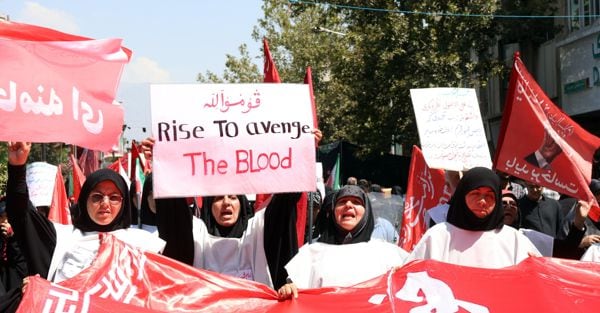
Gli iraniani partecipano alla cerimonia dell’Arbaeen per le strade della capitale Teheran, in Iran, il 4 agosto 2026. La Giornata dell’Arbaeen segna la fine del quarantesimo giorno successivo alla festività sciita dell’Ashura, che commemora la morte dell’Imam Hussein nella battaglia di Karbala. EPA/ABEDIN TAHERKENAREH
“This maximalist stance of theirs will, in the long term, contribute to their isolation,” emphasises Behnam Ben Taleblu, an Iran expert at the Foundation for Defence of Democracies, a think tank critical of the Iranian regime. Divisions are emerging within the Iranian government itself over how to manage the Strait. The most radical wing of the Pasdaran regards control of the Strait of Hormuz as the main lever for exerting pressure on the West following the weakening of Iran’s nuclear programme and its allied militias in recent years. The Iranian armed forces have suffered significant losses since the United States and Israel launched a surprise attack on 28 February, but have nevertheless managed to keep Washington on its toes by disrupting shipping traffic in the Strait and striking US targets in the Persian Gulf. Conversely, as the *Wall Street Journal* notes, the more moderate faction within the Iranian leadership “is concerned that the naval blockade imposed by the US in response to Iranian attacks on Hormuz is pushing the country’s economy to the brink of collapse. The International Monetary Fund forecasts that the Iranian economy will contract by 6 per cent in 2026. Core inflation stands at around 69 per cent, whilst the population is having to cope with fuel shortages and other hardships typical of a war economy”.
The Iranian blockade of the Strait of Hormuz, notes the US business newspaper, “has had a profound impact on global oil supplies: flows from the Persian Gulf have fallen to around 36 per cent of pre-conflict levels. However, the price of crude oil has failed to remain consistently above $100 a barrel, a threshold that could have inflicted sufficient damage on the US economy to force Washington to back down. Even with the Iranian-backed Houthi rebels disrupting Saudi oil shipments in the Red Sea, crude oil has remained below $80 a barrel.”
Some of the oil from the Gulf has, in fact, been rerouted to avoid the Strait of Hormuz. Some ships have managed to pass through it by negotiating agreements with Iran or by switching off their tracking systems and undertaking the crossing under extremely risky conditions. “There were many factors that mitigated the impact,” explained Barbara Leaf, former head of the Middle East desk at the State Department during the Biden administration. According to Leaf, following the Israeli and US attacks on Iranian nuclear facilities in June 2025, China had “read the signs” and begun to build up oil reserves. Although he has toned down his rhetoric regarding potential offensives on a scale comparable to the Second World War, Trump is maintaining the naval blockade against Iran and has reimposed sanctions that make it very difficult for Iran to export oil.
In the long term, however, Iran’s leverage over the global economy and its Gulf neighbours could diminish if Saudi Arabia, the United Arab Emirates and other major oil producers were to succeed in developing alternative infrastructure that bypasses the Strait of Hormuz. “Iran’s oil exports also depend on transit through the Strait of Hormuz. A prolonged disruption to traffic would deprive the Islamic Republic of its main source of revenue and, at the same time, accelerate the Gulf states’ efforts to build alternative routes bypassing the Strait. China, one of Iran’s most important partners, has not come to its aid. Beijing has reduced its purchases of Iranian oil, helping to keep prices low, and shows no signs of wanting to return to previous levels,” notes the Wall Street Journal. Meanwhile, mediators from Egypt, Pakistan and Qatar hope that, once a temporary solution for navigation through the Strait has been found, the United States and Iran can return to the negotiating table.
5 August 2026
Tajani speaks with Araghchi: “The importance of continuing the dialogue and avoiding further escalation was reiterated”
“I have just spoken with the Iranian Foreign Minister, Abbas Araghchi. He briefed me on the negotiations Iran is holding with Oman to reopen the Strait of Hormuz to commercial traffic. I reiterated the importance of continuing the dialogue to swiftly reach a political solution to the crisis, including with the United States, and to avoid further escalation. It is essential to guarantee full freedom of navigation in the Strait of Hormuz, without tolls or restrictions, in the interests of regional stability and the global economy.” This was stated in a post on ‘X’ by Foreign Minister and Deputy Prime Minister Antonio Tajani.
5 August 2026
4,600 vials of plasma-derived medicines have been sent from Italia to Nablus
Over 4,600 vials of plasma-derived medicines, produced using plasma donated by donors in Emilia-Romagna, have been sent to Nablus, in the West Bank, to support Palestinian patients suffering from congenital bleeding disorders, for whom access to treatment is becoming increasingly difficult, particularly given the complex international situation. The shipment of coagulation factors VIII and IX – produced in excess of national requirements – along with a number of vials of prothrombin complex concentrates, is taking place as part of the Haemo_Pal project. Promoted and coordinated by the National Blood Centre and the National Institute of Health, and funded by Italian Cooperation through the Italian Agency for Development Cooperation, Haemo_Pal aims to meet the therapeutic and care needs of patients with coagulopathies and haemoglobinopathies, despite the severe humanitarian and health crisis currently affecting not only the Gaza Strip but also the West Bank.
5 August 2026
US, NBC: Pentagon draws up new nuclear strategy in the event of war
The Pentagon is drawing up a new US nuclear strategy that highlights the possible use of short-range tactical weapons in the event of a regional conflict with China or Russia. This is according to a report today by NBC, citing five sources familiar with the plans, who say that the strategy – classified as confidential – sets out nuclear options for the commander-in-chief in crisis situations.
5 August 2026
Gaza, Pezeshkian: Iran will support whatever decision the Palestinian leaders take
“The Islamic Republic of Iran will support any measures, initiatives and decisions that the Palestinian leaders adopt in the negotiation process.” This was stated by Iranian President Masoud Pezeshkian, who today – according to the Iranian news agency ISNA – held a telephone conversation with Khalil al-Hayya, the new head of the political bureau of Hamas and the Palestinian Islamic Resistance Movement (Hamas), to whom he expressed his appreciation for his role in coordinating between the Palestinian factions.
Referring to the recent aggression by Israel and the US against Iran, Pezeshkian stated that “despite these challenges, the Palestinian issue has retained its central position in the foreign policy of the Islamic Republic of Iran; it has not been overlooked by officials, policy-makers or Iran’s Supreme Leader, and continues to be regarded as the primary issue facing the Islamic world”.
5 August 2026
Iranian media: ‘Iran-Oman agreement would not immediately reopen the Strait of Hormuz’
Any agreement between Iran and Oman on future arrangements for navigation in the Strait of Hormuz would not lead to the immediate reopening of this strategic waterway, according to a report by the Iranian state broadcaster IRIB, which cites a well-informed source. This is reported by Al-Jazeera. The source stated that negotiations on future navigation arrangements are taking place exclusively between Tehran and Muscat and “have nothing to do with the United States”. “A possible agreement between Iran and Oman on the rules governing the passage of ships through the Strait of Hormuz has nothing to do with the immediate reopening of the strait,” the source added. Even if Iran and Oman were to reach an agreement, the strait would remain closed as long as what Tehran describes as “US violations” persist, according to the report. “The reopening of the Strait of Hormuz depends on a change in US behaviour and the rectification of its violations,” the source stated. These statements also come following reports in the Iranian media that Tehran is close to reaching an agreement with Muscat on a new shipping corridor, provided that the United States ceases to interfere in the negotiations. Iranian officials have repeatedly accused Washington of attempting to influence the negotiations and of delaying an agreement through military threats.
5 August 2026
Iran, Al Arabiya: Pakistan’s Prime Minister and Chief of Defence Staff to visit Riyadh tomorrow
Pakistani Prime Minister Shehbaz Sharif and Army Chief Asim Munir are due to visit Saudi Arabia tomorrow. This was reported by the Saudi broadcaster Al Arabiya, citing Pakistani sources.
The broadcaster points out that the visit is taking place at a time of “intense diplomatic activity in the region”, particularly with a view to resolving the conflict between the United States and Iran, in which Islamabad is acting as a mediator.
5 August 2026
Media: Hormuz will continue to be a geopolitical lever for Iran for a long time to come
Iran’s ability to profit from the Strait of Hormuz “will diminish, but may never disappear entirely” and “even if the tolls Iran can impose decrease over time, its strategic influence will not necessarily wane. Indeed, it may even grow stronger as the regime institutionalises its regional influence’. This is according to The Economist in an analysis entitled ‘How long can Iran use Hormuz as a weapon?’, which concludes that Tehran could continue to exploit the Strait both to generate revenue and to maintain strong geopolitical leverage well beyond the end of the war. The Economist points out that around 20 per cent of the world’s oil and liquefied natural gas passes through Hormuz. With the war, the Gulf states have sought alternatives. Saudi Arabia’s east-west pipeline, which bypasses the Strait by crossing the peninsula to the port of Yanbu on the Red Sea, was transporting just 1 million barrels a day for export before the war. Today it operates at a capacity of 7 million. The United Arab Emirates have maximised the use of their Habshan–Fujairah pipeline, which now carries 1.8 million barrels a day, compared with 1 million before the war. Around 200,000 barrels pass through a smaller, previously inactive Iraqi pipeline to Turkey. The Gulf states are also building alternative pipelines, but these will not be sufficient to completely replace the Strait. Furthermore, even the alternative routes carry risks. To leave Yanbu, oil must pass through Bab al-Mandab, which is vulnerable to attacks by the Iran-aligned Houthis, or via the Suez Canal, which opens out onto the Mediterranean. However, on 29 July, a drone struck an oil tanker at Damietta, just 50 km as the crow flies from that outlet. And, whilst there are some alternatives for crude oil, those for refined fuels and liquefied natural gas (LNG) are very limited. New infrastructure will take years to build and could be vulnerable to further attacks.
5 August 2026
Iran: Tehran says Trump is unreliable; he has said 75 times that the Strait of Hormuz was open
Donald Trump’s approach to negotiations is “contradictory and unreliable”. This was stated by Esmail Kowsari, a member of the Iranian parliament’s National Security Committee, speaking to the Iranian broadcaster Irib, adding that the US president had claimed 75 times that the Strait of Hormuz was open, when in fact it was not. Kowsari also stated that Trump had spoken of an “Iranian defeat” 106 times and had declared that there would be an “imminent agreement” with Tehran 88 times.
5 August 2026
Media: Israeli forces raid West Bank refugee camp
Israeli forces raided the Qalandiya refugee camp, north of Jerusalem, arresting several people and “seriously assaulting” a journalist. This was reported by the Palestinian news agency Wafa, which stated that the troops “stormed the headquarters of the camp’s Popular Committee, forced some residents out of their homes and compelled a family to evacuate their home”. According to eyewitness accounts, the troops were accompanied by a large number of military vehicles and “demolition machinery”.
5 August 2026
Egypt: Israeli withdrawal is a prerequisite for Trump’s plan for Gaza
Egyptian Foreign Minister Badr Abdelatty is in Amman for a meeting of ministers from the region on Jerusalem, which will inevitably focus broadly on the situation in Gaza, the Israeli withdrawal and the other ongoing crises in the region. Abdelatty – according to a spokesperson – spoke on the sidelines before the start of the meeting with his Tunisian counterpart, Mohamed Ali Nafti, calling for the “full implementation of the US President’s peace plan for Gaza, including the completion of the first phase, the guarantee of full, safe and sustainable access for humanitarian aid”, but above all the “Israeli withdrawal from the Gaza Strip”, deemed a “necessary condition for the rapid implementation of recovery and reconstruction programmes”. The two ministers also touched upon the Libyan issue, expressing support for the continuation of the tripartite mechanism launched by Egypt, Tunisia and Algeria to guide the country towards a unified and peaceful political process. The Amman meeting brings together ministers from Arab and Islamic countries with the aim of “exploring ways to support the legitimate rights of the Palestinian people and preserve the legal and historical status of Jerusalem”.
5 August 2026
Iran, Bloomberg: Riyadh has begun talks with the Houthis via Oman
Saudi Arabia has begun talks with the Yemeni Houthi movement, via mediators from Oman, to prevent an escalation of the conflict and safeguard its oil industry and economy. This is according to Bloomberg, citing sources familiar with the matter, who say that Riyadh is nevertheless planning military options should diplomacy fail.
5 August 2026
Houthis: ‘A Saudi oil tanker has been hit in the Red Sea’
The Iranian-backed Yemeni Houthis have claimed to have attacked a Saudi oil tanker off the coast of Yanbu in the Red Sea, as the rebels continue their declared naval blockade of Saudi Arabia. The group “successfully struck the Saudi oil tanker ‘Wafa’ in the northern Red Sea, off the coast of Yanbu, with several ballistic missiles”, said their military spokesman Yahya Saree in a video statement, adding that this was the eighth vessel to be targeted since the blockade began on 22 July.
5 August 2026
Iran, CNN: US has used 80 per cent of its THAAD interceptors
Stockpiles of the United States’ main air defence systems have fallen significantly during the war with Iran: the armed forces have used up almost 80 per cent of their THAAD missiles and around half of their Patriot interceptors. This is according to CNN, citing sources familiar with the latest report on stockpiles.
The Centre for Strategic and International Studies estimates that the United States had around 2,200 Patriot missiles and 452 THAAD missiles in its arsenal before the start of the war with Iran.
5 August 2026
Trump: Iran is no longer capable of building nuclear weapons
US President Donald Trump has stated that Iran is no longer capable of building nuclear weapons and that this will be formally confirmed. “Iran, for example, will never have a nuclear weapon. It is not already capable of doing so, but this will be formalised,” Trump said in an interview with Fox News.
5 August 2026
CNN: ‘80 per cent of THAAD interceptors and around 50 per cent of Patriot interceptors have been used against Iran’
The conflict with Iran is putting unprecedented pressure on US missile stocks, which have reached “dangerously low” levels. According to CNN, military operations have led to the deployment of a significant proportion of the most advanced air defence interceptors, prompting Washington to reassess the risks of a protracted campaign. The US armed forces have deployed nearly 80 per cent of their THAAD interceptors and around half of their Patriot interceptors compared with pre-conflict stocks. During the hostilities, the military has used virtually all the long-range, precision-guided surface-to-surface missiles at its disposal.
5 August 2026
Hegseth takes issue with CNN over the missile shortage: ‘Shame on you’
US Secretary of Defence Pete Hegseth has dismissed the validity of a CNN report claiming that, since the start of the war with Iran, the US has used up 80 per cent of its THAAD interceptor missiles and 50 per cent of its Patriot missiles. “That headline is NOT true, CNN. Shame on you,” Hegseth wrote on X, posting a screenshot of a moment from the programme in which the story was presented, complete with the accompanying summary banner and the claim that 80 per cent of the THAAD missiles had been used up. “We don’t hate the fake news media enough,” he added.
5 August 2026
Axios: ‘US close to provisional agreement on Hormuz; announcement expected today’
The United States, Iran and Oman are close to reaching an interim agreement on the reopening of the Strait of Hormuz: Washington is set to announce the deal today, according to Axios, citing two regional sources and a US official. The agreement, which has been under negotiation for several weeks, aims to restore the truce between the US and Iran and to restart negotiations on a nuclear deal. The preliminary agreement would incorporate certain Iranian demands regarding traffic control rights in the strait, which it did not have prior to the war. The agreement under discussion would consist of a provisional 60-day mechanism, which could potentially be extended.
5 August 2026
Trump: ‘The Strait of Hormuz will open very soon, otherwise there will be severe consequences’
“The Strait of Hormuz will open very soon, or they will suffer a devastating blow, and then the Strait will open.” This was stated by President Donald Trump in an interview with Fox News, in which he assured that Iran “will never have a nuclear weapon”.
5 August 2026
Trump: ‘The agreement on opening the Strait of Hormuz? It could be reached today or on Thursday’
“A lot of progress has been made” and an agreement “is possible tomorrow or the day after”, that is to say, on Wednesday or Thursday. This is what Donald Trump said, shortly before boarding Air Force One in Los Angeles – where it is still Tuesday evening – en route to Las Vegas, in response to a question about the speculation reported by Axios that an agreement on the opening of the Strait of Hormuz is expected today, Wednesday 5 August. “They rang me and said: ‘Please, let’s talk about it.’ They want to talk. The funny thing is that they’d never said that before; they always say: ‘We’re not negotiating.’ But then they ring, they want to talk, and we’re talking,” he added.

