
Irving Penn: the rigour of the essential
An exhibition exploring the work of one of the pioneers of modern photography has been staged in the former slaughterhouse

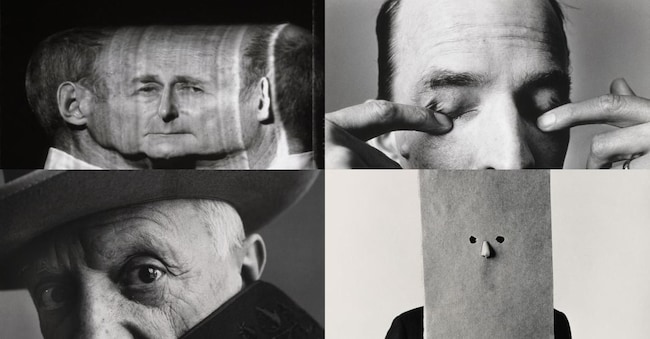
The exhibition dedicated to Irving Penn at the Centro della Fotografia in Rome – a space of around 1,500 square metres, which opened on 30 January in the former slaughterhouse – does more than simply trace the career of a great 20th-century photographer: it presents a precise vision of photography, founded on control, precision and essentiality. Through a curated selection featuring portraits, fashion and still lifes, a coherent aesthetic emerges clearly, built up over time with almost artisanal discipline.
Upon entering the galleries, what strikes you first is the sense of restraint. The backdrops are neutral, devoid of any extraneous narrative elements. This choice, which might seem simple, is in fact at the heart of his aesthetic: eliminating the superfluous to focus the viewer’s gaze on the essence of the subject. The void is not absence, but an active space that highlights posture, gaze, fabric and skin. Every detail emerges with almost tactile precision.
Penn’s technique is inseparable from his vision. His use of the view camera and large format allows him rigorous control over composition and extraordinary definition. Nothing is left to chance: the position of the hands, the tilt of the torso, the fold of a garment are all carefully calibrated. The light, soft and diffused, does not dramatise but shapes; it caresses surfaces, renders volumes with delicacy, and avoids harsh contrasts. The result is a subtle balance between physical presence and formal abstraction.
The portraits
The portraits are particularly striking, with their psychological intensity arising precisely from the simplicity of the setting. The subject, isolated in a confined space, seems almost compelled to confront the lens. In some images, the tension is palpable: shoulders stiffen, the gaze becomes piercing, the body interacts with the corner or the edge of the frame. Penn does not intrude, but waits; he creates a minimalist setting in which the personality can emerge without distractions.
The portraits
As early as the 1940s, Penn was producing famous portraits for *Vogue*, photographing artists, writers and actors against neutral backdrops or in very confined, angular spaces. This approach eliminates narrative distractions; it focuses attention on form and intensifies the subject’s presence. Among the famous portraits that defined his iconic style, the following are on display: The portrait of Pablo Picasso, Cannes, 1957. Here, Penn constructs an image of extraordinary psychological tension through the use of negative space. The painter appears wrapped in a dark coat, his gaze intense and watchful. One hand partially covers his face, leaving only one eye fully exposed. This compositional choice is no accident: the isolated eye becomes the magnetic centre of the image, a symbol of artistic vision and the ability to ‘see beyond’. The neutral background eliminates any environmental reference. There is no studio, no works of art: there is only the person. Penn does not depict the myth, but the man. The use of soft light shapes the face without dramatising it, accentuating wrinkles and contours.

