
Islands, volcanoes and mountains: here is where to learn the art of retreating
A guide to new retreats, an increasingly popular formula with which you disconnect from everything to find yourself and have new experiences

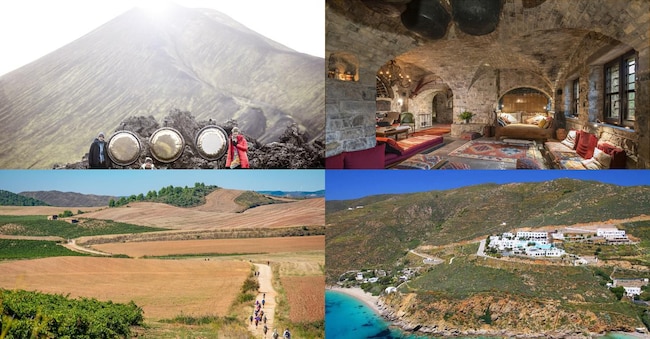
The new wellness buzzword is retreat. Not that spas and medical spas are in decline, on the contrary, but with "retreats" the concept of feeling good is being renewed. They are a travel opportunity to take care of oneself, meet people who share the same quest, discover new places. A shrewd forerunner, Marcello Murzilli had already grasped this ten years ago when he founded the Eremito in an isolated former medieval monastery in a Unesco reserve in Umbria, where there is no telephone reception and people sleep in minimalist cells: that formula of silence, disconnection and immersion in nature for solo travellers would one day become true luxury. He held on, and today it seems that the data prove him right. Ecology, sustainability and spirituality are pillars of quality of life. According to the Global Wellness Institute in 2024 wellness tourism reached a turnover of 900 billion dollars, up 16%, a value that could exceed 2 trillion by 2030.
"These types of experiences silence the daily background buzz, with the help of experts who facilitate the regeneration process, together with a community of reference," notes Laura Montesanti, founder of Synergy, the first Retreat Travel Show that connects retreat leaders with the hotels that host them and the travel agents that offer them. "They are powerful in leading to profound change, thanks to the acquisition of skills and tools that remain and help in everyday life.
Regenerative Experiences
In the holistic and spiritual field, these kinds of experiences can lead to an authentic inner journey, as well as to ever-changing places. For example, during Vocal Odyssey workshops, led by the British singer-songwriter Nessi Gomes, one learns to interpret the voice as an instrument of identity and evolution. The duration varies from half days in the cities included in Nessi's tours, to full immersions of ten days in Greece, at the Aegialis hotel, the only five-star hotel in Amorgos overlooking the Aegean Sea. The gongs, on the other hand, are the instrument of Pauline Fabry, a German performer who builds them using meteorite particles collected in Iceland or on Mount Etna, where she also organises her off-route trips: they are true works of art (one is in the hashram of fashion designer JJ Martins in Milan) that she uses for her Sound Healing ceremonies, sound therapy, and for GongHypnosis, the result of collaboration with scientists who study the relationship between perception and resonance.
From itinerant retreats to those in iconic locations
Walking Mentorship retreats are by definition itinerant: for founder João Perre Viana, when you combine walking, nature and sharing you get in touch with the best part of yourself, because it has been proven that walking at your own pace between 8 and 15 km a day is not just an exercise, but reduces stress and improves concentration, motivation, memory and mood. A formula that is experimented on epic routes, such as the Camino de Santiago, the Via Francigena, the Costa Vicentina in Portugal. Some projects, on the other hand, are born with their own places, such as Terranam Wellness, in Galicia: after trying out retreats of all kinds, founder Maria Garrido promised herself, as a sign of gratitude, to one day create a place where she could catch her breath and find relief. In 2018, she realised her plan, following four guidelines: have fun, breathe, discover, unplug. No boot camp rhythms; no syllabus obligations; no standing quinoa salad in the kitchen (the menu is designed with a Spanish star chef); you do sound baths in a pajama chapel; two yoga classes a day; you get outdoors a lot. There are some twenty internal retreats, for men, others for women only (with My Menopause Centre) and in the future for Generation Zeta, for food enthusiasts with visits to mussel and wine producers, but they also host external groups, often pilgrims who have arrived almost at the end of the Camino de Santiago, which is half an hour from Terranam.
A strategy for hotels
The word retreat therefore has many facets: it can be a place or a time when one isolates oneself to devote oneself to personal growth or healing; it can be individual or group, stationary or require a trip. And that's not all: retreats also represent an economic opportunity for hotels, but one that is often underestimated by the hotels themselves, which fail to grasp this growing demand. Montesanti goes on to explain that hosting retreats is a way to occupy rooms in the low season, to expand the clientele, but also to offer original and innovative wellness programmes, and all this without investing resources, but simply by hosting experts in the field or wellness events. The spa is a value for a hotel, but with retreats it is not necessary, as other spaces and outdoor areas can be utilised. The change, meanwhile, is tangible even in the city. In Rome, for example, the Urban Retreat concept is developing, as has already happened in New York, London and Bangkok, where some hotels, such as Mandarin Oriental, Six Senses and Banyan Tree, are opening up some breathing and sound healing classes to the neighbourhood, creating a community of local guests. And Synergy itself, despite being an event for insiders, has launched the 'Transformation Series' on its website, free classes held by the most authoritative voices in the field. The first date is 8 April with Heather Lee, an expert in psychedelic experiences, a new frontier of wellness that is undergoing great development.

