
Israel and the Global Sumud Flotilla: Here is what international law says
Israel risks violations of international law by obstructing the humanitarian mission. The naval blockade in question raises serious legal and humanitarian concerns

3' min read
3' min read
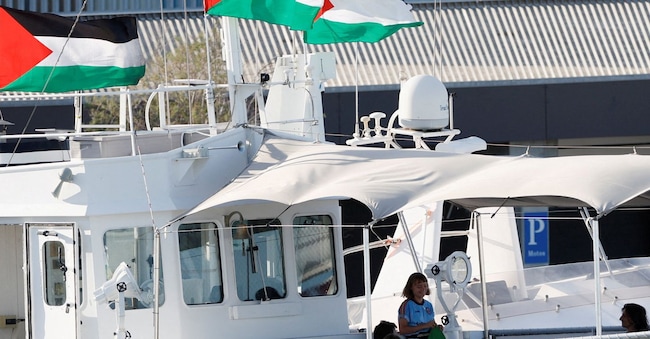
The picture of the violations of international law that Israel is likely to commit, in the event of obstacles being placed in the way of the humanitarian mission of the Global Sumud Flotilla that is heading from Barcelona, Genoa and other ports to Gaza, is clear. If Israel intervenes in international waters, as it has done on other occasions, on ships flying the flags of other states, it is certain to violate international law. On the basis of the 1982 Montego Bay Convention on the Law of the Sea (which Israel has not ratified, but which nevertheless reproduces general international law rules that are also binding on Tel Aviv) and customary international law, on the high seas the principle of freedom of navigation applies and, for any unlawful acts that take place on board a ship, it is only the state whose flag the vessel flies that has jurisdiction. This means that not only can Israel not intervene in a foreign ship, it cannot even prevent it from sailing.
Of course, the government's statements go in the opposite direction to international law: the Israeli Minister of National Security Ben Gvir declared that the volunteers on board the ships that are part of the flotilla, which carries out one of the most important and extensive humanitarian missions with the participation of ships and volunteers from over 40 states, are considered by Israel to be terrorists and, therefore, the aim is to arrest them.
Here it is clear that the very factual basis for considering those on board ships that are part of an international humanitarian mission as terrorists is lacking. In any case, beyond the lack of a factual basis and the absence of any legal basis to consider those engaged in the mission to deliver aid to the Gaza Strip where the population is suffering from a famine caused by a government as terrorists, the interventions of the Israeli government itself in international waters would constitute an international tort. The violation, in these cases, would be perpetrated against the states whose flag the ships fly and, in the case of arrest of foreign nationals who do not commit any offence, also against the states of citizenship of the persons affected.
No justification for the naval blockade can be found in the law of war: not only as an occupying power Israel, according to Article 33 of the Fourth Geneva Convention relative to the Protection of Civilian Persons in Time of War, must refrain from actions constituting collective punishment of civilians, but the naval blockade cannot be invoked to commit serious violations of international humanitarian law leading to the commission of war crimes and crimes against humanity such as, for example, starving the civilian population. In some cases, the law of war allows a blockade but requires certain parameters to be met. In any case, the rules prohibit a naval blockade if it inflicts disproportionate harm on the civilian population, which, in this case, would continue to be deprived of the humanitarian aid necessary to feed and care for itself, despite Israel's obligation, as also clarified by the International Court of Justice, to apply international humanitarian law and the rules laid down in the Fourth Geneva Convention on the Protection of Civilians in Occupied Territories.
On the other hand, to get a clear picture of the violations one only has to reread the report of the commission of enquiry set up by the UN Human Rights Council in 2010, in the aftermath of Israel's attack on the humanitarian ship Mavi Marmara that was on its way to Gaza by forcing the illegitimate naval blockade ordered by Tel Aviv. On that occasion, nine volunteers were killed and more than 50 people wounded, and the concluding document adopted by the commission pointed out that the naval blockade had been disproportionate, carried out violently and with an unjustifiable level of brutality. A scenario that could be repeated.


