Middle East

Israel and Iran, five questions and answers to understand the attack and its scenarios

From the origins of the operation to the role of the US, what to expect from the offensive

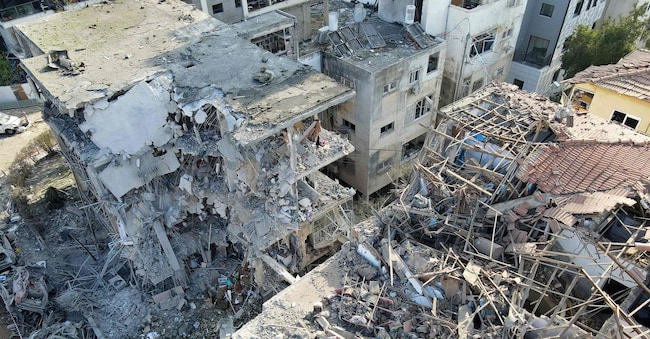
Un edificio colpito vicino a Tel Aviv

4' min read

4' min read

Israel's attack on Iran has opened a new and even more traumatic chapter in the Middle East conflict, capable of diverting Tel Aviv's attentions from the Gaza offensive front to the confrontation with the Islamic Republic. Hostilities had already erupted intermittently in the almost two years of IDF assaults on Gaza and the indirect response of actors along the so-called Axis of Resistance, Tehran's network of anti-Israeli allies. Now a showdown is on the horizon with sharp repercussions on the Middle East region itself and perhaps beyond, given the threats already wielded by Iran over attacks on military bases in the EU perimeter.

When and how did the new offensive break out

?

On the evening of 12-13 June, Israel launched an unprecedented attack on Iran, an offensive that had already been leaked in the days before but remained in the balance until its actual outbreak. Only on the eve of it, US President Donald Trump had declared that the attack 'could have happened', without making a definitive statement one way or the other. There was no need: the very night the attack was launched, dubbed Rising Lion, a biblical reference to Israeli might. The assault moved against three concatenated targets on the horizon of the IDF: uranium enrichment sites, missile production sites and the military leadership of the Islamic Republic.

Loading...

The official intention of Israel and its Prime Minister Benjamin Netanyahu is to stem a possible nuclear escalation by Iran, effectively bypassing the negotiations held in recent months between the US and Iran to restore the agreement signed by the two in 2015 and scrapped by Donald Trump in his first administration. In the first phase of the attack alone, some 200 Israeli fighter jets conducted targeted strikes against a hundred military and nuclear targets. Iran responded on 13 June with what Iranian media described as 'hundreds of missiles', triggering the wrath of the Israeli executive. Early reports speak of some 78 victims in Iran and 3 in Israel.

But why did Israel attack?

In a televised address, Netanyahu stated that the attack was to 'remove threats' to 'Israel's survival'. The PM claims that Iran has produced enough enriched uranium to build nine nuclear devices and is ready to use it against Tel Aviv. "Iran could produce a nuclear weapon in a very short time. It could be a year or a few months,' Netanyahu said.

The first outcome of the offensive was, in effect, to 'decapitate' the Iranian military leadership and some key men in Tehran's nuclear programme. The IDF claimed the killing of General Hossein Salami, head of the secretive Islamic Revolutionary Guard Corps (IRGC), Iranian Armed Forces Chief of Staff Mohammad Bagheri, Ayatollah Ali Khamenei's aide Ali Shamkhani, and Air Force Commander Ali Hajizadeh.

The Israel Defence Forces also claim the killing of experts involved in the nuclear programme such as Ali Bakhouei Karimi, Mansour Asgari and Saeed Barji. A widespread interpretation is that Israel struck to increase diplomatic pressure on Tehran in the midst of negotiations with the United States, tilting them towards a more Washington-friendly agreement.

Now what can happen?

The most obvious fear is that of a new regional escalation, accelerating and aggravating the one that has already been going on since October 2023. The options on the table for Israel and Iran are - relatively - more circumstantial. According to an analysis published by Paul Salem, senior fellow at the Middle East Institute, Israel can either go for a halt in the offensive to reopen diplomatic spaces or insist on following the line of actions against Hezbollah in Lebanon to "further degrade Iran's nuclear programme and weaken its leadership and decision-making apparatus". Also according to Salem, the Iranian margins are narrower. Tehran could only respond immediately to the offensive, but does not seem to be projected towards a large-scale war 'that it cannot win'.

The "military power imbalance with Israel and the United States is stark," Salem writes. While Iran can inflict damage, the defences of Israel and its partners are capable of neutralising most attacks'. On the one hand, 'striking US assets would trigger a forceful US response, an outcome Tehran seeks to avoid'. On the other, 'attacking targets in the Gulf would alienate key regional partners, undermining Iran's long-term position'.

And what role is the United States playing?

Washington's line is quite ambivalent. Trump had always tried, officially, to dissuade Netanyahu from an offensive against Iran in the middle of negotiations on the nuclear agreement with Washington. Secretary of State Marco Rubio also formally condemned the attacks on Iran as 'one-sided', ruling out his own involvement. At the same time, Washington has assisted Israel on the defensive and now Trump is riding the political pressure on Iran to reach an understanding 'before there is nothing left'.

LA PRESENZA MILITARE USA IN MEDIO ORIENTE

Loading...

What are the economic and financial consequences?

The markets could only react with nervousness, although the losses recorded so far seem to be limited and mainly relate to fears of spillover effects on energy prices. The most feared scenario is that of fallout similar to that already suffered with the conflict between Russia and Ukraine, although the scenario of a Middle East war in itself does not produce any particular upheaval. Mark Dowding, chief investment officer at BlueBay Fixed Income, said the impacts could be limited in the absence of a 'dramatic' escalation of Iran and focused mainly on the price of crude oil. "However, at a time of certain market complacency," he said, quoted by the Axios news outlet, "the Middle East and geopolitics more generally represent a source of risk that we cannot ignore.

Per approfondire

Israele e l’attacco all’Iran: come ci si è arrivati e cosa potrebbe accadere ora

Analisi

Copyright reserved ©
  • Alberto Magnani

    Alberto MagnaniCorrispondente

    Luogo: Nairobi

    Lingue parlate: inglese, tedesco

    Argomenti: Lavoro, Unione europea, Africa

    Premi: Premio "Alimentiamo il nostro futuro, nutriamo il mondo. Verso Expo 2015" di Agrofarma Federchimica e Fondazione Veronesi; Premio giornalistico State Street, categoria "Innovation"

Loading...

Brand connect

Loading...

Newsletter

Notizie e approfondimenti sugli avvenimenti politici, economici e finanziari.

Iscriviti