Operation Rising Lion

Israel attacks Iran. Army and Pasdaran leadership killed. Teheran: "We will punish them".

The IDF conducted 'a targeted pre-emptive strike against nuclear targets'. The capital was also hit. Iran promises retaliation. The USA underlines that it did not take part in the operation. Oil soars. Asian stock exchanges down

by Marco Masciaga

Aggiornato il 13 giugno 2025 ore 08:40

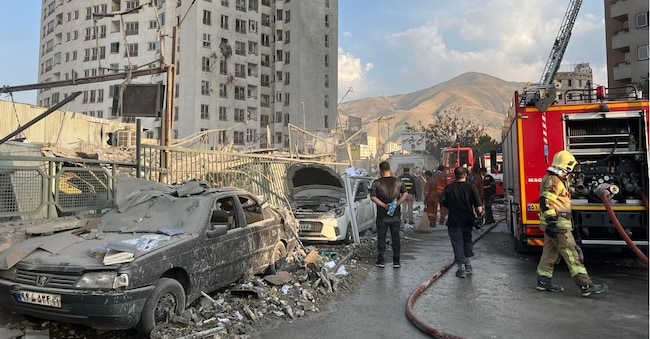
 Vigili del fuoco al lavoro all’esterno di un edificio colpito da attacchi aerei israeliani a nord di Teheran, Iran, 13 giugno 2025. EPA/ABEDIN TAHERKENAREH

6' min read

6' min read

From our correspondent

NEW DELHI - In a military operation destined at the very least to trigger a dangerous new escalation of tensions in the Middle East, Israel overnight launched a 'pre-emptive strike based on high-quality intelligence' against Iran, 'with the aim of damaging the nuclear programme' of the Islamic Republic.

Loading...

According to a spokesman for the Israeli Defence Force (Idf), "dozens of Air Force aircraft" took part in the operation that targeted "dozens of military and nuclear targets in different areas of Iran", including the capital Tehran.

In a pre-recorded video message, Israeli Prime MinisterBenyamin Netanyahu stated that the attack targeted Iran's main uranium enrichment facility in Natanz, as well as the most important Iranian nuclear scientists involved in the development of atomic devices and the core of the country's missile programme.

Immagine satellitare fornita da Maxar Technologies e scattata il 12 febbraio 2025 mostra una panoramica dell’impianto nucleare iraniano di Natanz, a sud della capitale Teheran. Una nuova esplosione è stata udita nelle prime ore del 13 giugno 2025 presso il principale sito di arricchimento dell’uranio di Natanz, nell’Iran centrale, secondo quanto riportato dalla televisione di stato iraniana, dopo che Israele ha lanciato attacchi aerei contro la Repubblica Islamica. (Foto di Immagine satellitare ©2021 Maxar Technologies / AFP)

Operation Rising Lion - which has targeted "the heart of Iran's nuclear enrichment programme and its efforts to develop a nuclear weapon" - will last for as many days as necessary, said Netanyahu who, while not naming names, added that the Israeli raids targeted "high-level commanders". According to IDF spokeswoman Effie Defrin, the Iranian one had now become "an imminent and existential threat" to the Jewish state.

Drones also smuggled into Iran by the Mossad

.

In preparation for the air raids against Iranian military and nuclear facilities on Thursday night, the Mossad established a military base in Iran, where drones were stored. A senior Israeli security source explained this to the media. The drones had been smuggled into the country long before and were used during the attacks. At the beginning of the attack, and in parallel with the air force raids, the Mossad activated the systems already in place, the source said, adding that the explosive drones were fired at ground-to-ground missile launchers at a military base near Tehran. At the same time, the source said, Mossad commando teams operated in central Iran deploying operational precision-guided weapons systems in open areas near Iranian surface-to-air missile systems. The source added that the Mossad also installed offensive attack systems and additional technology on vehicles inside Iran, with the aim of neutralising Iran's air defence capabilities that could threaten Israeli fighter jets. The IDF completely destroyed Iranian defence systems at the beginning of the attack.

The impact of Israeli attacks

According to reports on Iranian state TV, among others, the commander-in-chief of the Guardians of the Revolution, Hossein Salami, the Chief of Staff of the Iranian Armed Forces, Mohammad Bagheri, and Fereydoon Abbasi, a scientist who formerly headed Iran's Atomic Energy Organisation, lost their lives in the attack. In an attempt to kill prominent figures of the regime and the atomic programme, Israel hit residential areas of both Tehran and other cities in the country.

According to rumours that have not yet been confirmed, among the victims of the Israeli raid are at least two other prominent scientists involved in the nuclear programme.

Netanyahu: "Colpito il cuore del programma nucleare iraniano"

Images released by Iranian state TV show several residential buildings in Tehran heavily damaged and a building more than 10 storeys high partially collapsed. The headquarters of the Guardians of the Revolution, or Pasdaran, the main body of the Iranian Armed Forces, was also heavily damaged. Witnesses report columns of smoke and a fire.

"The International Atomic Energy Agency is closely monitoring the deeply worrying situation in Iran. The agency can confirm that the Natanz site is among the targets," IEA chief Rafael Grossi wrote on X. "The agency is in contact with the Iranian authorities and our inspectors and they are monitoring radiation levels," he added. Grossi went on to inform Israeli President Isaac Herzog that, according to information in his possession, the Natanz plant had suffered serious damage. According to Grossi, there has been no leakage of radioactive or chemical contamination outside the plant near Isfahan in central Iran, and no casualties have been reported.

Washington: 'Unilateral action from Israel'

.

The White House reported that in the wake of the Israeli attacks in Iran, Donald Trump convened the National Security Council for today, Friday.

But on the diplomatic front, the most striking fact is undoubtedly the strength with which the United States has distanced itself from the Israeli operation. 'Tonight,' said US Secretary of State Marco Rubio, 'Israel took unilateral action against Iran. We are not involved in attacks against Iran and our priority is to protect American forces in the region', a formula that leaves some doubt as to whether the US is prepared to offer protection to Israel when the inevitable Iranian response occurs.

"Let me be clear," Rubio added, "Iran must not target American interests or personnel. The United States has deployed air defence systems to protect the approximately 40,000 US soldiers deployed at more than ten military bases in the Middle East. This was told by a US defence official to the New York Times, but also without specifying what role the US would assume in the defence of Israel in the event of Iranian retaliation.

Trump: "Iran cannot have the atomic bomb"

.

In recent weeks, the growing distance between the Trump administration and the Netanyahu government had become evident, with repeated appeals from Washington not to attack Iran while negotiations with emissaries of Tehran's leadership on the nuclear programme were ongoing. The next meeting was scheduled for Sunday.

Donald Trump and senior White House officials expected Israeli attacks on Iran. Two sources told CNN. In a press conference on Thursday, the US president had said that the attack was "possible" but also asked Israel not to do it. In a statement to Fox News, the president emphasised that 'Iran cannot not have a nuclear bomb', but confirmed his hope 'to return to the negotiating table. We'll see'. A few hours before the raid, the tycoon had written on his social network Truth that the US remained committed to 'a diplomatic solution'.

Israele attacca Iran, esplosioni a Teheran

Hold on for Iranian retaliation

.

Iran's Supreme Leader, Ayatollah Ali Khamenei, said in a statement that Israel had 'unleashed its evil and bloody hand' against Iran and that it would meet 'a bitter fate for itself' because of this.

Predicting how long states can continue to act as spectators is not easy. The spokesman of the Iranian Armed Forces Headquarters, Abolfazl Shekarchi stated that 'Iran will give a decisive response to the savage attacks of the Zionist enemy, conducted with the direct help of the United States. Harsh punishment awaits Israel'.

An Iranian military source confirmed to Reuters that 'Iran is planning a harsh response to the attack'. In a statement from the Guardians of the Revolution, the elite corps just beheaded by tonight's raid, 'the Israeli attack was carried out with the full knowledge and support of the evil rulers of the White House and the US terrorist regime'.

The first Iranian counter-move, in anticipation of further retaliatory actions, was the launch of dozens of drones targeting Israel: the Israeli army claimed to have intercepted and shot down the drones launched by Iran, about a hundred of them, all of which were detected outside Israeli territory. Jordanian Air Force jets and air defence systems also shot down several missiles and drones that entered Jordanian airspace this morning, according to the state-run Petra news agency.

The IDF also released a video showing Iranian ballistic missiles being hit and destroyed on the ground before being launched towards Israel. In the meantime, the Home Front Command released an update informing civilians that it is no longer necessary to stay near air raid shelters, however, restrictions on gatherings remain in place.

Tehran calls for emergency UN Security Council meeting

In light of the Israeli air strikes, Iran's representative to the UN, Amir Saeed Iravani, called for an emergency meeting of the UN Security Council and "decisive action by this international body against the Zionist regime's crimes against Iran". This was reported by the Tasnim news agency. "In a reckless, unlawful and premeditated act, the Zionist regime has carried out a series of coordinated military attacks against the Islamic Republic of Iran's nuclear facilities and civilian infrastructure, which are considered a clear violation of the UN Charter and the fundamental principles of international law, and whose dangerous consequences seriously threaten regional and international peace and security," reads the letter sent by Iravani.

A state of emergency was declared in Israel. Ben Gurion International Airport and the country's entire airspace have been closed, as have those of Iran and Iraq. Israeli Defence Minister Israel Katz warned the civilian population in a statement that he expects 'an immediate attack from Iran with drones and missiles'.

Prime Minister Netanyahu warned the civilian population that they may have to spend long periods in air raid shelters in anticipation of an expected retaliatory attack by Iran. The Israeli leadership - Axios journalist Barak Ravid reports - has been moved to a safe location.

Saudi Arabia, Iran's main antagonist in the Arab world, condemned the Israeli attack, calling it a violation of sovereignty and international law. IDF Chief of Staff Eyal Zamir said that tens of thousands of soldiers were mobilised and 'ready on all borders'.

Heavy fallout on financial markets

.

Israel's attack on Iran immediately rattled the markets, especially the oil markets. Light crude jumped 11.67% to $75.98, while Brent crude rose 11.38% to $77.25. The Nikkei 225, the Tokyo Stock Exchange's index of leading stocks, closed down 0.89 per cent. The Nifty 50 of the National Stock Exchange in Mumbai lost 0.66 per cent. Seoul's Kospi was also down 0.87 per cent.

According to some oil analysts, if Iran decides to target traffic through the Strait of Hormuz, it could send crude oil prices soaring above $100 per barrel. A situation that would probably be considered intolerable by the US administration already struggling with the inflationary pressures expected from the White House's protectionist policies.

Copyright reserved ©
Loading...

Brand connect

Loading...

Newsletter

Notizie e approfondimenti sugli avvenimenti politici, economici e finanziari.

Iscriviti