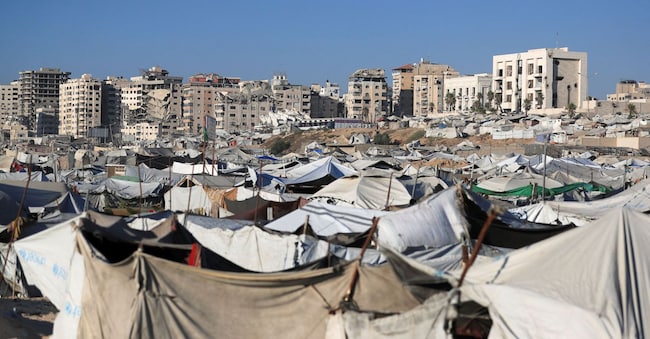
To ensure the safety of the Israeli army, the yellow line that confines the people of Gaza to a narrow coastal strip becomes a land barrier.
The IDF admitted this following a request from the Associated Press after it had examined the satellite images.
Loading...
According to the Israeli media, the earthwork is already 23 km long, out of a total of 59 km marking the border between the Gaza Strip and Israel.
In addition to the physical barrier, the army has also stated that it has established a security zone equipped with intelligence resources and technology, aimed at ‘preventing infiltrations and protecting Israeli troops and communities around the Gaza Strip’.
This is a factor that further diminishes the Gazans’ chances of regaining possession of their land and makes the ‘temporary’ nature of the border established by Donald Trump’s peace agreement even less likely.
Loading...
Gaza, Israele mostra video delle truppe in azione vicino alla linea gialla
The deadlock in the work of the Board of Peace and CENTCOM on Gaza is therefore helping to increase Israel’s control over the Strip, to the detriment of a population already exhausted after two and a half years of war, destruction, civilian casualties and forced displacement. Following Sunday’s march, in which thousands of people – backed by a section of the Israeli government – headed towards the Strip with the intention of resettling it, the risk that the population will be prevented from returning home has become all the more real.
Despite the peace agreement, the violence continues. “In recent days,” said the spokesperson for the UN High Commissioner for Human Rights, Thameen Al-Kheetan, the Israeli army has stepped up its attacks in the Gaza Strip, killing and injuring dozens of Palestinians”, to the extent that “nine months after the ceasefire was announced, there is still no place that is safe for Palestinians”.
Today, 21 July, is proof of this: at least 11 people have been killed in Israeli attacks. An entire family of six – a mother, father and four children – were burnt to death in their home in Gaza City during an air raid. The Israeli army has stated that its target was a Hamas militant and that it is still investigating the consequences of the attack.
Gaza prima e dopo i bombardamenti: le scioccanti immagini riprese dai droni
Three more people died in another airstrike near the headquarters of the Muslim Youth Society in a central part of the city, whilst two others were killed in al-Zahraa, in the centre of the Strip, in an attack on a car. The UN has reported an increase in violence against civilians, noting that in the week from 13 to 20 July alone, ‘the Israeli army killed 57 Palestinians, including six children and eight women’, and emphasising that ‘under international law, deliberately targeting civilians constitutes a war crime’.
The situation for Palestinians in the occupied territories remains difficult. Three people were injured in an attack by settlers in the town of Raba, east of Jenin, whilst another was injured by the Israeli army during a raid in Abu Dis, south-east of occupied Jerusalem.
And whilst the Israeli Supreme Court states that ‘anyone who describes the State of Israel as an apartheid state should not be allowed to enter Israel’, the IDF has established a closed military zone and, in effect, issued an order prohibiting access to the outdoor toilet of a Palestinian home near Hebron, because a settler’s caravan that has settled nearby has set up a swing between the toilet and the Palestinians’ house.
The local family, who live in the house with 14 relatives, are therefore forced to use the toilets at the community centre or to ask their neighbours for permission to use theirs. The same military order also restricts access to their adjacent sheepfold, which is only permitted in the presence of military personnel every three or four days.