Middle East

Gaza, newborn dies of cold. Netanyahu: 'Israel has control from the river to the sea'

Already 11 children have died of frostbite since the beginning of winter. The Strip awaits the reopening of the Rafah crossing. 4500 children need urgent intervention, over 440 risk their lives

by Giulia Riva

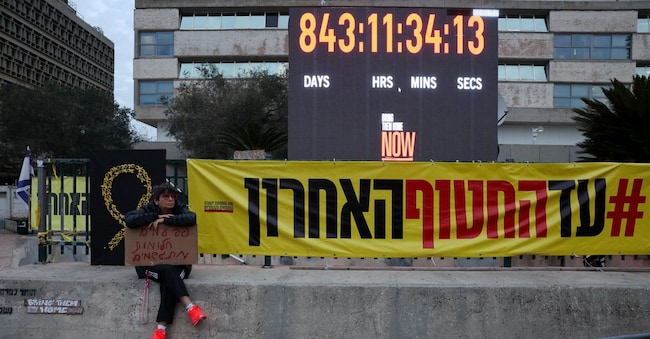
Una persona con un cartello con la scritta "A volte i sogni diventano realtà" è seduta accanto a uno striscione con la scritta "Fino all'ultimo ostaggio", nel giorno in cui l'iconico timer dell'orologio verrà spento, dopo aver segnato 844 giorni di prigionia degli ostaggi e il ritorno dell'ultimo ostaggio israeliano rimasto a Gaza, Ran Gvili, un agente di polizia fuori servizio ucciso mentre combatteva i militanti che si erano infiltrati in Israele durante il sanguinoso attacco di Hamas del 7 ottobre 2023, nella "Piazza degli ostaggi" a Tel Aviv, Israele, il 27 gennaio 2026. REUTERS/Nir Elias

9' min read

Translated by AI
Versione italiana

9' min read

Translated by AI
Versione italiana

A 12-day-old child died of frostbite in the Rantisi Children's Hospital in Gaza City. Palestinian media report this, citing the Gaza Ministry of Health. He isthe eleventh child to die of frostbite this winter. The inhabitants of the Strip cling to the hope of the announced reopening of the Rafah crossing after almost two years.. This is said by Save the Children.

The crossing has become the focus of renewed hope for families awaiting the possibility of medical evacuations, educational opportunities for students, family reunification, and urgent aid deliveries. "Families in Gaza are waiting with cautious optimism and hope for the Israeli authorities to define the next steps for the announced reopening of the Rafah crossing. The news that has emerged is a positive development that offers hope to many people, even though free access through Rafah was never supposed to be conditional," says Shurouq - Gaza media officer for Save the Children - adding that "the crossing must be opened in both directions to allow the safe passage of humanitarian aid and the free movement of civilians".

Loading...

The reopening of the Rafah Crossing Point

Some 20,000 Palestinians are waiting to leave the Gaza Strip to receive treatment in Egypt, as the actual reopening of the crossing appears to be getting closer. This was announced by the Hamas-controlled Gaza Health Authority, pointing out that among them are 440 emergency cases with immediate risk to life, some 4,000 cancer patients and 4,500 children in need of urgent surgery. With the return to Israel of the remains of Ran Gvili, the last remaining hostage in Gaza, one of the main conditions for the reopening of the crossing has been met, but the indications remain conflicting: a source in al-Arish, Egypt, speaks of a possible reopening by Sunday, while the broadcaster al-Araby al-Jadeed indicates Wednesday as a provisional date for preparations and the Israeli daily Yedioth Ahronoth hypothesises the start of passenger traffic as early as Thursday, with 100-150 transits a day. According to the plan under discussion, Egypt will send daily lists of names for Israeli control, with a gradual increase in capacity.

At least 488 Palestinians dead in the 'truce'

Two Palestinians were killed by Israeli army fire in the Tuffah neighbourhood of Gaza City, Gaza Strip, in the early hours of dawn. This was reported by Palestinian sources, quoted by the Israeli daily Haaretz.At least four people were killed - includinga minor - and three others were wounded in the Israeli shelling carried out today near the Al-Batsh cemetery located in the Al-Tuffah neighbourhood in eastern Gaza City. This was reported to the Wafa news agency by hospital sources. The affected area is beyond the Yellow Line, under Israeli control, and is the same where the body of the last Israeli hostage was recovered yesterday. Palestinian media reported the desecration of several graves during the search carried out by Israeli forces. Since the ceasefire came into effect on 11 October, at least 488 Palestinians have been killed and another 1,350 injured.

Iran, US and Israel between diplomacy and armaments

Six thousand one hundred and twenty-six. That is the minimum number of deaths ascertained so far in Iran - although many more people are currently missing - during the attempts to suppress the uprisings across the country by the regime in Tehran. These figures were released by Associated Press, but come from the US-based Human Rights Activists News Agency, which monitors the Iranian situation by verifying every death through a network of activists on Iranian territory. The Internet blockade imposed by the Islamic Republic makes it impossible to independently assess the death toll. The Iranian government has released more restrained numbers - 3,117 dead - claiming that 2,427 of them were civilians or members of the security forces and calling the others 'terrorists'.

Hamas demands that 10,000 men of its security force be included in a future Palestinian administration for the Gaza Strip. According to a source in the organisation told the German news agency 'Dpa', an agreement has also been reached with the United States to this effect, provided that all candidates pass a security check. The Hamas police, it is pointed out, have the best knowledge of the region. The source also recalls what happened in Iraq, after the dismantling of the military structures and the Bath party.

The arrival of the aircraft carrier USS Abraham Lincoln - and the accompanying missile-launching destroyers - gives the US the ability to strike Iran, especially now that the Gulf Arab states have signalled that they want to stay out of any attack, despite hosting US military personnel.

Tehran has warned that in the event of a US attack, it would respond harshly against US interests in the region and against Israel, dragging the entire Middle East into a war, even though its air defences and military apparatus are still tested after the June war launched by Israel against Tehran.

Trump speaks of an 'evolving' situation: 'They want to make a deal. I know. They have called on numerous occasions. They want to talk,' the US president said in an interview with Axios. Words that contrast, however, with the deployment of a US armada in the region, aircraft carrier USS Abraham Lincoln in the lead. A deployment that the ayatollahs interpret as a direct threat. Diplomacy works on the edge of this precarious balance, in an attempt to keep a channel open and avert a new conflict. According to the Israel Hayom newspaper, White House envoy Steve Witkoff handed Trump a message from the Iranian foreign minister, Abbas Araghchi, and a written guarantee from the president, Masoud Pezeshkian, in an attempt to postpone an attack against Tehran. An Israeli official quoted by the newspaper explained that "Witkoff continues to insist on the diplomatic route to solve the Iranian problem".

On the ground, however, Iran is not waiting for the outcome of diplomacy. According to regional and Western intelligence sources - as reported by Adnkronos - the Islamic Republic has significantly reinforced its military presence along the southern coast, particularly in the Hormozgan province, around the port of Bandar Abbas, on the island of Qeshm and at the eastern entrance to the Gulf of Oman. Units of the Guardians of the Revolution and Basij militias, air defence systems, ballistic missiles, suicide drones and submarines have been deployed. The declared objective is to prevent any US amphibious operation and to maintain the ability to strike enemy naval forces in a strategic maritime space such as the Strait of Hormuz, through which some20% of the world's oil passes. Air defence represents one of the pillars of Iranian strategy. Short- and medium-range systems have been installed on the islands of Qeshm and Abu Musa, while advanced systems such as the domestically produced Bavar-373 and the Russian-made S-300 have been deployed in Bandar Abbas. According to the Iranian authorities, the Bavar-373 is able to engage targets up to 300 kilometres away and intercept even fifth-generation fighters.

Alongside this 'defensive shield', the sources reveal, Tehran deploys an offensive capability designed to ensure retaliation.

Two Iranian-backed militias in the Middle East have signalled their readiness to launch new attacks - possibly in an attempt to support Tehran after US President Donald Trump threatened military action if Tehran carried out mass public executions following the protests, reports Associated Press.

'Total war' in the event of an attack on Iran. This is the threat raised by Kataib Hezbollah, an Iraqi paramilitary group that - al-Jazeera satellite TV reported - has promised support to Tehran if necessary. Abu Hussein al-Hamidawi, the group's number one, asked his people to be ready. "We say to the enemies that a war against the (Islamic) Republic will not be a walk in the park," al-Hamidawi said in statements picked up by satellite TV. "Nothing will be left of you in our region.

Two Hezbollah militiamen who were attempting to restore an underground facility belonging to the Islamic fundamentalist movement in southern Lebanon were killed in an Israeli airstrike last night. This was reported by the Jewish state army. The raid took place in the area of Nabatieh. According to the Israeli Defence Forces (IDF), the militiamen's attempts to restore the underground site constituted a violation of the ceasefire between Israel and Lebanon and posed a threat to Israel. The Jewish state army released pictures of the attack.

US-Israel Agreements

Gil Pinchas, speaking to the Financial Times before stepping down as chief financial advisor to the Israeli Ministry of Defence and Armed Forces, said that Israel - in the talks it plans to hold in the coming weeks - will try to give priority to joint military and defence projects over cash disbursements.

"The partnership is more important than just the financial issue in this context, there are many things that equate to money," Pinchas told the Financial Times. "The vision has to be broader."

The financial support - or 'free money' amounting to $3.3 billion a year - that Israel can use to buy US weapons is 'a component of the MoU that may gradually decrease', Pinchas added.

In 2016, the US and Israeli governments signed a memorandum of understanding for the 10 years to September 2028. The document provides $38 billion in military aid, $33 billion in grants for the purchase of military equipment, and $5 billion for missile defence systems. Earlier this year, Israeli Prime Minister Benjamin Netanyahu said he hoped to "gradually reduce" Israel's dependence on US military aid over the next decade.

The clock goes off in the hostage square

The rumours of diplomatic activity for the renewal of security agreements between Trump and Netanyahu come on the day when - after recovering the body of the last remaining hostage in the hands of Hamas, 24-year-old policeman Ran Gvili - they are preparing to turn off the clock in the square now known in Tel Aviv as 'hostage square'. It has been 844 days (27 months) since the Hamas attack on 7 October 2023. A ceremony scheduled for 5.30 p.m. local time - 4.30 p.m. in Italy - in the presence of Gvili's sister Shira, survivors of captivity and grieving family members, will mark the turning off of the clock. The Times of Israel reports. Trump had indicated the return of all hostages as the first step in his 20-point plan to restore peace in Gaza.

Disarmament and Amnesty Hypothesis

Regarding what might happen next, a US official - at a press conference with journalists - reiterated the position of Donald Trump's administration that those in Gaza who agree to hand over their weapons will be granted amnesty. This was reported by several media outlets including Times of Israel and Al Jazeera. "We believe that disarmament should be accompanied by some kind of amnesty and, frankly, we think we have a very good programme for disarmament. We are in contact, or rather, our representatives are in contact with Hamas and we expect that to happen,' the US official said, adding later that 'if they don't disarm then they have violated the agreement'. The offer of amnesty to Hamas fighters in exchange for handing over weapons is also part of the 20-point plan presented by the Trump administration in September. The plan was welcomed by Prime Minister Benyamin Netanyahu, writes the Times of Israel, while his coalition allies criticised certain elements of the proposal that included the creation of a path to the establishment of a Palestinian state.

Hamas, in response, would like tointegrate its ten thousand police officers into the new administration that should replace the terrorist organisation in the running of the Strip (the National Committee for the Administration of Gaza). Ynet reports this, citing Reuters. Several sources emphasised that Israel will oppose this by referring to the agreement that provides for the disarmament of Hamas.

Israele diffonde immagini del recupero resti ultimo ostaggio a Gaza

Meanwhile - after Foreign Minister Antonio Tajani's request to convene the Israeli ambassador to Italy to ask for clarification about the episode involving two carabinieri on duty at the Italian Consulate General in Jerusalem - the Israeli army made it known that it was one of its soldiers (not a settler, as initially assumed) who stopped the Italian officers near Ramallah, forcing them to kneel down at gunpoint.

"Earlier this week (Sunday), a soldier spotted a vehicle heading to the community of Sde Ephraim along a route closed to civilian traffic in accordance with the assessment of the operational situation and designated as a closed military zone," the Idf explained to Rai Jerusalem to justify the incident. After stopping the plainclothes carabinieri, "the soldier classified the vehicle as suspicious. Since the diplomatic number plate was not identified at the time, the soldier approached the vehicle to stop it, pointing his weapon without opening fire, and ordered the passengers to exit the vehicle and identify themselves," he continued. "As soon as the passengers identified themselves as diplomats, the soldier immediately released them and reported the incident to his commanders," Israeli army spokesmen assured.

Meanwhile, Israeli Prime Minister Benyamin Netanyahu announced that 'Israel will maintain security control over the entire area from the Jordan River to the sea, and this also applies to the Gaza Strip. I have heard that I will allow the creation of a Palestinian state in Gaza, but this has not happened and will not happen.... I think you all know that the person who has repeatedly blocked the creation of a Palestinian state is me,' the prime minister told Times of Israel.

Copyright reserved ©
Loading...

Brand connect

Loading...

Newsletter

Notizie e approfondimenti sugli avvenimenti politici, economici e finanziari.

Iscriviti