The interview

Pizzaballa: Israelis and Palestinians need to recognise one another

According to Cardinal Pizzaballa, a guest at the Franciscan Festival, it is essential that everyone accepts ‘that the other person has a connection to this land, a history, and a right to live in freedom, security and dignity’

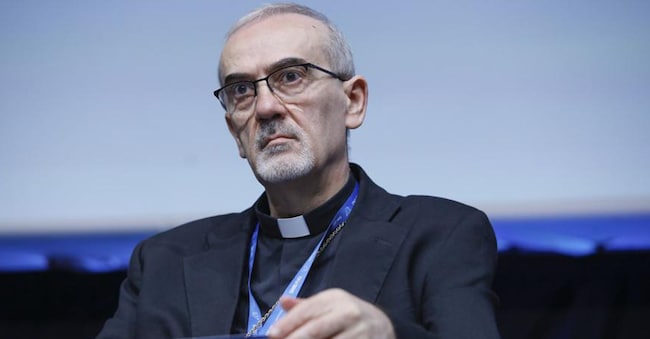
Patriarca di Gerusalemme. Pierbattista Pizzaballa in uno scatto al forum «Osare la pace»

5' min read

Translated by AI
Versione italiana

5' min read

Translated by AI
Versione italiana

Since 2009, the Franciscan Festival has been one of Italy’s leading cultural events, attracting tens of thousands of people every year with free talks, discussions and performances open to all. The 2026 edition will take place from 24 to 27 September in Bologna, in Piazza Maggiore, and, to mark the eighth centenary of the death of St Francis, will be dedicated to the theme ‘Sister Death. The transition that rewrites life’, featuring guests such as Giovanni Allevi, Michelangelo Pistoletto and Cardinal Matteo Maria Zuppi. Among the key figures will be Cardinal Pierbattista Pizzaballa, Latin Patriarch of Jerusalem, who is expected to attend two events on 24 September: at 3.00 pm, in the Farnese Chapel of Palazzo d’Accursio, the round-table discussion ‘Cultivating peace in lands scarred by war’ with César Essayan and Paolo Martinelli; at 5.00 pm, in Piazza Maggiore, the conference ‘Art and Faith in Dialogue: Voices for Building Peace’ with Francesco Monico and Michelangelo Pistoletto.

Your Eminence, how can we foster and promote peace in a land ravaged by war, in this year marking the 800th anniversary of the death of Saint Francis, who is remembered as a ‘peacemaker’?

Loading...

I believe that our primary responsibility is to stand by those who are suffering. When one has lost a child or a home, talking about peace can even seem offensive: peace must have a credible face. When Francis met the Sultan, he did not renounce his faith, but he refused to let the fact that they belonged to opposing sides make the meeting impossible. We too must speak out against injustice without allowing the injustice we have suffered to determine who we become. Teaching people not to hate, standing up for others, and maintaining relationships all pave the way for peace. Christian hope asks us what good we can do right now, without waiting for everything to change.

In your view, what is the best way forward for the much-needed dialogue between Israelis and Palestinians?

Mutual recognition: accepting that the other person has a connection to this land, a history, and a right to live in freedom, security and dignity. As long as we imagine a future without the other, or one based on their subordination, there is no room for dialogue. This does not mean treating everything as equal: equal dignity does not erase differences in responsibility, power and circumstances. The security of Israelis and the freedom of Palestinians must be accommodated within the same political framework. We must also rebuild trust by resuming meetings and working together. Religious communities, too, have a responsibility: not to provide a sacred justification for isolation.

What is the current situation of Christians in the Palestinian territories and in Israel?

Christians share in the lives and hardships of their peoples. In Gaza, the small Christian community, together with the entire population, bears the wounds of bereavement and destruction. The Church seeks to support and assist people, not just Christians. In the West Bank, the burden is felt through the occupation, restrictions on movement, the crisis in employment and pilgrimages, and attacks by settlers. People emigrate not only because of poverty, but because they are losing faith in the future. In Israel, the Christian communities – largely Arab – participate in social life, but face discrimination, tensions and insecurity, including that linked to local crime. There are also Jews who identify as Catholics and migrants, each with their own distinct needs. Our shared task is not to preserve a memory of the past, but to enable a living community to express its faith and continue to serve society.

Looking beyond the borders of the Middle East, how can the teachings of St Francis serve as a beacon for peoples suffering from war?

St Francis was a profoundly free and resolute man. His poverty was not a glorification of destitution, but a way of freeing himself from the need to possess and dominate. He still challenges us: do we wish to base our security solely on being stronger than others? This is a question addressed above all to those with political, economic and cultural responsibilities, and also to the Churches. Peace requires decisions that come at a cost and the renunciation of one’s own interests; it cannot be left to the goodwill of the victims. Francis does not leave us a political programme, but a criterion: does our way of life create opportunities for others to live, or does it restrict them?

Dostoevsky wrote that ‘beauty will save the world’. In an age marked by war and dehumanisation, what kind of beauty can become a path to salvation and restore dignity to human beings?

Loading...

There is nothing beautiful about the suffering inflicted on a child or the humiliation of a person. Beauty can, however, be found in the response to evil. In Gaza, I was struck by the children, the educational activities and the desire to rebuild: people still had something to hope for and something to offer. For a Christian, the point of reference is Christ crucified: it is not the violence of the cross that is beautiful, but the love that does not fail even there. The Resurrection tells us that that love was not in vain. We can be saved by a beauty that enables us to recognise the intrinsic value of every life. It is not for us to restore dignity: no violence can erase it. We can, however, recognise it and defend it.

In your experience in the Holy Land, can art, the care of places and the preservation of religious heritage make a tangible contribution to reconciliation?

Yes, but not automatically. A religious site can foster encounters or be used to assert exclusive ownership: it depends on how we look after it and make it accessible. The collaboration between Christian communities in the restoration of the Holy Sepulchre, for example, shows how caring for a place can become a shared responsibility. Safeguarding means passing on a memory without turning it into a weapon against that of others, holding together both the stones and the people. A restored sanctuary, yet one that is cut off from the suffering of those living nearby, risks losing something essential. Art does not replace justice, but it can create shared experiences that make the possibility of coexistence less abstract.

Ettore Sottsass maintained that design should help people to live, whilst Pavel Florensky linked beauty to truth and the spiritual dimension. What responsibility do artists and intellectuals have today in combating indifference and defending human dignity?

I would not ask artists to become preachers. Art and thought need freedom, including the freedom to unsettle and to ask questions. This freedom, however, comes with a responsibility: to look at reality without selecting only what confirms one’s own convictions; to give a face back to those who have become mere numbers; and to challenge the oversimplifications that make an entire people guilty. Then there is a practical question: for whom do we create works of art, objects and spaces? Even those who are poor, sick or displaced need places that convey care. Culture must not only denounce what destroys social cohesion, but help us to imagine a different way of life.

Copyright reserved ©
Loading...

Brand connect

Loading...

Newsletter

Notizie e approfondimenti sugli avvenimenti politici, economici e finanziari.

Iscriviti