
Istanbul platform of the contemporary
The CI BLOOM fair, born as a project of Contemporary Istanbul, is in its fifth edition
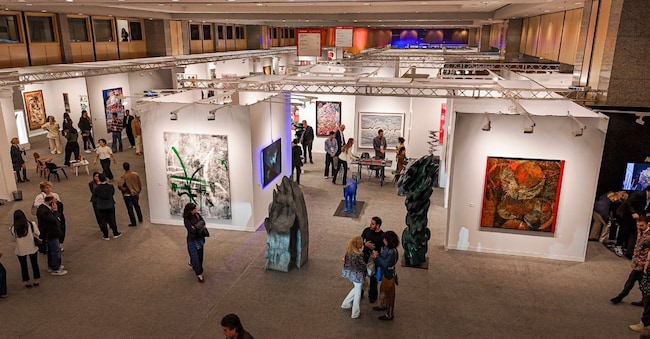
In Istanbul, the contemporary art market no longer merely chases global flows, but intercepts and reworks them, sometimes anticipating them. In a cultural geography that has shifted eastwards over the past fifteen years, the city on the Bosporus has transformed its historical function as a hinge "into a real platform for production and exchange, where art is not just a commodity but a symbolic infrastructure". Ali Güreli, head of Contemporary Istanbul, Turkey's leading international contemporary art fair, founded in 2006 and now a point of reference for galleries, collectors and institutions between Europe, the Middle East and Asia, a veritable orientation device, "a curatorial machine capable of reading market transformations and returning them in the form of a narrative", explains.
The 'Focus Asia' axis - which he strongly advocated - is not an exotic concession, but the recognition of a structural rebalancing: 'Shanghai, Seoul, Singapore are no longer emerging peripheries, but centres of cultural irradiation with which Istanbul has an increasingly less asymmetrical dialogue,' adds Güreli, who is preparing the next edition to be held in the autumn. This change is reflected in the very composition of the local artistic fabric. Whereas in the 2000s, the scene was dominated by a few established galleries and a still shy collecting sector, today the panorama appears to be dotted with independent initiatives, hybrid spaces, nomadic platforms. In this context, the CI BLOOM fair, born as a project of Contemporary Istanbul, which in April 2026 reached its fifth edition, hosted in the spaces of the Lütfi Kırdar Rumeli Salonu with the most dynamic expressions of the Turkish contemporary scene, is very interesting.
Platform
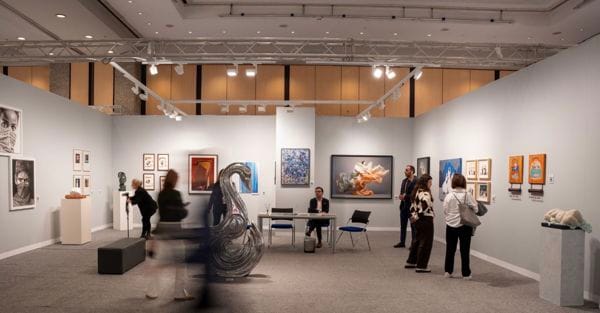
"More than just a collateral fair, CI BLOOM presents itself as a living platform, capable of giving visibility to emerging galleries and independent initiatives from different cities across the country," says Güreli. "Its progressive growth testifies to a paradigm shift, as the centre of gravity has shifted towards young, experimental and sometimes hybrid practices that intercept new audiences and redefine the relationship between artistic production and the market, collectors and professionals. No less relevant is the economic model adopted. In a context marked by currency volatility and rising operating costs, the 30% reduction in fees with respect to 2025 and the fixing of the exchange rate in Turkish lira "represent a political choice, to support the basic infrastructure of the system, i.e. the galleries, in order to preserve their design capacity". This strategy is accompanied by the involvement of industrial and institutional partners - from BMW Türkiye to Turkish Airlines - configuring an ecosystem in which private support becomes a structural lever. The growth of the market, after all, is not only measured in numbers - albeit significant - but in its ability to absorb shocks and reconfigure itself. In this sense, contemporary art in Istanbul is increasingly approaching a form of relational economy in which the value does not reside solely in the work, but in the network of relationships it activates. The growing presence of Turkish collectors at international fairs testifies not only to an expansion in demand, but also to a greater sophistication of taste and acquisition strategies. Decisive, finally, is the relationship with urban space. The choice of Tersane Istanbul as exhibition venue for the main fair is not neutral: the reconversion of the former Ottoman arsenal into a cultural hub signals a desire to inscribe the contemporary within a historical stratification that is not removed, but reinterpreted. It is in this tension between memory and project that Istanbul today finds its distinctive feature: a city that, in redefining its art market, also redefines itself.
CI BLOOM April 2026, Lütfi Kırdar Rumeli Salonu Istanbul

