
Third year in the red for industrial production: -0.2%
In December, Istat estimates -0.4 month, +3.2% yearly thanks to the rise in pharmaceuticals and cars.
by Luca Orlando
The upward trend in December was not enough and for the third year in a row industrial production closed in the red. However, the slowdown was only two decimals, thanks to December's +3.2%. This was an interlocutory month, with a drop of four decimals compared to the previous month but a recovery spread across several sectors in the annual comparison.
Decisive in this second area was the surge in pharmaceuticals, which saw production rise by almost 24 points. Transport equipment also did well, as did metal products and plastic rubber.
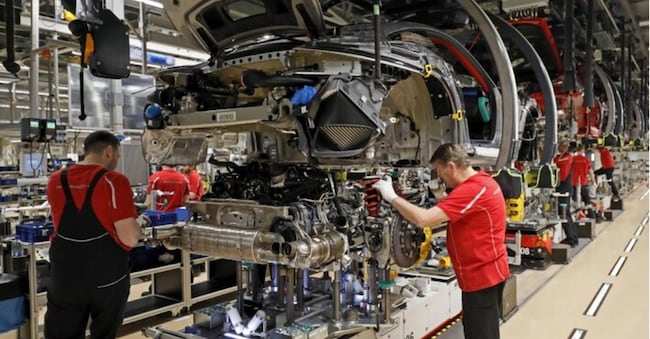
For motor vehicles, which faced a December 2024 low, the rebound is evident, with year-on-year growth of 35%.
Declining, on the contrary, are a handful of sectors including chemicals, textiles-clothing and wood, slowing down in the order of three percentage points. Budget 2025 improved thanks to the partial recovery in the second half of the year, visible in production as well as in companies' revenues. The estimate by Prometeia and Intesa Sanpaolo sees global turnover at 1122 billion, up at current values by just a couple of billion, 0.2% more. This is not enough to make up for the drop in 2024, and which nevertheless keeps manufacturing at historically high levels, close to the record of 2022, with a distance (boosted above all by the inflationary spurt) of more than 200 billion from the pre-Covid period, corresponding to a positive difference of more than 23 percentage points, which rises to around forty for specific sectors such as food and pharmaceuticals. In any case, although the second half of the year saw some signs of recovery, for Italian industrial production this is, on an annual average, the third consecutive period in the red, with a seasonally adjusted index that has fallen to 94.5. The year-on-year decline was 0.2 %, with the largest declines in textiles-clothing and transport equipment (cars).
Even across the border in Europe, the picture remains in the balance, with December on average disappointing for the three largest continental economies, with Spain (-2.5%), France (-0.7%) and Germany (-1.9%) closing the last month of 2025 in the red on a monthly basis. For Berlin, in particular, the difficult phase is confirmed (the annual figure is also down by 0.6%), even in the presence of a car sector that has returned to a tonic state: in December, in fact, cars produced in Germany increased by 17% compared to the same month of the previous year, bringing the annual balance to 4.15 million, 2% over 2024. A glass half-full in recent comparisons, not entirely satisfactory when looking at the splendour of the past, with Berlin able to touch production close to six million vehicles.


