Macroeconomics

Cars alone are not enough: production down 1% in June, down 0.6% year-on-year

A second consecutive month in the red. The fashion and machinery sectors are performing poorly, whilst cars and pharmaceuticals are not enough to lift the average.

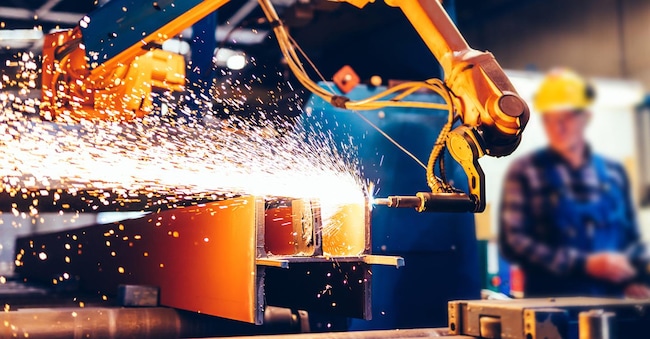
Worker controls robotic arm to cut steel in a factory. Modern heavy industry, technology and machine learning Photocreo Bednarek - stock.adobe.com

3' min read

Translated by AI
Versione italiana

3' min read

Translated by AI
Versione italiana

Cars and pharmaceuticals are not enough. Although the sectors that have traditionally been the strongest in recent times continue to grow, the average figure for industrial production in June was negative, dragged down by a long run of negative figures, starting with the fashion sector.

Over the month, the economic decline was one percentage point, or 0.6 per cent year-on-year, thereby further reducing the already meagre growth forecast for 2026, which now stands at 0.5 per cent. The worst-performing sector is textiles and clothing, down by more than seven points, but the wood and paper, rubber and plastics, chemicals, metallurgy and machinery sectors are also holding back growth.

Loading...

By contrast, the electronics, pharmaceuticals and transport sectors are performing well, driven recently by the recovery in the car sector, which continued to grow by more than 10 per cent in terms of production in June (under the ‘motor vehicles’ heading, which also includes commercial vehicles).

Looking at the first half of the year as a whole, whilst the transport sector – with a 10-point increase – is the best-performing sector of 2026, elsewhere, as one scans the list of sectors, there are more than a few negative figures. This is the case for fashion, timber and paper, and the chemicals sector, whilst the food sector is hovering just above zero, at the same levels as in 2025.

The manufacturing figures are not particularly impressive – a fact already reflected in the second-quarter GDP figures, which show signs of resilience for Italia, with figures exceeding expectations (+0.2 per cent quarter-on-quarter, +1 per cent year-on-year, driven, however, by services rather than industry), prompting the Parliamentary Budget Office to revise its 2026 estimate upwards by four decimal places to +0.9 per cent, driven by domestic demand against a backdrop of zero growth in net exports.

A picture that remains one of mixed fortunes, because whilst it is true that, in a complex period such as the present one, total exports grew by 3.4 per cent between January and May, of the nine billion increase in current value, a full six billion is attributable to gold bullion destined for Switzerland, and once this is factored out, the progress made by ‘Made in Italy’ products is significantly scaled back. This is further highlighted by the decline in overseas sales in 2026 for food, fashion and furniture, whilst machinery and transport equipment (excluding cars) remain stagnant. Elsewhere in Europe, the signs are mixed. Whilst French industrial production in June fell slightly (-0.1 per cent month-on-month, -1.1 per cent for manufacturing alone), there is a notable improvement in Germany. With Berlin recording second-quarter GDP growth in line with Italia’s performance, whilst June saw manufacturing orders rise more than expected, particularly from the domestic market: the overall increase was 3.1 per cent for the month and 6.5 per cent year-on-year, with machinery posting double-digit growth. In terms of production, the automotive sector in Germany remains in the balance, with domestic output down by three percentage points in the first half of the year despite a positive June. Total production between January and June in Berlin nevertheless stood at 2.1 million units, whilst in Italia – where volumes have also risen by 26 per cent compared with last year’s lows (though by only 4.5 per cent in June) – 167,000 cars were produced.

In detail

In June 2026, the seasonally adjusted industrial production index is estimated to have fallen by 1.0% compared with May. On average for the second quarter, production levels rose by 0.4% compared with the first quarter of 2026.

The seasonally adjusted monthly index rose on a month-on-month basis only for energy (+0.8 per cent), whilst it fell for consumer goods (-0.7 per cent), intermediate goods (-0.9 per cent) and capital goods (-2.1 per cent). Adjusted for calendar effects, in June 2026 the overall index fell by 0.6% year-on-year (there were 21 working days compared with 20 in June 2025). Consumer goods (-3.2%) and intermediate goods (-1.2%) showed a decline. Conversely, year-on-year growth was observed for capital goods (+0.6%) and, to a greater extent, for energy (+1.7%). The sectors of economic activity recording the highest year-on-year increases are the manufacture of computers, electronic and optical products, electro-medical equipment, measuring instruments and watches (+4.5%), the manufacture of transport equipment (+3.2 per cent) and the supply of electricity, gas, steam and air (+2.3 per cent). The largest declines were observed in the textile, clothing, leather and accessories industries (-7.1 per cent), in other manufacturing industries, and the repair and installation of machinery and equipment (-3.6 per cent), and in the manufacture of machinery and equipment n.e.c. (-2.3%).

Copyright reserved ©
Loading...

Brand connect

Loading...

Newsletter

Notizie e approfondimenti sugli avvenimenti politici, economici e finanziari.

Iscriviti