
Agri-food crisis in Gaza: 97 per cent of arable land inaccessible following the ceasefire
Territorial restrictions and a shortage of agricultural resources are bringing production to a standstill, putting the livelihoods of over half a million people in the Gaza Strip at risk.

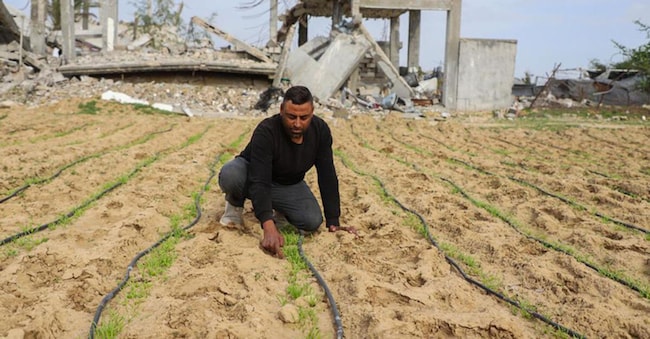
It is not just death and destruction: in the Gaza Strip, we are heading towards the complete elimination of any possibility of rebuilding an agri-food system that could guarantee even a bare minimum of subsistence.
Since the ceasefire was declared in October 2025, only 3 per cent of cultivated land has remained accessible, due to the westward expansion of the so-called ‘yellow line’, which separates the area of ceasefire (ceasefire, ed.), from the area controlled by the military.
Data collected by the United Nations Satellite Centre (UNOSAT), and the Food and Agriculture Organisation of the United Nations (FAO), show that the figure has fallen from 601 hectares of intact and accessible land in October 2025 to 448 hectares as at 24 June this year. As of today, 4,091 hectares – 27 per cent of the arable land in the Strip – are accessible but not intact. The areas around Deir al-Balah and Khan Younis are the most devastated.
Access to greenhouses has also decreased: 224 hectares (16.6 per cent) are available, compared with 226 hectares (17.3 per cent) in October 2025.
Rafah has the highest levels of inaccessibility, with 97.2 per cent of arable land and 98.4 per cent of greenhouses inaccessible, whilst the most extensive material damage is concentrated in northern Gaza and the Gaza governorates.

