Writing

The era of ‘humanised’ texts: how AI is trying to hide its own style

The paradox of modernity lies precisely here: writing like a human, but with the help of an algorithm

3' min read

Translated by AI
Versione italiana

3' min read

Translated by AI
Versione italiana

The paradox of modernity lies precisely here: writing like a human, but with the help of an algorithm.

Relying on AI for writing has now become extremely widespread: from important emails to annual reports, academic theses and even more mundane tasks such as love letters. It’s a shortcut: AI processes the text in a matter of seconds, saving us time and effort. This is tolerable, but to what extent? The main concerns arise particularly in education: using AI for writing means delegating to a machine a task that should be carried out using our own knowledge and refined through our capacity for analysis.

Loading...

At least, it should. This is why many universities are increasingly relying on systems capable of determining whether a text is unauthorised copy-and-paste generated by AI. The problem is that these programmes are not infallible: several studies have shown that detectors can produce false positives and that their reliability varies depending on the type and length of the text. GPTZero, one of the first tools to gain popularity following the launch of ChatGPT, emerged precisely in this context, having been developed in early 2023 by Edward Tian, then a student at Princeton.

Beyond the actual effectiveness of the detectors, the issue of transparency remains. For the European Union, knowing when content has been generated or manipulated by AI has become important in order to safeguard information and enable citizens to understand the origin of what they are reading, watching or listening to. From 2 August 2026, the transparency requirements set out in Article 50 of the AI Act will apply, which also include the machine-readable labelling of content generated or manipulated by AI, including text.

In this context, Anthropic has beaten everyone to it, announcing that the Claude models launched from 2 August onwards incorporate an imperceptible, machine-readable watermark into the text, designed to withstand even standard copy-and-paste operations and subsequent modifications. The company is also developing tools to enable third parties to verify the presence of this watermark.

However, the legislator’s initiative raises some doubts about hybrid content, produced through collaboration between humans and machines. Indeed, some observers point out that the issue should not be so much ‘how the content was generated’ as ‘what was generated’. And whilst, in this regard, ‘there remains great confusion under the heavens’, to paraphrase Mao, ‘the situation is excellent’ for tools that instead aim to humanise AI-generated writing.

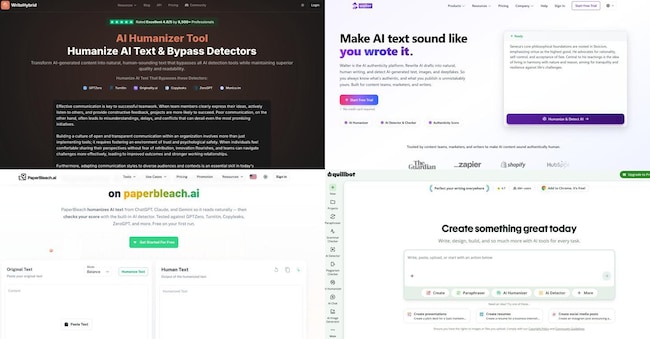
Let’s talk about AI humanisers, a category of paid tools that has grown rapidly in recent years. Their purpose is to take text generated by a language model and rewrite it, reducing its syntactic predictability and introducing imperfections, variations in rhythm and lexical choices that are intended to make it more like human writing. Many of these services also openly state a second objective: to reduce the likelihood of the text being recognised by AI detection systems. Even GPTZero, which began as a detector, has added functions to rewrite and ‘humanise’ content, shifting its positioning from a simple detection tool to a platform for text analysis and revision.

There are now more than a hundred of them online, and it is no easy task to determine which ones are truly the most effective. A number of recent industry tests, including the 2026 AI Humanizer Benchmark and independent analyses of platforms such as HumanizeKit and PaperBleach, have sought to compare these tools by subjecting them to stress tests using complex texts. The evaluation focuses primarily on three parameters: the Bypass Rate, i.e. the percentage of times the rewritten text manages to avoid being classified as AI-generated; Meaning Preservation, which measures how well the system manages to alter the form without changing facts, quotations or the logic of the argument; and Register Control, that is, the ability to adapt the rewritten text to the context, maintaining an academic, technical or narrative tone as required.

Among the tools that feature most frequently in tests are Rytr Pro, which regularly tops independent rankings; Walter Writes, which brings together various detection systems on a single platform, including GPTZero, ZeroGPT, Turnitin, Originality and Copyleaks, and offers different tone options; and Undetectable.ai, one of the most widely used services, which allows you to set the readability level of the final text and displays a ‘before and after’ detection score.

Copyright reserved ©
Loading...

Brand connect

Loading...

Newsletter

Notizie e approfondimenti sugli avvenimenti politici, economici e finanziari.

Iscriviti