
It’s not just the heat: Piedmont and Sardinia are battling wildfires
A heatwave is expected over the next few days, with maximum temperatures forecast to reach 43 degrees

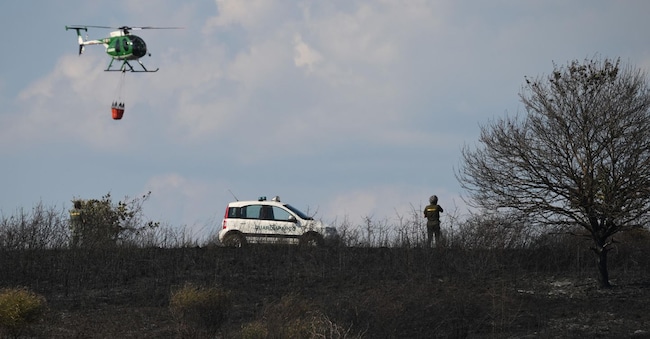
It is not just the high temperatures that are affecting and stifling the cities; a heatwave has also been declared for Sardinia and Piedmont fire emergency. The two regions have, in fact, had to contend with the flames that have destroyed hundreds of hectares of vegetation, mobilising hundreds of people, including volunteers, fire prevention staff and firefighters.
900 hectares gone up in smoke
According to initial estimates, the worst damage was recorded in Piedmont, where around 900 hectares of vegetation were reduced to ashes. A total of 700,000 trees were lost in what the regional government has described as ‘a veritable ecological catastrophe’. This is also because the flames have compromised ‘local biodiversity; it will take between 2 and 5 years for the first plant species to return, and between 50 and 70 years for the ecosystems of oaks, beech and tall coniferous trees affected in recent hours to regain their original structure’.
500 people on the ground and 60 vehicles
A breakthrough came late in the evening thanks to the rain and the efforts of ground and air crews, with 500 people and 60 vehicles deployed to extinguish the flames and clear the affected areas. “We are continuing to monitor the situation on the various fire fronts in Piedmont with the utmost commitment, deploying both personnel and equipment,” said the President of the Piedmont Region, Alberto Cirio, alongside the Regional Councillors for Civil Protection, Marco Gabusi, and for the Environment, Matteo Marnati. “The climatic and meteorological conditions affecting the entire Po Valley have now persisted for weeks, with temperatures well above the seasonal average and very little rainfall, and this means the highest alert level for fire risk remains in place.” A meeting of the water emergency task force has been convened for Monday.
7 fires in Sardinia
Sardinia was also affected by the fires, with roads closed and, for a few hours, Olbia Airport shut down as well, with flights diverted to Cagliari and Alghero until 7 pm, when the airport reopened. In this instance, around seven fires were reported, though they were small or contained in scale, and involved helicopters, Canadair aircraft and hundreds of people on the ground, including forest rangers, firefighting personnel and civil protection staff, as well as firefighters. As a precaution – and, in some cases, to allow emergency services to carry out their work – sections of state and provincial roads were closed to traffic.
Temperatures of up to 43 degrees
However, vigilance remains high due to the weather forecast. Over the next few days, temperatures are expected to reach up to 43 degrees in some parts of Sardinia and 40 degrees in the Po Valley. According to experts at meteo.it, temperatures will be 7–8 degrees higher than the historical averages for this time of year. There are concerns about sea surface temperatures, which in some areas are around 28–29 degrees, representing an anomaly of approximately 4–5 degrees. All this translates into a huge build-up of potential energy, capable of fuelling extreme weather events. In fact, severe thunderstorms are expected in Piedmont, Lombardy, Veneto, the Autonomous Provinces of Trento and Bolzano, Friuli-Venezia Giulia, Emilia-Romagna and the Marche, accompanied by strong gusts of wind, localised hailstorms and frequent lightning.

