
Italgas: start of new centre in Florence to manage the entire network remotely
The pole will operate together with its Turin 'twin' to remotely monitor and control the 74,000-kilometre network of the group led by Paolo Gallo

3' min read
Key points
3' min read
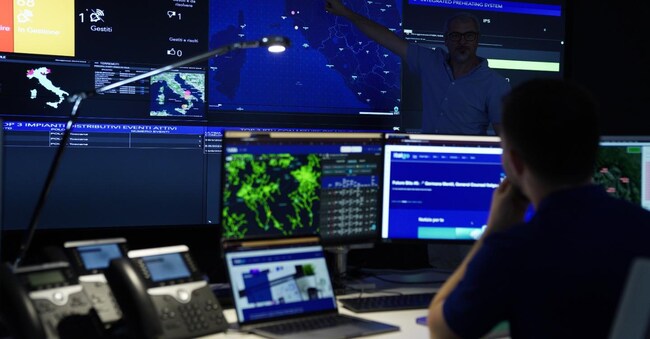
To summarise the meaning of the building block launched yesterday, at the headquarters of the subsidiary Toscana Energia (of which the group owns 50.6%), Italgas CEO Paolo Gallo explains that 'we make industry but, above all, industry of the future'. And, in fact, the new command and control centre for plants and networks, inaugurated in the Tuscan capital, represents, together with its Turin 'twin' launched at the end of 2021, a crucial step to remotely monitor and manage 74 thousand kilometres of gas distribution network (including the Sardinian network and the 8 thousand kilometres of the Tuscan 'arm'), 800 large plants and 8 thousand secondary substations distributed throughout the territory.
The 'heart' of the new Florentine centre
.You can tell this by looking up at the large screen inside the room that houses the 'heart' of the new centre. From here, Italgas technicians can manage the entire 'machine' and process all the reports collected by the toll-free emergency number (located in the adjacent room), optimising times and acting remotely on the network - reproduced with a precise map of the entire peninsula - through the proprietary Dana (Digital Advanced Network Automation) software. A technology that makes it possible to act on sensors and actuators installed throughout the network, i.e. without the need for operators in action in the field, and that has been set up within the digital factory, the 'engine' of the group's digitalisation strongly desired by Gallo since his arrival at the helm of Italgas.
Gallo: fully digitised network by early 2025
It is no coincidence that, in the brief press conference organised yesterday, which was also attended by the top management of Toscana Energia (president Fabio Giorgetti and CEO Bruno Burigana) and the mayor of Florence, Sara Funaro, Gallo retraced the path, starting precisely from the new Florentine chapter. 'This control centre is only the most advanced aspect of a unique digital development in the world,' he continues. 'We started in 2017 and today our network is almost entirely digitalised. We will reach 90 per cent within the year and 100 per cent by early 2025. Now it is possible to have even more control over our network and to intervene in advance'.
CEO: need to decarbonise molecules not just electrons
A very clear roadmap, then. Like Gallo's vision of the challenges awaiting Italy with an eye on decarbonisation. "Those who say that the future of energy will only be from renewable sources tell a very beautiful but unrealistic tale because it is not feasible from a technical point of view'. The reason is quickly stated, adds the CEO: 'Those who know about complex energy systems know that something else is needed. To achieve the decarbonisation targets we also need to work on the gas infrastructure, to decarbonise the molecules as well, not just the electrons. And to do this, we need intelligent, flexible and digitised networks'.
The Plan for Greece
.The network running along the peninsula is practically close to the finish line, then. But the group is also intent on accelerating in Greece. "We count on digitalising the 8 thousand kilometres of the Hellenic network in a couple of years," explains the number one of Italgas Reti, Pier Lorenzo Dell'Orco, after illustrating the most recent steps in the digitalisation process - such as the new Nimbus smart meter (now being tested on the territory, with 20 thousand pieces of equipment already installed, and ready to be marketed) -, and the other new steps. Starting with the '3D Asset Mapping' system, a sort of 'Tac of the grid', says Dell'Orco, which allows the underground to be mapped and which in the future will also be able to dialogue with Dana.


