
Italia–US: global competition hinges on tax policy
Simone Crolla, Managing Director of AmCham Italy: “To attract talent, capital and new business ventures, we need innovative tax policies and investment incentives.”

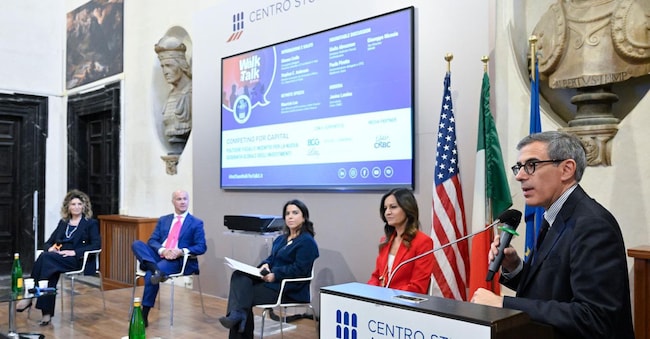
Global competition “is no longer determined solely by labour costs or the size of markets, but by the ability of economic systems to offer stability, predictability and conditions conducive to development”. It was with this observation that Simone Crolla, Managing Director of AmCham Italy, opened the meeting entitled ‘Competing for capital: fiscal policies, incentives and the new global geography of investment’, organised by the American Chamber of Commerce in Italy as part of the fifth edition of the ‘Walk the talk’ initiative. At the heart of the discussion was the increasingly strategic role of tax policy in driving economic growth and regional competitiveness, within an international context characterised by profound geopolitical transformations and the redefinition of value chains.
Global challenges
The starting point for the debate was the idea that governments, institutions and businesses can use taxation as a lever for industrial and development policy, by analysing the new dynamics of global geopolitical competition, strategies for attracting foreign investment and the opportunities arising from growing international economic cooperation. “To attract talent, capital and new business ventures,” explained Crolla, “we need innovative tax policies, investment incentives, regulatory simplification and the ability to create business-friendly ecosystems, in which quality of life plays an essential role.”
The aim, as reiterated by the managing director of AmCham Italy, remains “to provide a practical overview of the policies and tools that enable global challenges to be transformed into opportunities for growth, strengthening the competitiveness of local areas and promoting sustainable and long-term development, particularly along the transatlantic axis”.
Italian policies
As Crolla pointed out, in order to encourage foreign investment, our country must be ‘attractive to international capital, not only from an institutional point of view – and therefore in terms of stability and legal certainty, which are characteristics that Italia possesses on the international stage – but also because there are tax incentives that may appeal to potential investors’. Tax incentives, in fact, according to the managing director of AmCham Italy, are a genuine ‘enabling factor’ that those deciding whether to invest in our country consider very carefully.
The event was also attended by the Deputy Minister for the Economy and Finance, Maurizio Leo, who outlined the government’s achievements in this area over the past four years. ‘As regards taxation,’ he said, ‘we have included in the reform measures that specifically concern international taxation and are geared towards two objectives: legal certainty and simplification. With regard to legal certainty, we are providing clear rules for those residing in Italia. We have also paid close attention to so-called ‘new residents’. On the issue of foreign subsidiaries controlled by Italian companies, we have simplified the regulatory framework.”

