
Iran, Italia between caution and fears. All the moves from Mattarella to Meloni, with the unknown Salvini
Caution is no longer enough. Hooking up with Europe, working with the E4 to defend ships in Hormuz, and pressure from the League to suspend sanctions on Russia

Key points
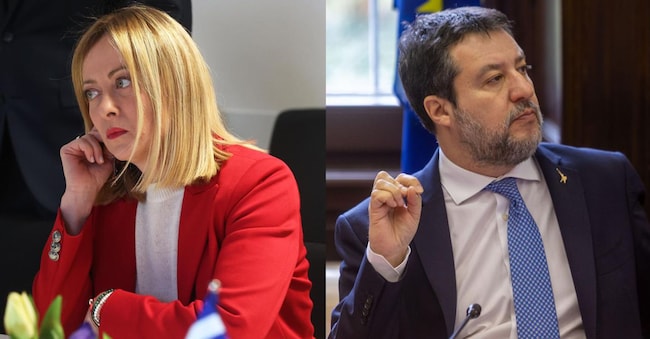
The measure of the bewilderment in Giorgia Meloni's government is given by the Lega Nord deputy premier Matteo Salvini, with the rift that came this morning. 'I hope that those who attacked,' he said, 'are aware of the consequences and the duration' of the conflict. He does not name Donald Trump and Benjamin Netanyahu, but the Carroccio leader is the first in the majority to distance himself more sharply from the 'Epic Fury' operation that from Iran has spread to the Gulf and touches Turkey and Cyprus, that is NATO and the European Union. Before him, the Defence Minister, Guido Crosetto, and the Prime Minister herself had merely admitted that the aggression against Tehran took place outside the rules of international law.
Meloni's cautiousness and hooking Europe
So far, the Prime Minister has attempted equidistance: total silence in the first two and a half days after the start of the US-Israeli raids against Iran, continuous internal meetings, obtaining the Parliament's OK to send military aid to the Gulf countries and, finally, engaging with the main European partners. First in the informal working group on competitiveness, already assembled with the Germans and Belgians before the Alden Biesen summit. The obvious goal is not to remain isolated and, above all, to share quick solutions to rising energy prices.
Fears for the economy
Economic concern tops the list. Everything government and majority would have wanted except a new war in the Middle East with a high level of uncertainty just a few weeks before the referendum on justice reform and in the pre-election year (general elections are expected in the spring of 2027). A crisis that risks thwarting the rigour in keeping the public accounts on which Meloni, in tandem with the Minister of the Economy, Giancarlo Giorgetti, has bet to accredit on the markets a 'new' Italia that would be politically stable and economically reliable in the eyes of international investors. The constraints, the deficit not yet below 3% of GDP and NATO commitments on defence spending to be maintained make Italy's margins for manoeuvre very tight: the budget deviation avoided so far could eventually appear as the only viable path.
Energy in the spotlight
Confidence in Trump, who assures the end of the war is near, has not waned in Palazzo Chigi and its surroundings, nor has the conviction that Khamenei's theocratic regime has reached intolerable levels of ferocity towards young people and women. But the unpredictability of the US president is now clear, as is the need for Italia - a medium-sized manufacturing power dependent on energy imports - to protect its national interests. The urgency in the short term is calming fuel prices; but in the long term, to use Giorgetti's words, it is to prevent the rising cost of energy from destroying 'the purchasing power of families' and altering 'the competitiveness of our businesses'.
Russia Relations and Dilemmas in Government
This is why Italia is calling on Europe to adopt 'extraordinary measures' as it did in 2022 after the outbreak of war in Ukraine and to speed up the revision of the Ets system already called for by Rome in January. But it is Salvini who raises the extremely delicate issue of a halt to sanctions against Russia, sanctions on which Meloni has so far been very firm: "I hope for an immediate awareness at the top of the EU Commission," said the League leader, "and that, if not definitively cancelled, at least all the impositions that are putting some of our sectors out of business are suspended. If the US does it, why can't the EU?".


