
Italia, Germany and France hold a summit today: the aim is to reach a common position on defence to counter Trump
Meanwhile, Secretary-General Mar Rutte is meeting the US President in Washington in an attempt to avert rifts with the European member states of the North Atlantic Treaty Organisation
by Andrea Carli
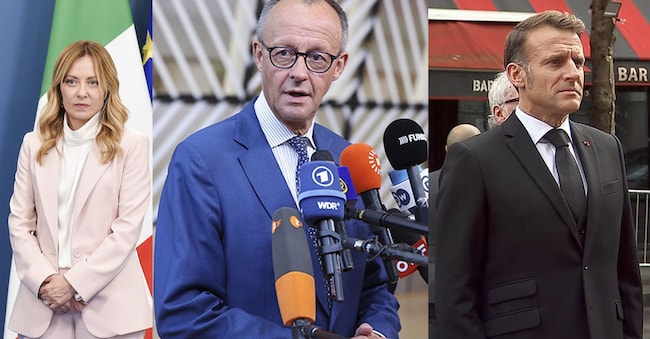
The NATO Secretary-General is meeting the US President in Washington. The leaders of five countries with significant influence within the Atlantic Alliance are meeting in Berlin to draw up a common strategy. A ‘one-two’, marking a move towards the NATO summit in Ankara on 7 and 8 July.
This meeting is of crucial importance, given that one of the items on the agenda is particularly sensitive and tricky: defence spending, or ‘burden-sharing’ – that is, the distribution of military expenditure amongst the member states of the North Atlantic Treaty Organisation. In the background lies the pressure exerted by US President Donald Trump for Europeans to do more and commit adequate financial resources. In other words: the Old Continent must take responsibility for its own security. But that is not all: the ‘uninvited guest’ is the plan outlined by the US, which heralds, if not a withdrawal, then at least a reduction in the presence of troops and equipment.
The Secretary-General Mark Rutte flew to Washington to meet the tycoon and, on the same day, joined a video conference with the leaders of the E5 (Germany, France, the United Kingdom, Italia and Poland), who had been invited to Berlin by Chancellor Friedrich Merz. The summit also features on the Italia Government’s website, listed amongst the Prime Minister’s official engagements, Giorgia Meloni. The aim is to arrive in Ankara as a united front; this meeting is shaping up to be a litmus test for an Alliance that must prove it can function even with a reduced and constrained US presence.
The E5 Group summit in Berlin
The Berlin summit is tasked with identifying the lowest common denominator of shared European interests to be defended in Turkey. Rutte, with his (sometimes criticised) ‘daddy diplomacy’, is seeking to avert divisions between the US and its NATO allies, which would inevitably play into the hands of Russia and China. However, the recent remarks by US Defence Secretary Pete Hegseth – who once again branded the Europeans as “freeloaders” before announcing rigorous scrutiny of individual national defence investment plans – show just how complicated this attempt at mediation is.
Italy’s position
The issue of resources remains a hot topic. Discussions in Ankara will focus on compliance with the spending targets set at the Hague summit on 24 and 25 June 2025, namely the objective of allocating 5 per cent of GDP to defence spending by 2035 (comprising 3.5% for conventional defence and 1.5% for internal security and dual-use technologies). Meloni explained that, on that occasion, Italia will report defence spending of 2.8% of GDP for the current year. This acceleration (Italia had ended 2025 at just over 2 per cent) has been made possible by the inclusion in security expenditure of cyber-security, space, border protection and dual-use technologies. Italia has confirmed its refusal to purchase weapons for Ukraine from the US, choosing not to join NATO’s PURL programme, and is proceeding with extreme caution regarding European loans from the SAFE fund, preferring to safeguard public finances and prevent military spending from diverting resources away from support for households and businesses affected by high energy costs.


