
Italia is not a country for young people, here's how it can become one
From Diana Bracco to Lavinia Biagiotti Cigna, to Marina Brambilla and Alessandro Molinari: at the Festival of Economics, the discussion on wages, trust, education and the future of the new generations

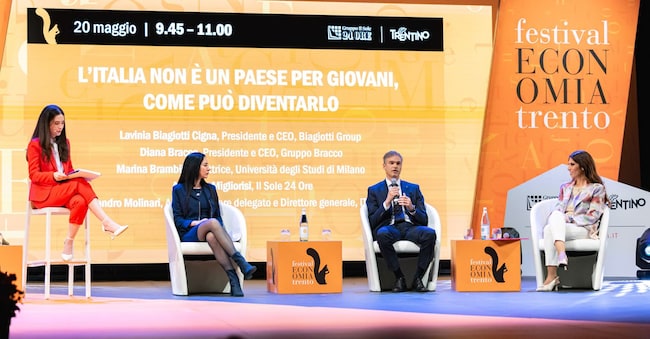
"It is not enough to imagine a country for young people, we must imagine a bridge between generations". Lavinia Biagiotti Cigna, president and managing director of Biagiotti Group, summarised in this way one of the key points of the opening panel on the first day of the Trent Economics Festival entitled 'Italia is not a country for young people, how can it become one'. A debate that brought together business, university, welfare and training, with speeches by, in addition to Biagiotti Cigna, Marina Brambilla, Rector of the University of Milan, Alessandro Molinari, CEO and General Manager of Itas Mutua, and Diana Bracco, President and CEO of the Bracco Group.
The latter defined the relationship between Italia and the new generations as 'a real emergency', linked to the denatality, the demographic crisis and the difficulty of getting those who go abroad to return home. "We need competitive entry salaries, support for parenthood, crèches and parental leave", she said, also pointing to research, start-ups and university spin-offs as decisive areas. He then recalled the Bracco Foundation's "I will become" project, with "over 4 million euro since 2012" and more than "2,500 young people" reached.
Biagiotti Cigna took the topic to the terrain of Made in Italy. She recalled that she started working at the age of 17, alongside her mother Laura, and pointed to trust between generations as a decisive lever: "The "what do you think" I think is a good two-way key". For her, the answer is not just retaining talent. "I try to create value in the area to attract international tourism first and foremost, she explained, citing fashion, art and sport as three integrated dimensions of her business.
The issue of skills also emerged strongly in the passage on manufacturing. Biagiotti Cigna claimed "the intelligence of the hands" and the value of know-how, against the idea that the new generations are far removed from practical trades. "Made in Italy know-how is an aggregator," he said, also linking it to the need to respond to what he called the 'economy of loneliness'. And he closed with an image: "I feel a bit like a torchbearer", called upon to keep a light burning and give a trajectory to those who come after.
Marina Brambilla instead insisted on the role of universities. Italian universities, she said, are increasingly attractive, but they must think of themselves as part of a wider ecosystem."The quality of our universities is excellent, she explained, while noting that the rankings do not always fully capture it. For the rector of the University of Milan, young people also choose on the basis of life and job prospects, not just academic reputation.


