
Italia to lead the NATO mission in Kosovo. Crosetto: ‘Radar in the Balkans to defend us too’
At the Atlantic Alliance Film City base in Pristina, Italian General Roberto Vergori takes over command of the mission

Key points
- Crosetto: ‘Radar in the Balkans to defend Italy too’
- The Balkans: a priority for Italian defence and security policy
- Over 4,000 soldiers are deployed on the NATO mission
- Italia has led KFOR on 15 occasions
- The new commander, Vergori, born in 1971, has commanded the Folgore Brigade
- The spectre of US military cutbacks
PRISTINA (from our correspondent)
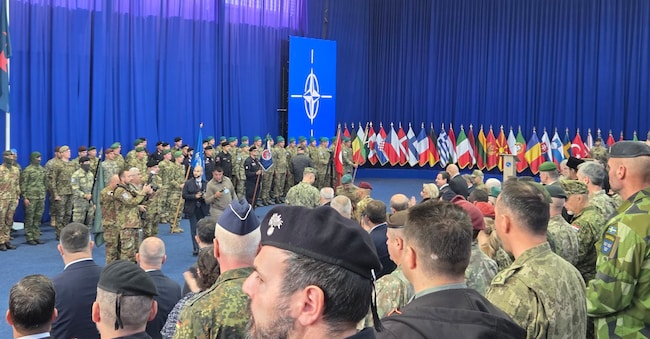
At NATO Headquarters in Camp Film City, Pristina, the Italian tricolour is currently the guest of honour. In a hangar situated on the site of the former Kosovafilm film studios, Major General Roberto Vergori is taking command of the NATO KFOR mission. The new commander of the Atlantic Alliance’s multinational force is taking over from Turkish General Özkan Ulutaş. After a year, Italia returns to command of the mission in Kosovo, but this time during a more complicated phase, due both to tensions in the Balkans and to the escalation of conflicts in the East, in the Middle East.
The deployed soldiers from 31 nations (with German, Greek, Turkish, Romanian and American troops marching) give a good idea of what KFOR is: a mission that brings together several countries in an attempt to stabilise a part of the Balkans which, in the not-too-distant past, was the scene of clashes between Serbs and Kosovars. Following some recent protests linked to the presidential elections in Serbia, we are now told that the situation has returned to normal.
Crosetto: ‘Radar in the Balkans to defend Italy too’
The Defence Minister, Guido Crosetto, is also attending the handover ceremony at KFOR’s headquarters in Pristina. “We are resuming command under General Vergori, and we do so with a commitment that will continue even as KFOR scales back its presence in Kosovo, because for us the Balkans represent a key focus for our security,” the minister remarked on the sidelines of the ceremony. Ensuring the security of the Balkans, and utilising the region in the future – including by installing radar systems here that will enable us to defend both these countries and our own to prevent threats – is of fundamental importance. If one considers – the Defence Minister continued – that the missiles which struck the airports in Saudi Arabia were built by the Houthis, and not by skilled engineers, and reached a speed of 8,500 kilometres per hour, one can understand the threats that all countries face in the future and how important it is to also safeguard neighbouring countries and friendly nations, precisely in order to establish, together with them, a defence against these threats that can prevent them in the future,” concluded Crosetto.
The Balkans: a priority for Italian defence and security policy
An Italian officer leading the mission in Kosovo confirms Italia’s leading role in the security of the Western Balkans. One of the Meloni government’s foreign policy priorities is to bring the countries of the Western Balkans into the European Union. Kosovo submitted its application for membership in December 2022. Kosovo’s future integration into the European Union, as well as that of Serbia, remains closely linked to the implementation of the dialogue between Kosovo and Serbia facilitated by Brussels, which is expected to lead to a comprehensive and legally binding agreement on the normalisation of their relations.


