
Italia is the world’s leading builder of cruise ships
A study by CDP confirms that Italian shipyards account for 57 per cent of the vessels ordered up to 2039. Germany accounts for 19 per cent and France 14 per cent.

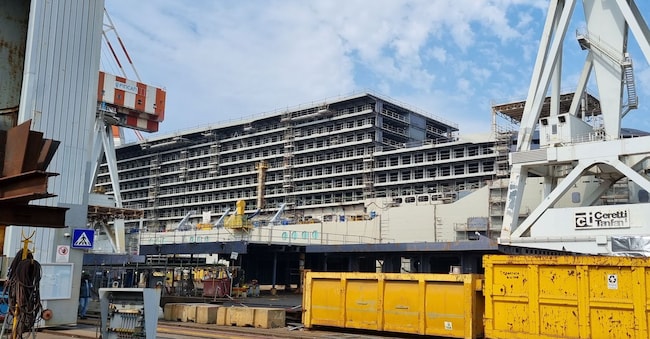
Italia leads the world in cruise ship production, as well as ranking first in Europe; indeed, it accounts for 57 per cent of global orders between 2026 and 2039 and 54.4 per cent of the value of ships ordered. All this takes place against a national backdrop in which 451 shipbuilding companies (excluding the yachting sector) operate, with a turnover of 7.9 billion. This is confirmed by a study by CDP (Cassa Depositi e Prestiti), which *Il Sole 24 Ore* is able to reveal in advance.
The report confirms that, in terms of global shipbuilding, ‘Asia plays a dominant role in terms of volume. Since the early 2000s, China has seen its share grow to the point where it now accounts for over half of global production and 60 per cent of orders, whilst South Korea and Japan follow in second and third place respectively in terms of volume. Against this backdrop, Europe retains a more marginal position, accounting for around 3 per cent of total production (data updated to 2025, editor’s note)’.
The study also notes that standardised segments for freight transport account for the lion’s share of global production. In 2024, container ships and bulk carriers accounted for, respectively, 41 per cent and 27 per cent of global production volumes respectively, followed by tankers (gas carriers and oil tankers), which account for around 17 per cent and have benefited in recent years from the strong growth of the LNG (liquefied natural gas) market. The passenger sector (cruise ships and ferries) accounts for just over 2 per cent.
Against this backdrop, China, South Korea and Japan have, in terms of production specialisation, consolidated their position precisely in highly standardised sectors: cargo ships account for around 60 per cent of China’s shipbuilding exports, over 40 per cent of South Korea’s and more than 70 per cent of Japan’s. Alongside these segments, tankers – which involve a higher degree of technological and design complexity than cargo ships – nevertheless represent a significant part of the production portfolio of these Asian countries.
Europe, however, as the CDP report points out, ‘dominates high value-added niches. Italia and France specialise in the passenger segment, which accounts for 75 per cent and 64 per cent, respectively, of their exports in this sector and in which they represent 20 per cent and 12 per cent of the global market. Germany has a more diversified portfolio, with a significant presence in the small cargo ship segment as well.


