The study

Restricted Traffic Zones: Italia tops the European rankings for restricted traffic zones

According to a study by the Luiss Business School’s Car and Mobility Observatory, 56% of the traffic restrictions recorded in Europe are concentrated in Italia

by Simonluca Pini

3' min read

Translated by AI
Versione italiana

Key points

  • Limits based on numbers rather than perceptions

3' min read

Translated by AI
Versione italiana

Italia: a land of saints, poets, navigators and Low Traffic Zones. Of the approximately 500 active Low Traffic Zones in Europe, a staggering 446 are located in Italy. It seems a highly improbable figure, but confirmation comes from the study “Cars and Cities, Beyond the Ban” by the Car and Mobility Observatory of the Luiss Business School, which analyses the relationship between private mobility and urban space in light of new environmental, economic and social requirements. The analysis focuses on the role of UVARs (Urban Vehicle Access Regulations), the measures that regulate vehicle access in urban areas to reduce traffic, congestion and pollution, as well as other mobility regulation tools such as 30 km/h zones and pedestrian areas.

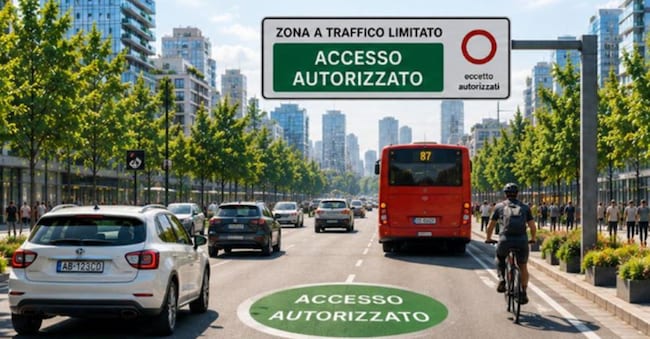
Uvars encompass various types of measures, for which the study proposes a specific classification into five categories: Congestion Charges, Low Emission Zones (LEZs), Restricted Traffic Zones (RTZs), Pedestrian Zones and other specific restrictions for particular categories of vehicles. More generally, our country has 485 access restriction measures – including ZTLs, Low Emission Zones (LEZs) and congestion charging schemes – accounting for over half of the European total (56.2%), which stands at 863 measures.

Loading...

Traffic restrictions, which in most Italian cities go hand in hand with genuine traffic-calming measures – that is, a range of urban planning, street furniture and road design initiatives designed to reduce vehicle speeds and discourage through traffic, thereby improving safety for pedestrians and cyclists. These measures may seem like the solution to a long list of problems, but in real life – where people are very often forced to use their cars – they frequently cause traffic jams in neighbouring areas, with a corresponding increase in pollution. Because despite an ‘anti-car’ narrative, often written by those who live within the restricted traffic zones (ZTL) themselves or have the financial and professional means to avoid using a car, in the aforementioned ‘real life’ there are more and more motorists who would love to get around on cargo bikes costing several thousand euros in a 15-minute city, but are forced to spend hours in traffic in cars worth less than a child carrier bike.


Restricted Traffic Zone: a single portal is needed

Every city has its own restricted traffic zone (ZTL). With different access rules, varying timings and, above all, signage that is often unclear. The perfect example comes from the city of Bologna. Because whilst the investment in ‘Città 30’ – the second such scheme in Italia after Olbia – has involved significant expenditure on signage, there is a lack of illuminated signs beneath the entry points indicating whether the restricted traffic zone is active or not. Certainly useful for motorists, less so for the council’s coffers. A portal that could be linked to cars. Another element, in fact, that would help prepare our system for the future is the launch of a single national portal that brings together all the measures adopted locally and thus accommodates the increasingly connected and digitalised cars coming onto the market.


Limits based on numbers, not perceptions

Finally, the study highlights a key issue that cuts across the board: the lack of ex ante and ex post analysis regarding the introduction of restrictive measures. According to the Observatory, it is essential to adopt monitoring systems based on key performance indicators (KPIs) to assess the effectiveness of interventions and guide future policies in a more informed and transparent manner.

Fabio Orecchini, Director of the Car and Mobility Observatory at Luiss Business School, pointed out that “the world’s population is becoming increasingly urbanised; the relationship between cars and cities is therefore a key factor in the quality of life of billions of people over the coming decades. The research highlights the significant attention Italia pays to this issue, given that more than half of all urban traffic restriction measures recorded in Europe are concentrated in our country. However, the lack of effective coordination at national level is evident. The example of other countries, such as Germany, France and Spain, shows us that for low-emission zones, uniform national definitions – currently non-existent in Italia – are possible, allowing motorists to better navigate the various local restrictions in place.”

Copyright reserved ©
Loading...

Brand connect

Loading...

Newsletter

Notizie e approfondimenti sugli avvenimenti politici, economici e finanziari.

Iscriviti