
Italian athletics runs more than society
After Tokyo, many champions and victories, but above all, according to Andrea Schiavon, Italian athletics tells of a successful melting pot that is already in the future
5' min read
5' min read
'Where is the victory', wonders the Inno di Mameli and also Andrea Schiavon who, with Before winning. Quello che ci insegna la nuova atletica italiana (Before winning. What the new Italian athletics teaches us), sketches the competitive paths of many Italian men and women of today and the future of Italy. Because athletics medals have social contours that are born on the track and arrive in the lives of each of us. And, if the book is a mine of documented portraits, it is also a precious compendium of technique and rules: it is clear that Schiavon, a former sports journalist for 'Gazzetta dello Sport', 'La Stampa' and 'Tuttosport', and now director of the SIT-Sport, Inclusion, Talent Foundation, has frequented training and competition grounds as an aspiring athlete and then as a journalist, and has talked to those who build their successes with patience, tenacity and planning. And he did it with sincere passion, which shines through on every page, and which makes him write: 'Italian athletics is winning again because it has the strength not only to win medals but to do something much more powerful: to inspire'.
Athletics Italy came back big at the Tokyo Games: five golds, an edition never seen before. More than the brilliance of those medals Schiavon questions what comes before: 'Medals, sooner or later, are destined to become memories. What really counts comes before the victory. Being an athlete is not a comfortable life. So he goes on to investigate the stories of the top blue medallists, the turning points of their careers, subjected to long waits, sudden reversals, long seconds. Between nowhere and glory, a handful of hundredths of a second or a few centimetres can pass: 'Waiting for a performance that does not come is long and difficult for those who watch it but becomes unbearable for those who seek it. Then the victory lasts an instant, the time of a finish line that immediately seems to vanish'.
Marcell Jacobs, before the double gold in Tokyo, was aiming for the long jump, training, believing in it, and it was difficult to turn the page, sacrifice and look for another way. What about Gianmarco Tamberi, gold in the high jump in Tokyo, but crippled a few weeks before the Rio 2016 Games. Four years of training, of details studied, rehearsed, assimilated and, then, just a breath of wind, and it all ends with an injury on the night when he had reached his peak. And Schiavon places alongside his story the exemplary story of Károly Takács (1910-1976), a Hungarian army marksman. He skipped the 1936 Games because to participate one had to be an officer and he was a sergeant. Then, the two wartime editions. And, during a drill, he loses his right hand. But he started training with his left and, in London 1948, first he jammed his pistol and then took the gold, long pursued.
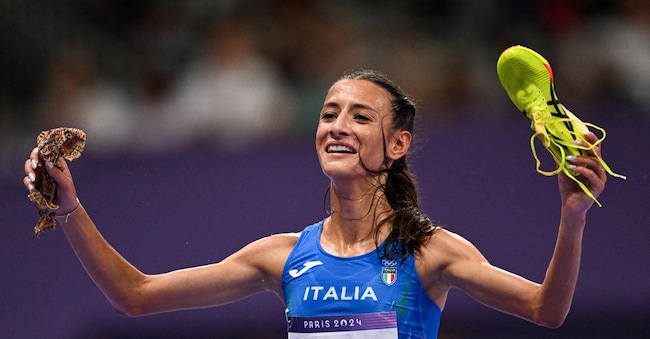
The stories of the marchers Antonella Palmisano and Massimo Stano, both gold medallists in Tokyo, best represent the thin border between perfect condition and stop due to physical problems, an infinitesimal balance that lasts one night, one day, that of glory, but behind how much life, how much waiting, how many dark days. In Larissa Iapichino, long-distance runner and daughter of athletes (Gianni and Fiona May), one finds dedication and talent; for Yeman Crippa, running is going far and discovering the world and even yourself. Leonardo Fabbri discovers weight as a child, has an impressive progression but, in 2024, has gone from glory to defeat, and to the kids he says: 'Don't be afraid to make mistakes. Enjoy everything." As does Nadia Battocletti, a middle-distance runner with many successes, 'whose distinctive strength is reading, translating, decoding the race, turning running into a mind game. The others run with their legs, she does it by putting an uncommon head into it'. Sara Fantini, a woman trained by a woman, is also a face of the new Italian athletics with her hammer and her victories: 'You must not be in a hurry, you must give yourself time to understand what you want to be and put in the effort and patience to become it. But even when you find your world and the right people to grow with, the process is not without conflict'.
The chapter that more than any other sums up the complicated puzzle towards success is the one about the baton, which the relay athletes pass to each other to get to the finish line, it is a matter of seconds, of centimetres: "You cannot pass the baton wherever you want. There is a clearly defined 30-metre-long changing area. If you pass it, you are out. Your team is disqualified. All it takes is one foot of a runner over that line and the whole relay is punished. It is not a simple penalty, there is no penalty. There is disqualification, even if it is the first team to cross the line, it is out. Whoever gets to carry the baton does so by running at 41 kilometres per hour. That means he covers more than 11 metres in one second. No matter how far you put the tape away from you, he will pounce on you in an instant'. And then you never have to turn around: the change happens with your eyes closed. A magic that has been tried a million times in training and which enhances the group: 'if the changeover from one fractionist to the next works, the relay goes much faster than each individual member can do alone. The team before the individual.


