Games

Italian BrainRot: now also invading video games

From viral phenomenon to digital store colonisation: how AI-generated memes are transforming the gaming market

4' min read

4' min read

One of the most viral social trends of this 2025 is surely that of brainrot, a term that Oxford Dictionary has elected word of the year 2024. These are videos generated with generative artificial intelligence, in which absurd characters - such as "Crocodile Bomber", "Capuchin Dancer" or "Tung Tung Sahur" - move against psychedelic backgrounds while a synthetic voice recites nonsensical sentences. Nonsense videos that mix irony, surrealism and sometimes politically incorrect provocation, often crossing the line into bad taste.

One of the first videos to have defined the imagery of this trend, which rewrites the aesthetics of the contemporary meme, was 'Tralalero Tralalà', in which an anthropomorphic shark, with blue trainers on his feet, recites verses accompanied by artificial intelligence-generated audio. A video, initially uploaded to TikTok in January 2025, which triggered an avalanche of imitations and reworkings, reaching record numbers: over 7 million views for the single video and 3 billion global views for the entire phenomenon.

Loading...

From social to platforms: the economics of nonsense

Thanks to algorithms that push the most viral content, it has become relatively easy to come across these videos with nonsense aesthetics, from TikTok, which started the trend, to YouTube, which has always monetised creators with rewards per view. The result is a system in which while many are fascinated by and affected by brainrot (especially the younger Gen Z and Gen Alpha), just as many gain from creating them and riding the trend.

Several creators sell video lessons, guides, tutorials and courses on how to generate viral content with AI: instructions on how to build your own 'brainrot' universe and break through on TikTok, with prices ranging from 50 to 500 euros per course. And on Discord there are private communities where users exchange brainrot prompts and techniques for generating 'extreme' content by circumventing software guidelines. For a while now, that same aesthetic has begun to invade online gaming platforms from Playstation Store to Nintendo, via Steam and Play Store. In short, brainrot - willingly or unwillingly - has become a business model as well as an aesthetic.

The invasion of digital stores: the 'AI Slop Games' phenomenon

.

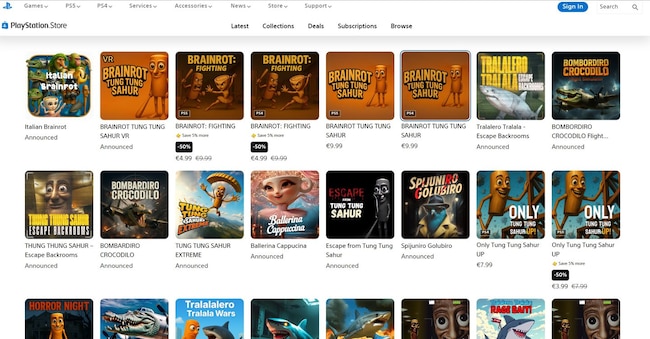
Not content with conquering social media, these memes are now invading the world of video games, as evidenced by the PlayStation and Nintendo store pages. According to a report by IGN, one of the leading international newspapers dedicated to video games and digital entertainment, the PlayStation Store and the Nintendo eShop are literally flooded with these low-quality titles, which some call, not bluntly, 'rubbish'.
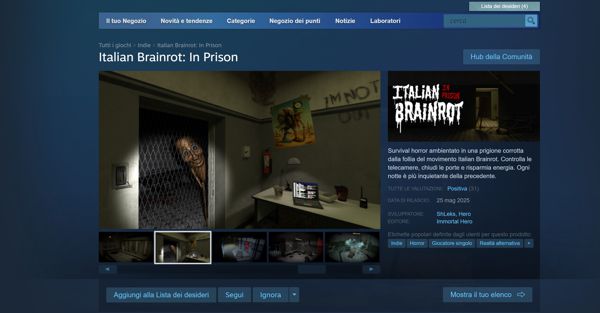
Just take a look around the offers to find truly improbable titles inspired by Italian brain rot. Examples? "Tralalero Tralala Simulator", "Escape Tung Tung Sahur Backrooms", "Cappuccino Assassino Shooter", "Bombardiro Crocodiro Simulator", "Tralalero Tralala Jumper" and "Ballerina Cappuccina Adventure". These are just a few of the dozens of similar titles - all featuring strictly AI-generated images - that can be found on the online stores of entertainment platforms, including the Play Store, where themed apps are numerous: from puzzles to game-play. According to what has been documented by some trade magazines, searching for terms such as 'Tralalero Tralala' on the PlayStation Store yields about a dozen games with artwork depicting sharks with shoes, while a search for 'Tung Tung' returns numerous results with images of wooden puppets armed with baseball bats. Only the Xbox store seems to be relatively safe from this invasion at the moment, thanks to tighter controls.

"AI Slop Games": anatomy of a digital scam

A specific term has even been coined for this type of titles: 'AI Slop Games', a definition created to indicate the very low quality with which they are made. Games recognisable by their artificially generated covers that often do not reflect the real gameplay at all, accompanied by fake screenshots or completely disconnected from the actual game. The production, as many industry magazines point out, is based entirely on recycled assets from free programmes, assembled with as little effort as possible. The price, strategically set between EUR 1.99 and EUR 4.99, is designed to attract impulse purchases.

Push Square and The Gamer pointed out that dozens of developers specialise exclusively in producing this content, creating a constant stream of new titles that are added weekly to digital stores.

The modus operandi is clear: these titles target an uninformed public that, seeing them on the store at such a low price, is enticed to buy them. With games based on brain rot characters, on the other hand, the focus is on a very young audience attracted by meme characters.

Even if there are no official numbers, there is no doubt that the phenomenon generates significant revenues by exploiting unconscious purchases, low prices and the promise of easy trophies, turning what started out as junk content into a veritable parallel gaming market.

The solution to the problem? For many observers, it is structural: improving the selection processes and filters of digital stores would be an optimal solution. But some observers go further, even proposing a total ban on games that use generative AI without providing transparent documentation on the datasets used, accompanied by a better discovery system that would allow quality titles to stand out in the sea of junk content.

Copyright reserved ©
Loading...

Brand connect

Loading...

Newsletter

Notizie e approfondimenti sugli avvenimenti politici, economici e finanziari.

Iscriviti